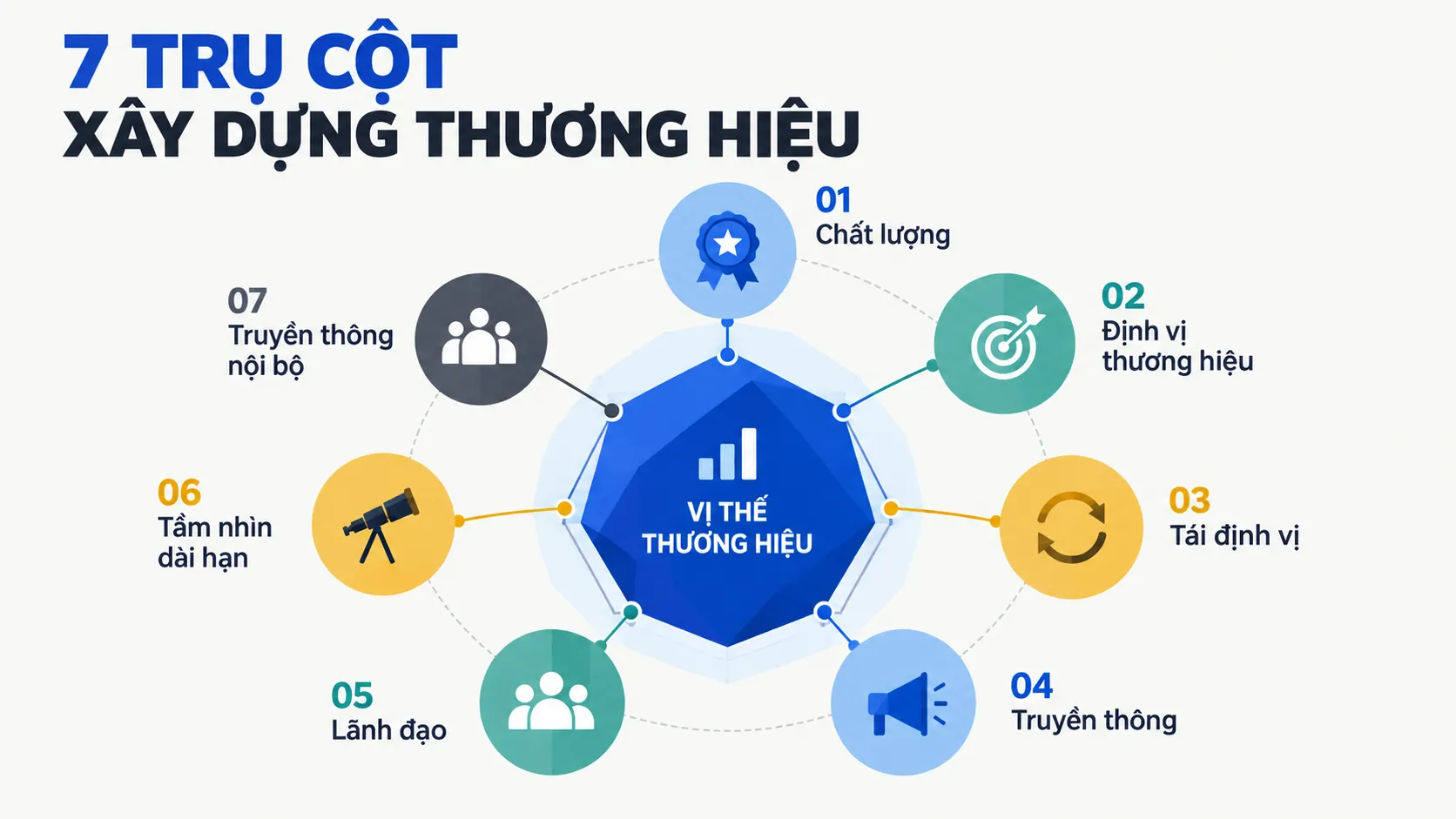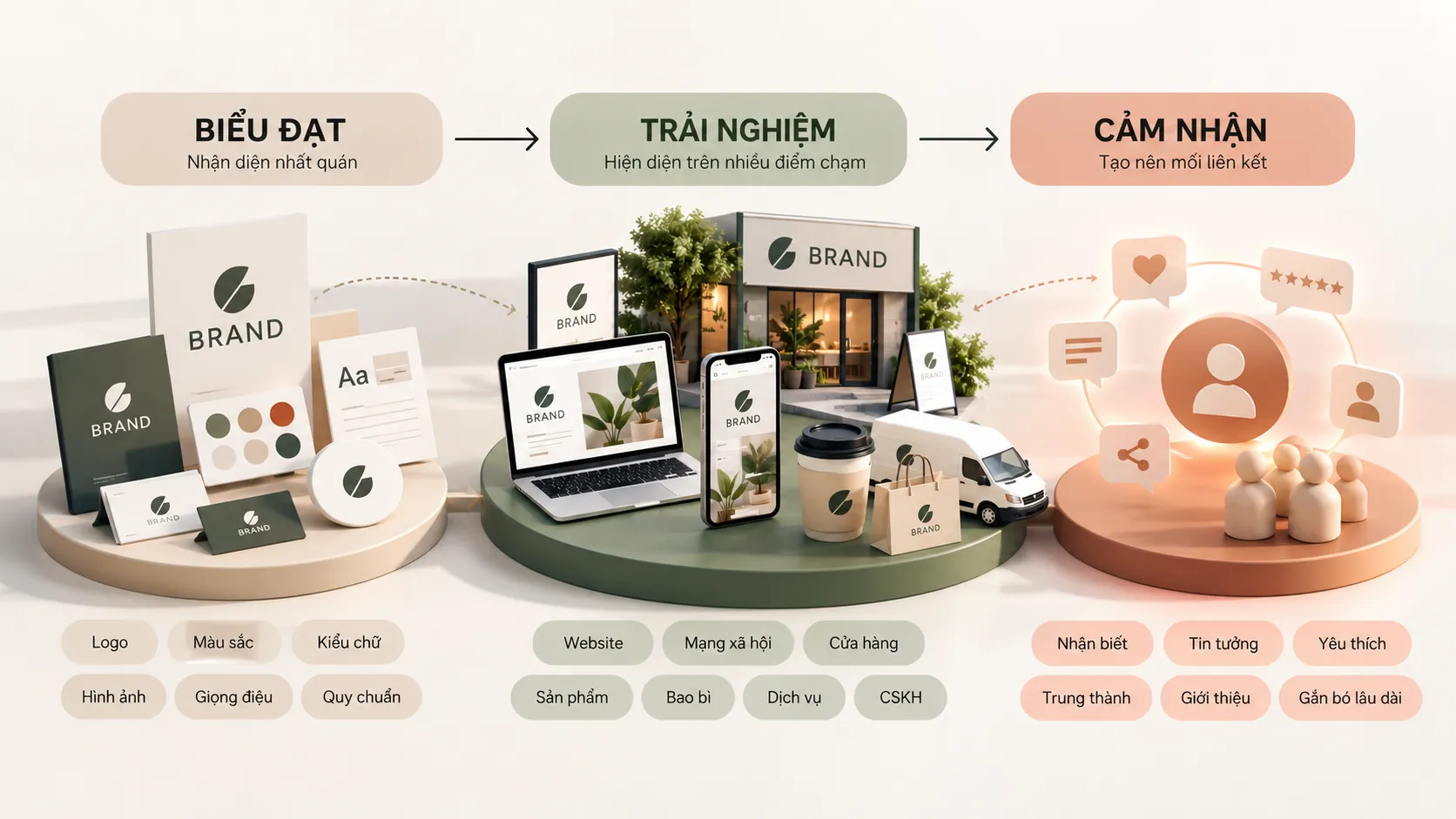
Repositioning and brand building: from promise to a standard touchpoint system

Customers do not experience a brand through a single logo, a campaign or an isolated purchase. They form their perception from the sum of what a business says, shows and does across many touchpoints. So when the positioning changes but the experience system does not change with it, the gap between promise and reality keeps growing. At a deeper level, brand repositioning is not just changing how a business appears; it is reorganizing how the brand promise is expressed and tested across the whole customer path.
KEY TAKEAWAY
Repositioning only has value when the new promise is translated into a consistent, deliberate touchpoint system that can be delivered in real operations.
Repositioning does not start with changing the image
When a business sees that its brand has aged, the common reaction is to start with what is easiest to see: the logo, colors, packaging, website, office or communication identity.
These assets matter, but they are only the visible expression of a larger problem.
If a business wants to be seen differently but its products, services, advisory approach, sales materials and after-purchase experience stay the same, the market’s perception will not change on its own. A new identity system can create new expectations, but it is the real touchpoints that decide whether those expectations are reinforced or broken.
In other words, repositioning is not a matter of changing what customers see; it is a matter of changing the relationship between what the business wants to be known for and what customers actually experience.
PRINCIPLE 01
A brand promise must have the capability to deliver
A positioning only means something when the business has the capability to turn it into an experience that can be observed. So before designing the identity system, be clear about what the business is committing to, with what capability, and where customers will recognize that commitment.
Otherwise the brand easily ends up with its image running ahead of reality: the identity conveys one position while the experience sends a different signal.
A brand is perceived through a chain of touchpoints
A customer rarely forms a perception of a business from a single encounter.
The path can begin with a search result, an article, a referral or an advertisement. Then come the website, the company profile, a meeting with the sales team, a quotation, the product, the place of business, email, invoices, after-sales service and the interactions that follow the transaction.
Each touchpoint contributes a part of the overall perception.
This raises an important management issue: a business cannot control its brand merely by controlling each design asset individually.
A beautiful website with an illogical company profile still creates an inconsistent experience. Carefully designed packaging paired with thin information on the sales channel can also erode the expectation the packaging creates. A well-designed space with a reception process that does not match leaves the same gap between image and reality.
So instead of asking “What should be redesigned?”, the more strategic question is:
“Where are customers meeting the brand, what do they need to understand at each touchpoint, and what role does each touchpoint play in reinforcing the brand promise?”
FRAMEWORK
Four layers for controlling the touchpoint system
This way of thinking moves a business from managing individual assets to managing the whole experience.
- Strategic anchor: define the promise, the positioning and the real values the business is able to stand behind.
- Touchpoint architecture: define where customers meet the brand, in what order, and what role each touchpoint plays.
- Prioritize investment: identify the touchpoints with a major influence on perception or decisions and focus resources there.
- Experience system: turn strategy into consistent design principles, content, behavior and standards of delivery.

1. Establish the strategic anchor before designing
A brand promise cannot stand apart from the business’s capability.
If a business claims to stand apart on speed but its operations cannot match that speed, the positioning quickly becomes an expectation with nothing behind it. If a brand wants to be seen as dependable but product information is unclear and communication is inconsistent, trust is hard to build with identity language alone.
So the first step of repositioning is to define, specifically:
- What does the business want to be chosen for?
- Which capability does that advantage come from?
- What gives this promise a basis?
- Through which expressions can customers recognize that promise?
- Which touchpoints can reinforce or weaken the desired perception?
COMMON MISTAKE
“The bigger the positioning, the more valuable the brand.”
Why it is not enough
A broad or ambitious positioning is not the same as a strong one. If the promise is not tied to a real advantage and does not show in the experience, the business is only making a claim larger than it can deliver. Positioning has value when it helps the market understand where the business is different and why that difference can be trusted.
2. Plan the touchpoint architecture instead of mechanically adding channels
Appearing on many channels does not automatically create a stronger brand.
Each channel has a different function in the customer path. Some create awareness, some provide information, some support evaluation, some drive the decision, and others are responsible for sustaining the experience after the transaction.
If everything is designed as an independent asset, a business easily ends up with “a lot, but disconnected”.
For example, the website may be talking about one positioning, the company profile expressing another, while the sales team uses yet another interpretation. Each component may be well designed on its own, yet the whole still lacks a common frame of reference.
PROCESS
- Define the path: list the stages customers pass through, from awareness, exploration and evaluation to decision and the experience after purchase.
- Map the touchpoints: identify where the brand appears at each stage and the role of each touchpoint.
- Define the information to convey: clarify what customers need to know, believe or do at each point.
- Set principles of consistency: define which elements must be kept throughout and which may flex with context.
- Review the gaps: find where the brand promise is not yet fully reflected in the real experience.
The key point here is that consistency does not mean every touchpoint must be identical.
A company profile does not need to be presented like a website. Packaging does not need the same content structure as a sales document. A brand space does not need to copy the language of advertising verbatim.
What needs to be consistent is the meaning the touchpoints convey together, while the way it is expressed can change with function and context.
FIELD NOTE
When reviewing a brand system, what stands out is usually not where the design is weakest but where the gap between touchpoints is greatest. A system can have many well-designed assets and still create a disjointed experience if those assets do not serve the same strategic direction.
3. Prioritize the touchpoints that influence decisions
Not every touchpoint needs to be invested in at the same level.
This is one of the important shifts when a business moves from the mindset of “making an identity” to “managing the brand experience”.
A B2B business may own a great many communication assets, yet the company profile, the website, a proposal or a meeting with the sales team may matter more when a supplier is being evaluated. In a consumer goods category, packaging and the point of sale may be where the brand is seen and judged most directly.
So the question should not only be:
“Which touchpoint is seen by the most people?”
But go one step further:
“Which touchpoint plays the most important role in forming perception or supporting a specific decision?”
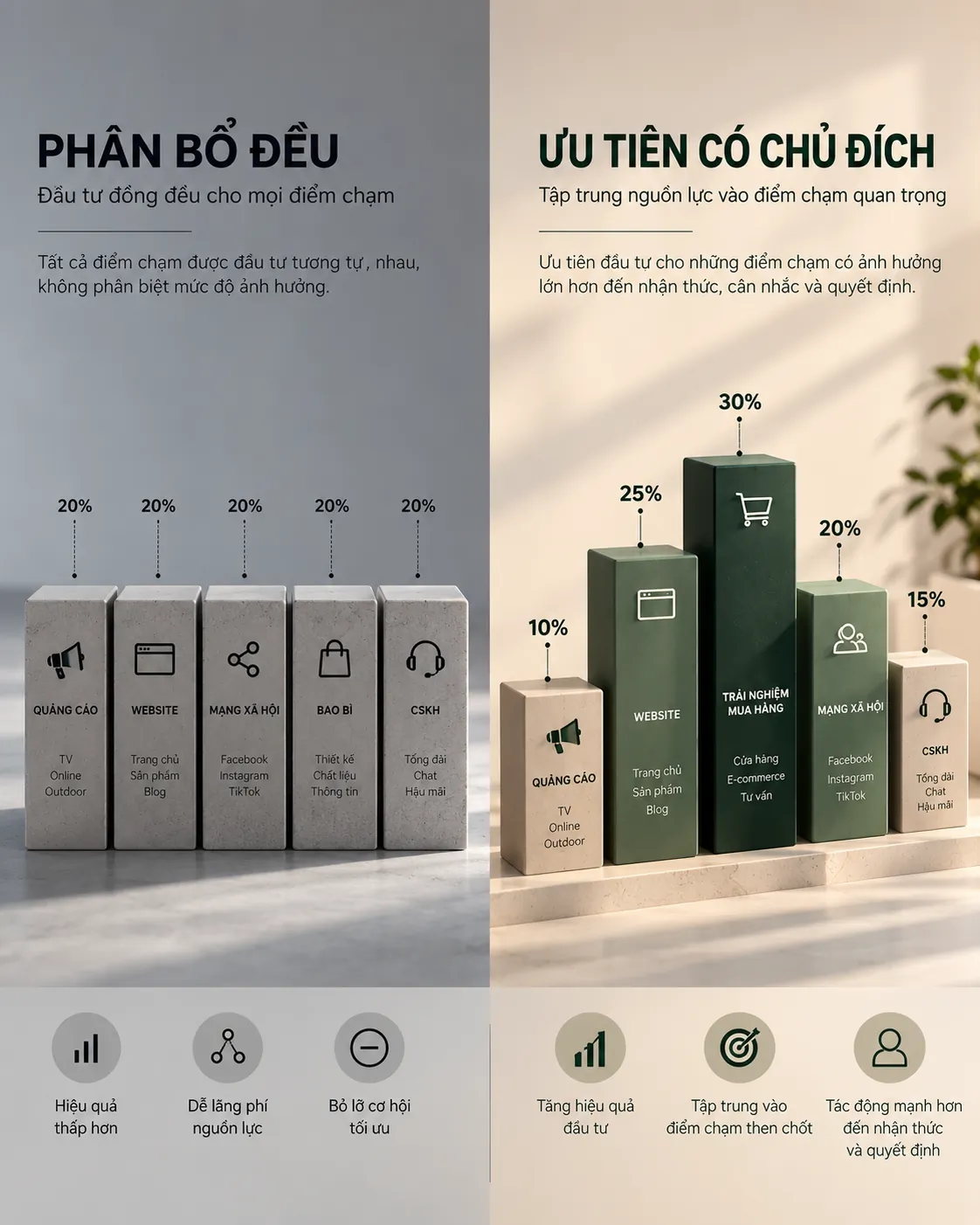
LESS EFFECTIVE
- Spreading resources roughly evenly across all touchpoints.
- Prioritizing assets that are easy to see but do not necessarily influence decisions much.
- Evaluating each design independently.
STRONGER
- Define the role of each touchpoint in the customer path.
- Prioritize the points with a clear influence on perception and decisions.
- Evaluate the system by the relationship between strategy, experience and desired outcomes.
This approach also helps a business spend its budget more soberly. Instead of trying to “refresh everything”, it can decide where to change first, where it only needs to standardize and where no intervention is needed yet.
4. Design the experience from strategy, not strategy from the image
Once the anchor and the touchpoint architecture are defined, design finally has room to play its role.
At this point, brand identity is no longer only a system of colors, typefaces, logos or layouts. It becomes a set of rules that lets the business express the same meaning across many different situations.
A good system must be able to answer practical questions:
- When it appears on the website, what should the brand make people feel?
- When presenting a proposal, what should come first?
- When designing packaging, which information must be seen first?
- When customers step into the brand space, what should they feel?
- When the team communicates directly, what behavior expresses the brand promise?
This shows that a real identity system lives not only in the brand guidelines. It has to be able to enter specific situations of use.
EXAMPLE
A business that wants to move from the image of a “product supplier” to that of a “partner with advisory capability” cannot simply change its colors and visual style.
The website needs to reorganize its information so customers understand the business’s problem-solving capability. The company profile needs to show capability and approach clearly. A proposal needs to support the decision process rather than just list a product range. The sales team also needs one shared way of explaining the value the business brings.
This shows that changing the identity is only one part of the process. The real change lies in how the new promise is brought into each touchpoint.
A good system does not mean absolute uniformity
One common misunderstanding in rolling out repositioning is the belief that consistency means everything must be identical.
In practice, a brand needs both consistency and adaptability.
If the website, packaging, sales materials, space and social media all use the same layout, the same amount of information and the same way of communicating, the system can become rigid. Conversely, if every touchpoint is free to interpret the brand with no shared principles, the brand loses recognizability and finds it hard to hold a clear position.
Consistency has value at the level of strategy and principle; flexibility should be allowed at the level of expression and context.
In a brand system, the first thing to check is not “is this design beautiful?” but “what job is this design doing?” Only then can you assess whether it conveys the right positioning, fits the customer path and stays consistent with the other touchpoints.
Repositioning must be tested in operations
A brand system is not complete at the moment the identity kit is handed over.
After rollout, a business needs to observe how the system is actually used. Which points are repeatedly misinterpreted? Which assets are hard to apply? Which content leaves customers with the wrong understanding? Which touchpoints still create the old impression even though the identity has changed?
This is why repositioning should be seen as a continuous process of adjustment rather than a project with only a start and an end.
CHECKLIST
Questions to ask:
- Is the current brand promise based on a capability the business can genuinely stand behind?
- At which touchpoints do customers meet the brand across the whole path?
- Which touchpoints have a major influence on perception or decisions?
- Are the touchpoints conveying the same meaning, or merely using the same identity kit?
- Is there a gap between the image the business wants to create and the actual customer experience?
- Is the system flexible enough to adapt to each context without losing the shared direction?
PRINCIPLE 02
Repositioning is the work of closing the gap between intention and experience
A business can decide how it wants to be recognized, but it cannot fully decide how customers will perceive it. That gap can only be narrowed by designing and operating the relevant touchpoints consistently.
From an identity kit to a system that can operate
The value of a brand lies not in the number of assets designed but in whether those assets together serve one clear direction.
A well-planned touchpoint system helps a business avoid two opposite extremes: on one side, a beautiful identity detached from operations; on the other, a capable real-world experience without a brand language clear enough for the market to recognize.
Repositioning should therefore be seen as a problem of connection.
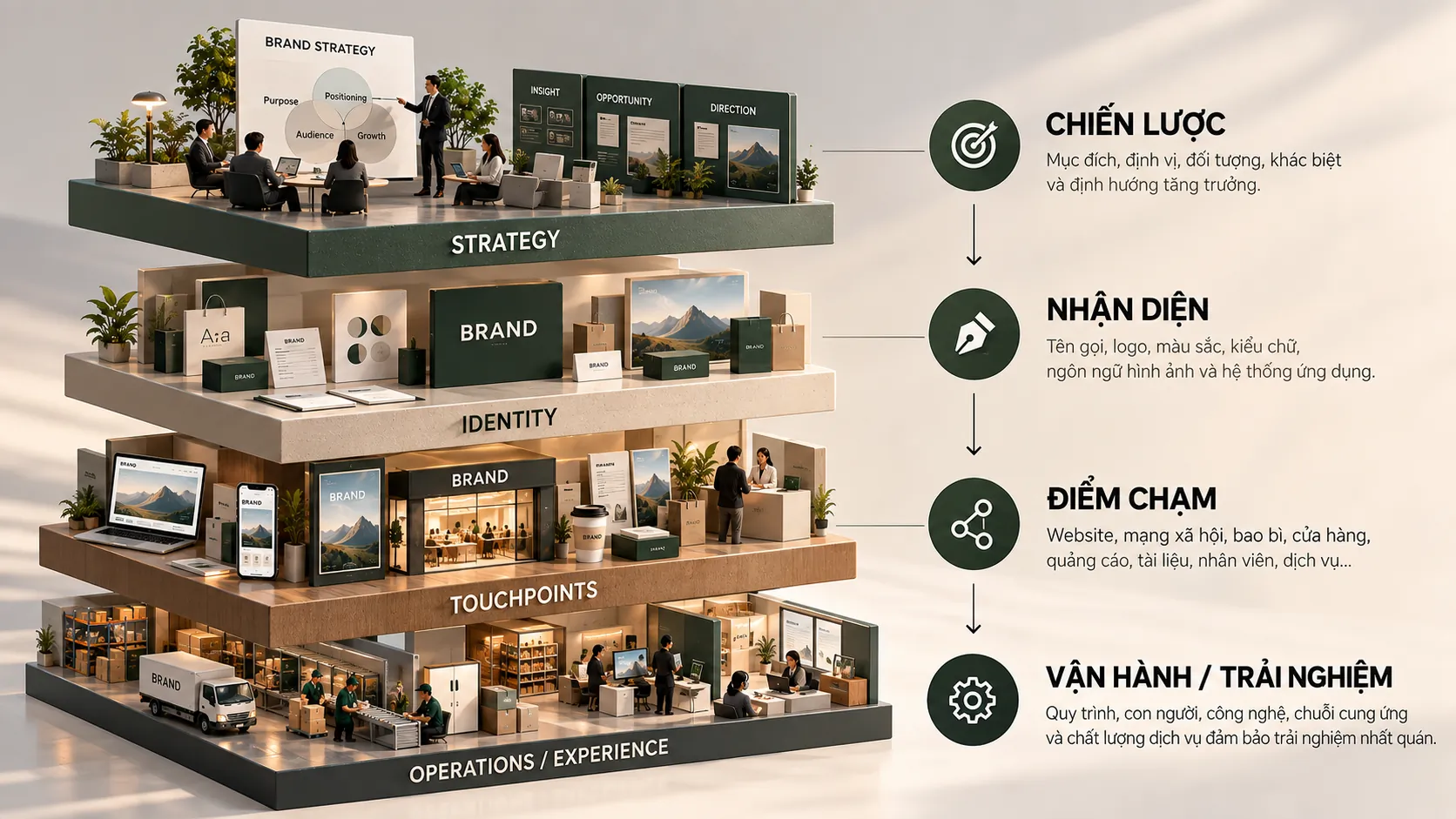
Strategy decides where the business wants to stand. Identity turns that position into signals that can be seen and recognized. Touchpoints bring those signals into the customer path. Operations finally decide whether the promise is proven.
A brand does not live in an identity kit; it is tested by how the promise appears and is delivered at each touchpoint.
Final word: control the brand through a system, not through individual assets
A mature brand does not have to look the same everywhere. What matters more is that customers recognize the same direction as they move through different contexts.
That is why repositioning should not end with a new logo, a new color palette or a new set of guidelines. These elements become strategic assets only when they are placed in the right touchpoint structure and supported by an experience able to deliver on the promise.
When a business knows what it wants to be chosen for, where customers meet it and which touchpoints truly matter, investing in the brand becomes more deliberate. Instead of constantly fixing individual image problems, the business can begin to manage the brand as a system.
FRESHBRAND
If the brand is changing its position, start by checking the touchpoint system rather than only the identity kit.
FreshBrand can approach this problem from positioning through touchpoint architecture to the identity system and experience, with the aim of making sure strategy is translated into consistent expressions in practice.