
Brand guidelines are not just a design manual: a reference system for managing brand identity
Many businesses invest in building a brand identity and still struggle to roll it out in practice. The sales team uses the logo in ways that break the standard, the communications team changes the typeface on its own, and agencies keep asking how to apply the identity. The problem is not necessarily the quality of the design. It may come from the business never having built a set of guidelines clear enough for every department to follow together.
KEY TAKEAWAY
Brand guidelines deliver value only when they turn identity principles into rules for application, a decision mechanism and an update process that the whole organization can use in the same way.
1. Why don’t current brand guidelines work?
Brand guidelines, the handbook for using a brand identity, usually bring together the rules for logo, color, typeface, imagery and how the identity is applied. However, a document with complete design specifications does not necessarily help a business manage its identity effectively.
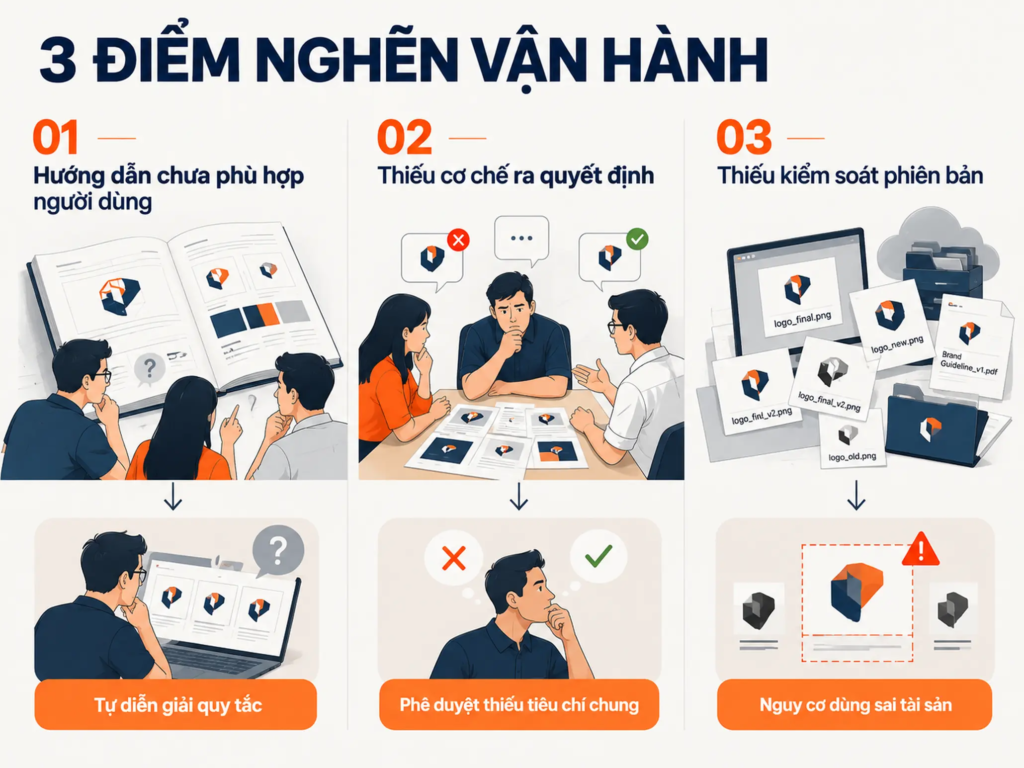
The gap between having a document and being able to apply it usually shows up in three problems: guidance that does not suit its users, no decision mechanism and no process for updating.
1.1. A document that serves designers but overlooks the people who operate the brand
Brand guidelines can specify precisely the logo’s clear space, the brand color codes and the proportions between graphic elements. This information is necessary for designers, but it is not enough to support everyone who uses the brand day to day.
Salespeople need to know how to use the logo in sales proposals. HR needs to understand how to apply the identity to recruitment materials and uniforms. Communications partners need to know which elements may be changed when designing ads for each platform.
If the document presents only specifications without application examples, users still have to interpret the rules themselves. Each department may then form a different understanding, and the identity gradually loses consistency.
1.2. No decision mechanism when a new situation arises
Not every situation in which the brand is used can be described in advance in a handbook. A business may need to design a new document format, run a campaign on a platform it has never used, or work with a partner that has its own technical requirements.
A practical guidance system needs to clarify three things:
- Which rules are mandatory? For example, requirements on logo proportions, identity colors or elements that must not be altered on one’s own.
- Which rules can be flexible? For example, how the layout is arranged within set limits to suit each format.
- Who can approve exceptions? The document should name the person responsible and the cases that must be referred to the Brand Manager.
Without these principles, design approval easily depends on personal preference. Decisions that recur many times are also hard to standardize into a common process.
1.3. No mechanism for version control and updates
A brand identity may change when a business widens its product range, develops a new market or adjusts its strategy. If the brand guidelines are not updated accordingly, the document gradually loses its relevance.
The problem is not only outdated content. A business may also have several versions of the logo, the color palette or the guidelines scattered across different folders. When the official version cannot be identified, staff and partners risk using the wrong brand assets.
Brand guidelines therefore need version information, an update date, a point of contact and a process for announcing when the standards change. The review cycle should follow how quickly the business and its identity system change, rather than assuming the same interval for every organization.
FIELD NOTE
A guidelines document can be professionally presented and still be hard to use if staff have to ask again every time a new application comes up. How easily people can find information, understand the rules and tell who has the authority to settle exceptions are factors to weigh when assessing the quality of brand guidelines.
2. A four-layer architecture turns brand guidelines into a governance system

To support identity governance, a business needs to connect brand direction with design standards, application touchpoints and document management.
This system can be organized into four layers: Strategy, Identity, the application ecosystem and technical reference. This is a proposed framework for governance, not the only structure that every business must follow.
FRAMEWORK
The four layers of the identity governance reference system
- Layer 1 — Strategic Layer (Strategy) Defines the purpose, competitive positioning and brand promise as the basis for identity decisions.
- Layer 2 — Identity Layer (Identity) Specifies how strategy is turned into logo, color, typeface, graphics and imagery.
- Layer 3 — Ecosystem Layer (the application ecosystem) Guidance for rolling out the identity across physical touchpoints, business documents and digital platforms.
- Layer 4 — Reference Layer (Reference) Manages brand assets, technical specifications, document versions and the update process.
The four layers need to be linked. Design standards must reflect the strategic direction; application guidance must turn the standards into concrete practice; and the reference system must help everyone find the exact document they need.
2.1. The strategic layer: setting the basis for identity decisions
The strategic layer answers the question: what does the brand need to express, and why?
The core content covers the brand’s purpose, competitive positioning, distinctive value and brand promise. This is the basis for judging whether a decision about imagery, language or application fits the direction that has been chosen.
If the document specifies only colors and typefaces without clarifying the brand character to be expressed, the design team may follow the specifications exactly and still produce materials that are disconnected in meaning.
For example, when developing an identity system for a business in agriculture, the design team needs to understand whether the brand wants to stress its production capacity, the transparency of its origins or its role in the value chain. Each direction can lead to different choices of imagery, information and presentation.
Positioning does not replace design standards. Rather, positioning provides the basis for building and assessing those standards.
2.2. The identity layer: turning strategy into visual standards
The identity layer defines the tangible components a business uses to express its brand identity. A complete system may include:
- Logo: The official versions, proportions, clear space, minimum sizes and cases of improper use.
- Color: The primary palette, supporting colors, color codes for each color system and the principles for combining them.
- Typography: Permitted fonts, the hierarchy of headings and body text, and the fallback when a font is missing.
- Graphics: Patterns, icons, lines and the components that make up the visual language.
- Imagery: Principles for selecting, treating and using images so they stay in line with the brand’s identity.
What matters is that each standard explains enough for users to understand how to apply it, rather than only giving specifications.
For example, color guidance should not stop at listing color codes. The document also needs to say which colors are for backgrounds and which for text, how to combine them on light or dark backgrounds and which cases may reduce legibility.
Likewise, the logo rules should include examples of correct and incorrect use. Giving only the standard version without explaining common mistakes makes it hard for users to tell when an application has strayed from the standard.
2.3. The ecosystem layer: bringing the identity to real touchpoints
An identity system can be rolled out consistently only when the business defines how it is used at real touchpoints.
This layer needs to cover the application groups that match the organization’s activities:
- Stationery and uniforms: Business cards, letterheads, staff ID cards and work attire.
- Physical environments and packaging: Signage, company premises, point-of-sale items and product packaging.
- Digital ecosystem: The website, email signatures, online forms and digital communication formats.
- B2B documents: The company profile, business introduction materials, sales proposals and presentations.
Each group of applications has its own conditions of use. A logo on a website may need a version suited to small display sizes, while a logo on signage has to be readable from a distance. The layout of a company profile also has different requirements from a social media ad.
Brand guidelines should therefore state which principles stay fixed and which elements may be adjusted by format. The goal is not to make every printed piece look identical but to let different applications still express the same identity.
2.4. The reference layer: controlling assets and versions
The reference layer supports using the right document, the right specifications and the right version. Components to consider include:
- A brand asset library with a clear storage structure and permissions.
- Logo formats and design files for different uses.
- Technical specifications on color systems, file formats and publishing requirements.
- Version history, update dates and the person responsible.
- The process for requesting, approving and distributing changes to the identity system.
A business should also set one official place for storage so that staff and partners know where to find the latest assets. When the standards change, there must be a way to announce it and to guide the handling of files or printed materials still using the old version.
The reference layer can be delivered as a single compiled document, a digital asset library or a combination of tools. The specific form matters less than whether users can find the right information and tell which version is currently in force.
3. The business value of standardizing brand guidelines
Standardizing brand guidelines does not automatically produce positive business results. The value of the system depends on how well the standards fit, how the rollout is organized and whether departments actually use the document.
Even so, a well-organized guidance system can support a business in three ways: operations, commercial communication and protecting consistency in how the brand is perceived.
3.1. Reducing repeated rework and approvals
When staff understand the rules and have application templates at hand, they have less need to guess or to ask again about matters already settled.
This can help reduce errors such as using the wrong logo, changing colors arbitrarily, using the wrong typeface or laying out documents off-standard. The business also has a clearer basis for responding to designs that do not fit.
To assess effectiveness, an organization can track the number of revision rounds caused by identity errors, the time spent finding brand assets and the number of cases that had to be redone because the wrong version was used. These are operating indicators that can be set up to compare before and after standardization.
It should not be assumed that every error will disappear. Still, turning recurring decisions into clear rules makes it possible to reduce errors that could have been avoided.
3.2. Supporting commercial activity and communication with partners
In B2B work, the company profile, sales materials and presentations are often the key points of contact between a business and its customers or partners.
A consistent identity system helps these documents present the business as organized and recognizable. Conversely, if each department uses a different style of presentation, the recipient may find it hard to recognize one coherent brand language.
Brand guidelines cannot replace product capability, service quality or evidence of the ability to deliver on commitments. Their role is to help a business present information clearly and consistently in its commercial communications.
Context: The business needs to standardize its identity system to support its export activities.
Decision: Reorganize the identity standards and how they are applied in the company profile.
Problem: If the document complies only with the design specifications and does not clarify how to present operating capability, the business may not convey all the information partners need.
Lesson: Brand guidelines need to support both maintaining the identity and how the business organizes information at its commercial touchpoints.
The example above illustrates the link between identity standards and B2B communication. The actual commercial effect still needs to be assessed with criteria that fit each business’s goals.
3.3. Limiting deviation as the brand develops
As a business expands its team, develops products or works with more partners, more people take part in rolling out the identity. If each person interprets the standards on their own, the differences between applications can accumulate over time.
A clear guidance system helps an organization tell apart the elements that must stay stable from those that may be adjusted. This lets the business develop new applications without rebuilding the whole way the brand is expressed for each project.
Consistency here does not mean every touchpoint must look the same. It means keeping the core principles while letting the design respond to different conditions of use.
4. Six signs that brand guidelines need a review
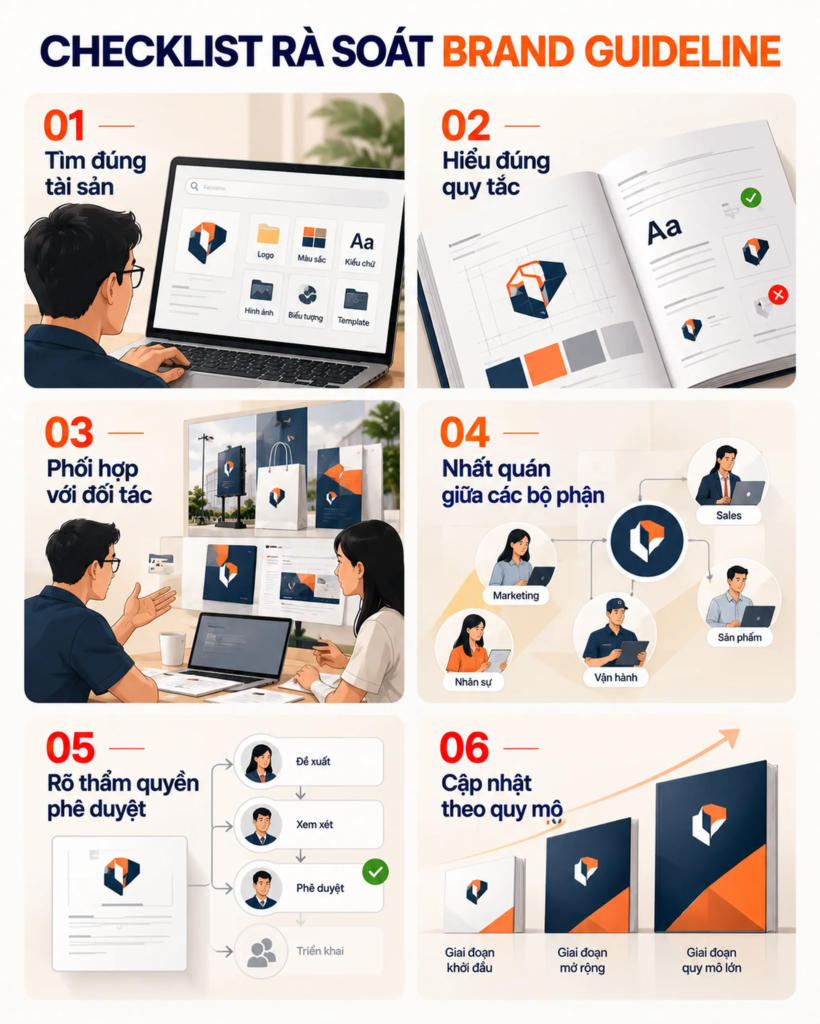
A set of brand guidelines does not need replacing just because it has been in use for many years. What matters is whether the document still fits the current direction, scale and operating needs.
CHECKLIST
Questions to ask:
- Can staff easily find the official logo version and brand assets?
- Do departments often ask again about application rules that are already in the document?
- Can agencies and partners carry out routine applications on their own without having everything explained again from scratch?
- Do the documents of the sales, marketing and HR departments show the same identity system?
- Has the business clearly separated the mandatory rules from the elements that may be flexible?
- Do the brand guidelines reflect the current product portfolio, communication platforms and scale of operations?
If many of the answers point to difficulty in operations, the business should reassess the structure and use of the document before deciding to redesign the whole system.
A review also needs to separate two situations. If the current standards still fit but the document is hard to use, the business can prioritize reorganizing the content, adding examples and improving the asset library. If the identity system itself no longer serves the brand’s direction, the scope of work may need to extend to adjusting the strategy and the design.
5. Managing identity in a large organization: the SCB case
In organizations with many departments, points of sale and partners, managing identity is not only about checking whether a design meets the standard. The system must also help many groups of people make consistent decisions under different operating conditions.
In the content on the project with SCB, the focus of FreshBrand’s solution is described as clarifying the decision architecture, rather than simply adding more content to the handbook.
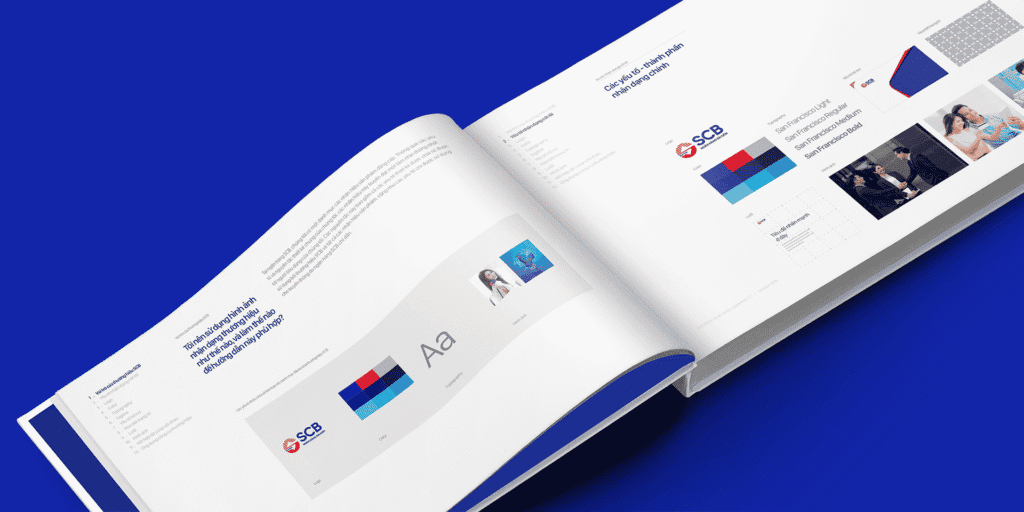
This approach distinguishes two groups of rules:
- Non-negotiable rules: Elements that must not be changed on one’s own because they affect the integrity of the identity system.
- Adaptable rules: Elements that may be adjusted within defined limits to suit each application.
Besides classifying the rules, the document needs examples of approved cases and cases that do not fit. Users can then compare against real situations instead of reading only general principles.
Note that the specific classification and the results of the rollout at SCB should be assessed against the corresponding project records and operating data. The governance principle that can be drawn, however, is this: the more closely guidance is tied to a decision mechanism, the more grounds an organization has to reduce its reliance on individual interpretation.
6. How to build brand guidelines that can be used in practice

Effective brand guidelines do not begin with listing every design item that could go into the document. A business should start from the problems to be solved, then organize the content and the governance process to match.
PROCESS
- Step 1 — Assess the current state Review the identity, the existing documents, the asset library and the application errors that commonly occur. Identify which departments use the brand and which situations cause difficulty.
- Step 2 — Set the principles Clarify the brand direction, the mandatory standards, the room for flexibility and the criteria for evaluating applications.
- Step 3 — Build guidance by touchpoint Add examples, application templates and guidance for the real needs of staff, partners and agencies.
- Step 4 — Set up governance Assign who manages assets, define approval authority and how exceptions are handled.
- Step 5 — Test and update Trial the document with its users, note what is hard to understand and adjust before wider adoption.
6.1. Prioritize the situations of most frequent use
A business does not have to complete every item at once. A more practical approach is to identify the applications that are used most often, involve many departments or regularly produce errors.
For example, if staff keep using the wrong logo in sales proposals, the business can prioritize standardizing the logo library, the sales document templates and guidance on choosing the right version. If the problem lies in digital communications, it should look at standards for content formats and the process for handing assets to partners.
Prioritizing by operating needs lets the document solve the problems that actually exist, instead of becoming a long drafting project that few people use.
6.2. Design the document around the needs of each group of users
Not every user needs to read all of the brand guidelines. Designers need detailed specifications, while salespeople may need only the guidance that relates directly to sales documents.
A business can organize the document into linked sections:
- The foundational principles section is for managers and decision makers.
- The technical standards section is for designers and production vendors.
- The application guidance section is for staff and partners.
- The resources and version management section is for those who need to find, download or update files.
This structure lets users reach the right information without rereading the whole document each time a specific need arises.
6.3. Measure how well it operates, not only how it looks
A beautiful, complete document does not necessarily solve the difficulties of rollout. After putting the brand guidelines into use, a business should check whether users can carry out routine tasks by themselves.
Some indicators that can be tracked include:
- The average time to find the right brand asset.
- The number of identity errors that arise in printed materials.
- The number of revision rounds caused by non-compliance with the standards.
- The share of documents using the correct version.
- The number of requests the Brand Manager must resolve because the guidance is unclear.
These indicators need to be defined according to real conditions, with baseline data to compare against. They do not prove the full value of the brand on their own, but they can help a business assess how useful its guidance system is.
7. Brand guidelines are part of the brand governance system
Brand guidelines do not replace brand strategy, and they cannot solve every identity problem on their own. The role of the document is to turn established principles into guidance that an organization can roll out consistently.
When the strategy changes, the identity system may need adjusting. When touchpoints expand, application guidance has to be added. When the business gains more staff or partners, the mechanisms for permissions and asset management also need to develop accordingly.
So assessing brand guidelines has to go beyond whether the document has complete design specifications. The business needs to consider whether the document helps users understand the rules, do the work correctly and handle new situations through a clear mechanism.
PRINCIPLE 01
A good identity system should be usable correctly without depending on personal interpretation
Consistency does not come from a Brand Manager checking every printed piece by hand. It is supported by clear principles, easy-to-follow examples, official assets that are easy to find and a decision mechanism that fits the size of the organization.
When these components are connected, brand guidelines can become a tool for governance rather than just a reference document for the design team.
FRESHBRAND
If a business already has an identity but still often runs into application errors, has to explain the standards again to each partner, or spends a long time approving the same recurring issues, it is time to look again at how its identity system is organized and run.
FreshBrand works with businesses on brand strategy and identity systems, tying design decisions to real application needs. The first step is to identify the current bottlenecks so as to choose the right scope of standardization, rather than assuming the whole document has to be redone.
Is your business struggling with design standards, the asset system or the approval mechanism for identity?