
Criteria for auditing a brand identity system: a handbook for executives

When starting a design or repositioning project, businesses are easily drawn into questions about whether the logo is attractive, the colors harmonious and the identity modern. But that is only the surface. A real identity system has to answer harder questions: Does it help the brand get recognized? Is it distinct enough not to blend in? Does it work consistently across the organization? Is it flexible enough as the business expands? And more important, is it managed as a strategic asset or treated as just a set of designs?
KEY TAKEAWAY
A good brand identity system does not only look good on a design board; it is clear about brand character, distinctive in its identity, consistent in operation, flexible in expansion and able to protect brand value over time.
A brand identity needs to be audited as a system
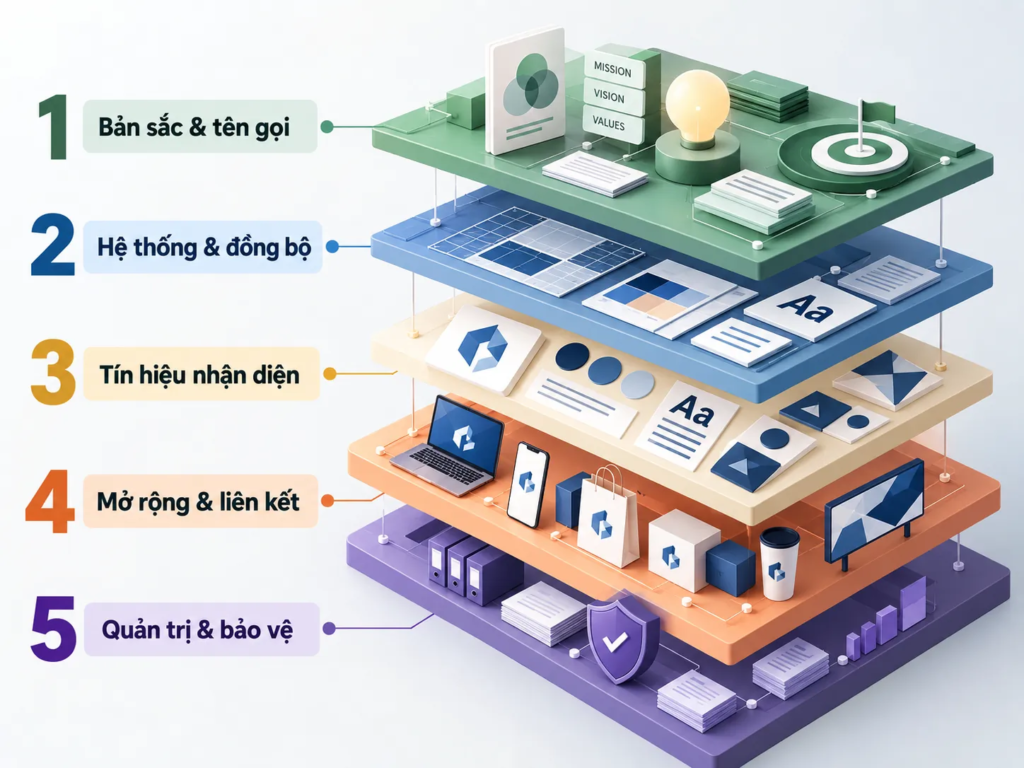
Brand identity is usually seen through tangible components such as the name, logo, color, typography, imagery, packaging, sales materials or brand space. Yet the value of an identity system does not lie in any single component.
A logo can be beautiful and hard to use. A color palette can stand out and look too much like a competitor’s. A set of guidelines can be thorough and hard to apply in daily work. A brand can own many identity assets and still not be recognized by customers as one system.
Brand identity auditing therefore needs to move from the question “Does the design look good?” to a broader set of questions: “Is this system performing its strategic function?”
PRINCIPLE 01
Brand identity is a system, not a collection of graphic assets
The value of an identity appears when the name, brand structure, visual signals, operating standards and touchpoints together create an experience that can be recognized and repeated.
It also means that an individual component should not be assessed apart from the context in which it has to work.
1. Brand character and name: what does the brand stand for?

Before assessing the logo or colors, executives need to return to the foundation layer. If brand character and brand architecture are unclear, optimizing the visuals easily becomes treating symptoms rather than the cause.
1. Does the brand have a living character, or only a look?
A brand can have a full logo, color and guidelines and still feel lifeless if it cannot express a consistent character.
“Alive” here does not mean using elaborate design. What needs checking is whether the identity system reflects how the brand wants to appear, communicate and be remembered.
2. Is the name distinctive enough?
The brand name needs to help the business create distance from the other choices on the market. A name that is too descriptive or too generic can make it hard for the brand to build identity assets of its own.
The audit question is not only “Is this name easy to read?” but also: Placed next to competitors in the same field, does the brand name create a recognition point of its own?
3. Does the name leave room for the future?
A name may suit the current product and become a limit when the business expands.
The brand name should therefore be considered in both directions: is it clear enough to suggest the field or core value, and at the same time open enough for the business to grow into related products, services or markets in the future?
4. Is the brand memorable?
Memorability is not simply a name that “sounds good.” It relates to how easy the brand is to recognize, to tell apart and to link with the experiences the business creates.
An identity system should be examined in real conditions: customers see it for a few seconds, at different distances, on different platforms. Does it carry enough signals for them to recognize and recall the brand?
5. Is the main brand independent enough?
From the start, the brand structure should avoid creating too many sub-brands, names or unnecessary variants.
As the system grows more complex, customers have to remember more names and the business has to manage more identity assets. It is therefore necessary to define clearly which is the main brand, which are product lines, and which elements truly need to be built into independent brands.
FIELD NOTE
In management practice, an identity system usually becomes hard to control not for lack of standards but because the business has too many exceptions. Each department, product or market creates its own variant, and by then the guidelines exist while the identity actually in use runs in many “versions.”
2. Standards system and consistency: can the identity be operated?
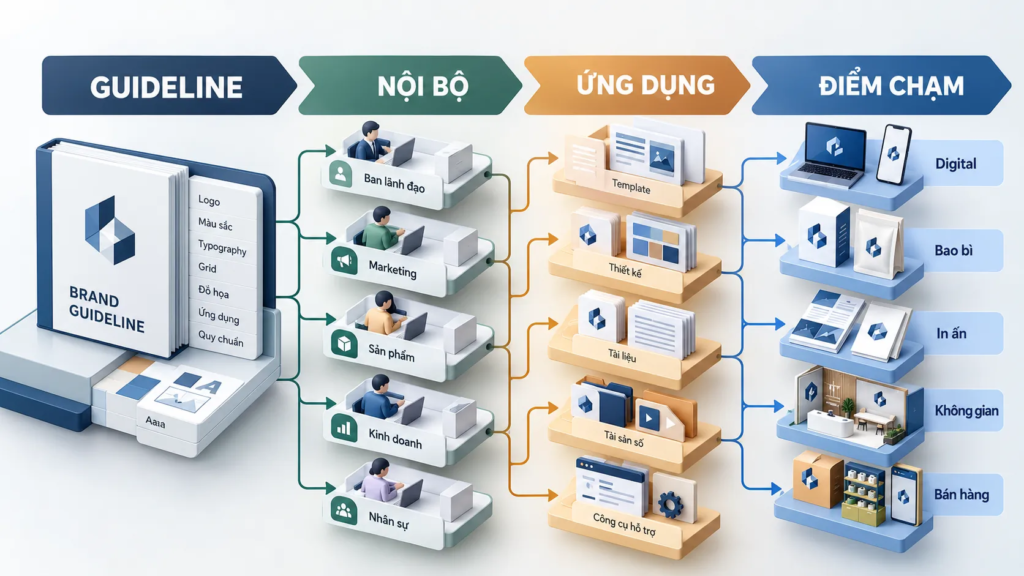
After the foundation of brand character comes the question of operation. An identity system truly exists only when many people, many departments and many touchpoints can use it by the same logic.
6. Does the business have a comprehensive standards system?
Brand guidelines should not be merely a document showing the logo and color codes. Depending on the size of the business, the standards system may need to cover the logo, color, typography, imagery, layout, spacing, icons, use across platforms and the cases where use is not allowed.
The goal is not a very thick document but a reference clear enough to reduce arbitrary decisions in implementation.
7. Are the standards feasible in daily operation?
An overly complicated rule can be right in theory and hard to apply in practice.
Internal users need to know what to do when they create a slide, a sales document, a social media post, a sign, packaging or a recruitment document. If every situation requires going back to the brand team, the system has not really given the organization the autonomy to operate.
8. Is internal distribution designed in from the start?
The brand handbook needs to be easy to reach and easy to look up. Digitizing the guidelines, organizing an asset library and distributing the standards through internal systems can narrow the gap between “rules” and “practice.”
A guideline that is not used is still, in essence, only a document.
9. Do the units across the organization comply?
A business may own a very sound identity set, yet the real experience differs between headquarters, branches, the sales office or communication channels.
A mechanism for checking compliance is therefore needed, rather than assuming that issuing guidelines means they are being followed.
10. Are there minimum visual standards?
An identity system needs to define clearly the minimum elements such as color, typeface, imagery, contrast, layout grid, size, spacing and incorrect uses.
This is the “fence” layer that protects consistency when the identity is implemented by many different people.
11. Does the logo work well in a commercial environment?
A logo does not live on an idealized presentation page. It appears on signage, packaging, documents, screens, products, merchandise and many environments with different display sizes.
Logo structures and arrangements suited to each touchpoint should therefore be checked, rather than assuming that a single version can solve every situation.
12. Does the system consider the global context?
If the brand plans to expand into other markets, the name, language, color, symbols and wording need to be considered in the corresponding cultural context.
A system that works in one market will not necessarily keep its meaning in another. This should be checked before expansion rather than handled after rollout.
FRAMEWORK
12 questions to audit operability
- Brand character: Do users understand how the brand wants to be recognized?
- Standards: Are the identity components clearly defined?
- Feasibility: Can internal users carry out most everyday situations on their own?
- Distribution: Are assets and guidelines easy to access?
- Compliance: Is there a mechanism to check and correct?
- Application: Does the identity work at real touchpoints?
- Expansion: Are there rules for new markets and contexts?
A strong identity system does not only answer the questions above correctly on paper. It has to help users make the right decisions faster in their daily work.
3. Identity signals: what do customers recognize the brand by?
Distinctiveness does not come from a distinctive logo alone. A brand can be recognized through a combination of signals: shape, color, typography, imagery style, language, sound or the way elements are organized at a touchpoint.
13. Does the system have distinctive signals?
The assets that can become the brand’s own signals need to be identified.
If removing the logo makes the whole design unrecognizable, the system may depend too heavily on a single asset.
14. Does the color create distance from competitors?
Color is often one of the identity signals that appears most frequently. But an attractive palette is not necessarily a distinctive one.
Color should be viewed in its competitive context: when brands in the same industry are placed side by side, does the color system create a clear enough distance?
15. Does the slogan play a real strategic role?
A slogan should not exist merely because a brand “needs a tagline.”
If a slogan is used, it should reflect a direction or promise the brand has grounds to pursue. A short line that is not tied to the nature of the brand will struggle to create lasting value.
16. Can the identity extend to multiple senses?
For brands with a suitable context, the identity system can be extended to sound or other multisensory elements.
The key point is that not every brand needs audio branding. It is a supporting tool, meaningful only when it serves the experience and recognition at suitable touchpoints.
LESS EFFECTIVE
- Evaluating the logo only in a static presentation.
- Comparing colors only with the brand itself, not placing them next to competitors.
- Treating each identity asset as an independent component.
- Judging differentiation by subjective impression.
STRONGER
- Checking the identity in real conditions of use.
- Assessing brand signals in the competitive environment.
- Looking at the whole system rather than a single asset.
- Combining distinctiveness with recognition and operability.
4. Scalability and strategic alignment: can the system withstand growth?
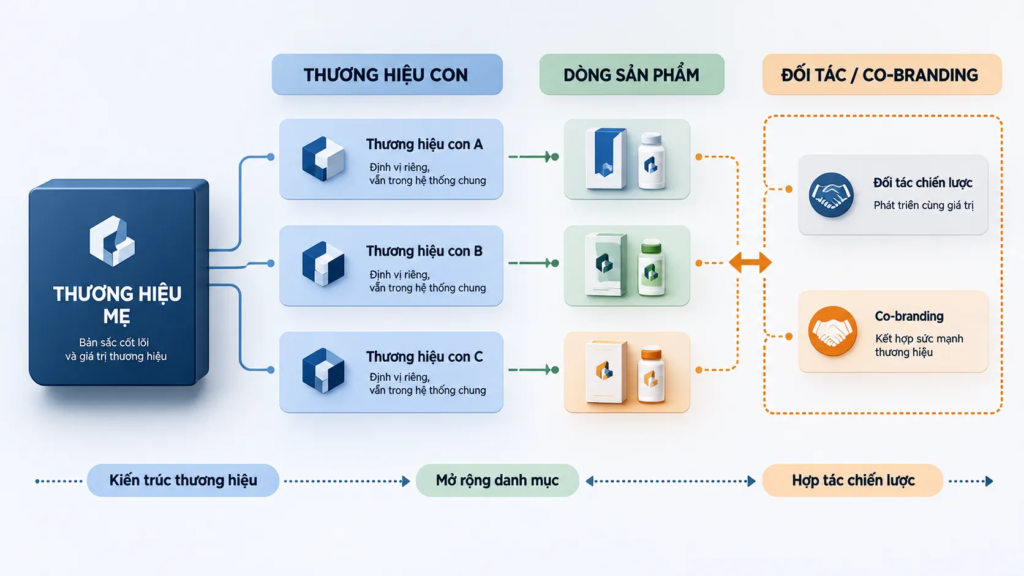
As a business grows, the number of products, sub-brands, partners and touchpoints grows with it. This is when the weaknesses in the identity architecture begin to show.
17. Does the identity work well across media?
An identity system needs to be tested in both digital and physical environments.
Websites, social media, digital advertising, packaging, signage, printed materials, retail spaces and other applications make very different demands. The more easily the system adapts without losing its core signals, the better it can operate.
18. Are there standards for co-branding?
Co-branding, sponsorship, strategic partnerships and joint marketing all create situations in which two or more identity systems have to appear together.
The business needs to define how to handle the size, position, spacing, weight and order of appearance of the brands involved.
19. Do the parent brand and sub-brands have a clear relationship?
When there are many brands, a clear logic of how closely they link is needed.
Do customers need to know which ecosystem a sub-brand belongs to? Where does the parent brand appear? How much independence may a sub-brand have? These questions belong to brand architecture before they become design questions.
20. How does the parent brand support a new brand?
A reputable parent brand can act as an endorsement for a new product or brand. But how prominently the parent brand appears needs to be designed on purpose.
If it appears too little, the business may miss the chance to use assets it already has. If it appears too much, the new brand may fail to form an identity of its own.
An identity system works well only when the people who use it share the same understanding of the core standards.
This is especially important in large organizations, where one brand asset may be used by Marketing, Sales, HR, Procurement, operations and outside parties.
22. Is the brand’s weight at each touchpoint reasonable?
Not every touchpoint needs to give the parent brand and the sub-brand the same space or the same priority.
Packaging, advertising, retail environments and sales materials have different goals. The system therefore needs to let the business shift its emphasis while keeping the relationships among brands.
23. Does the system allow quick retrieval?
An identity signal has value when viewers can quickly link it to the brand.
This comes not from a single component but from the controlled repetition of distinctive signals across many touchpoints.
24. Is the identity durable across all applications?
This is the final test of the system layer: once it leaves the design environment and enters real life, does the identity still keep the structure, proportion, color, imagery and consistency it needs?
EXAMPLE
An identity can be presented beautifully in a set of brand guidelines and still run into problems on small packaging, on signage seen from a distance, or on digital interfaces with many screen sizes.
That does not necessarily mean the original design was wrong. It shows that the system needs to be tested under the very conditions in which it has to work. A good identity should be designed together with its variants and rules of application, rather than judged only as “master artwork.”
5. Governance, flexibility and protection of brand assets
The longer an identity system is in use, the more it needs governance. Without governance, consistency can erode; without adaptability, the system can become a barrier to growth.
25. Is the system flexible enough?
Flexibility does not mean letting everyone change the identity as they please.
A flexible system needs to define clearly what is fixed and what can change. That lets the business adapt to new situations without losing its core signals.
26. Is the identity alive inside the business?
An identity is not only for customers.
Internal documents, announcements, forms, recruitment, the working environment and HR touchpoints also shape how the organization understands and uses the brand.
When an identity is rolled out externally without entering internal operations, the gap between the “designed brand” and the “practiced brand” can keep growing.
27. Have the identity assets been reviewed for legal protection?
The name, logo and certain identity assets can become important assets of the business. Intellectual property protection should therefore be considered early, with suitable advice from a legal expert or an intellectual property lawyer.
A visually distinctive design does not mean the business is fully protected in legal terms.
28. Is there a long-term plan to protect the brand?
Protecting the brand does not end at the moment the identity is approved.
The business needs to keep monitoring, checking and updating the system to limit the risk of copying, confusion, misuse or dilution of the identity over time.
CHECKLIST
Questions to ask:
- Does the brand have a clear character, or only an attractive set of designs?
- Is the name distinct enough, with room for the future?
- Do the logo, color, typography and imagery form a system?
- What distinctive identity signals exist beyond the logo?
- Are the brand guidelines clear enough for daily work?
- Can departments and branches implement the identity without creating too many variants?
- Does the system work well in digital, print, packaging and real-world environments?
- Are there rules for the parent brand, sub-brands and co-branding?
- Is the identity flexible enough while keeping its core elements?
- Have the brand assets been reviewed for legal protection?
- Is there a mechanism for checking and protecting the brand after rollout?
COMMON MISTAKE
“A beautiful logo and complete guidelines are all it takes for an identity system to be complete.”
Why this is not enough
The logo and the guidelines are important components, but they cannot by themselves guarantee a brand’s distinctiveness, recognition, operation and expansion. A system is truly complete only when the identity components, usage standards, brand structure and governance mechanisms all work together in practice.
6. A brand identity audit should happen before wide rollout
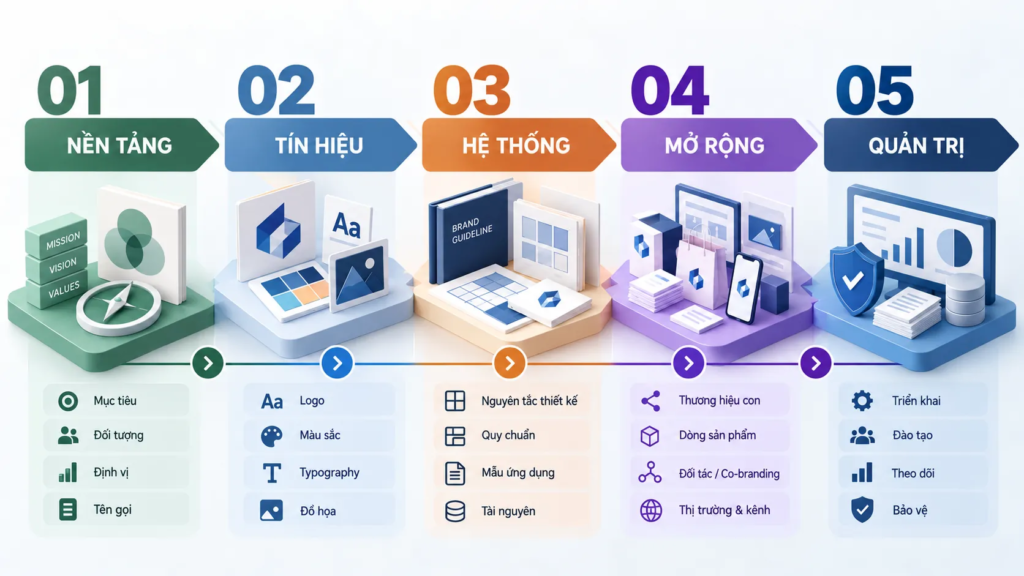
One of the common mistakes is to check the identity only at the end of the process, after the design is finished and the business has invested heavily in production.
A more effective approach is to audit layer by layer.
PROCESS
- Step 1 — Foundation audit: Determine whether the name, brand character, brand structure and room for growth are clear.
- Step 2 — Signal audit: Examine whether the logo, color, typography, imagery, language and distinctive signals create recognition and differentiation.
- Step 3 — System audit: Check the guidelines, variants, application standards and how well they can be rolled out across touchpoints.
- Step 4 — Expansion audit: Simulate situations such as sub-brands, new products, co-branding, new markets or new platforms.
- Step 5 — Governance audit: Define management responsibility, compliance mechanisms, the asset library and the long-term protection plan.
Auditing in layers helps the business see problems before they become real implementation costs.
WHAT WE LOOK FOR
In reviewing an identity system, what deserves attention is not how many assets the business owns but whether those assets work together.
- Which signals truly help the brand get recognized?
- Which rules create value, and which only make the system more complicated?
- What could break consistency as the business expands?
From an attractive identity set to a system that can operate
A brand identity system should not be judged by a single criterion.
It needs to be viewed through several layers: brand character, distinctiveness, memorability, consistency, operability, scalability, flexibility and the ability to protect assets.
The key point is not to confuse consistency with absolute uniformity. A good system does not require every touchpoint to look the same; it requires that different touchpoints can still be recognized as belonging to the same brand.
Likewise, flexibility does not mean allowing arbitrary change. It means the system has anticipated the variants a business needs to adapt, without losing the core structure of the identity.
Finally, aesthetics is not the counterweight to strategy. A good identity system should look good, but that beauty has to serve recognition, differentiation, use and growth.
A good brand identity system does not only look good when presented; it has to work well once it enters the life of the business.
Closing note: do not audit an identity by eye alone
A well-planned brand identity system is not a short-term cost for imagery. It is the infrastructure that lets a business organize how the brand appears, is recognized and is managed over time.
So before approving an identity system, executives should not only ask “Do I like this design?” but pose harder questions:
Is this brand recognized? Is it distinct enough? Can it be operated? Can it scale? And can the business protect it in the long term?
FRESHBRAND
If your business is preparing to build or restructure its identity system, the 28 criteria above can serve as a review framework before the design goes into use. What matters is not reaching a perfect “score” but seeing clearly the gaps that may affect how the brand is recognized, implemented and developed.