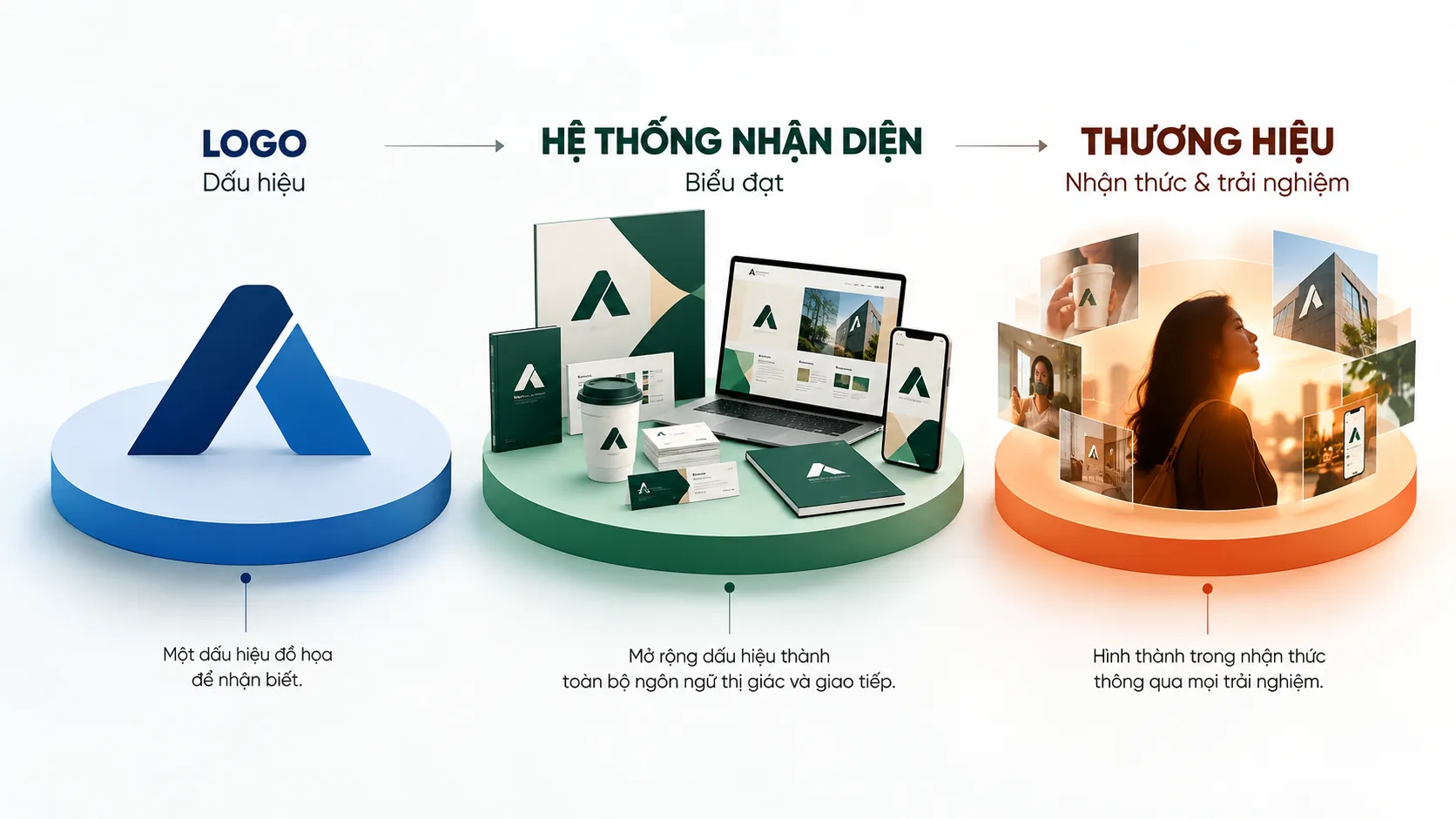
Brand identity refresh: a strategic touchpoint for business breakthrough

Every stage of growth puts a hard question to a business: does the current identity still reflect the position the business is moving toward? When the products have changed, the market has widened and the ambition has grown, but the brand’s image is still stuck at the moment it was created, a gap opens between the “actual business” and the “perceived business.” That gap does not always show up right away in business reports, but it can shape how customers, partners and employees interpret the company’s value.
KEY TAKEAWAY
A brand identity refresh does not begin with the question “what will the new logo look like?” but with “how does the business need to be identified today to fit tomorrow’s strategy?”
An effective identity system must at the same time:
- Carry forward the assets that already have recognition value.
- Reflect the current positioning and ambition accurately.
- Works consistently across the whole touchpoint system.
- Can adapt to the next stages of growth.
When brand identity no longer keeps pace with the business
A logo is not just an image placed on a business card, a package or a website. In a brand system it is an identity asset that helps the business be recognized, set apart and associated with a certain position.
The problem arises when that asset no longer fits the business it represents.
A business may have raised the quality of its products, expanded its capabilities, entered new markets or changed its target customers. But if those changes are not reflected in the identity system, customers may keep seeing the business as its “old version.”
PRINCIPLE 01
Brand identity must evolve with the business’s position
An outdated identity does not necessarily come from a design being old or new in an aesthetic sense. A system can still be well designed yet become unsuitable because the business has changed.
The important criterion, then, is not “is the logo modern?” but “is the current identity still doing the strategic job it was meant to do?”
This is also why a brand refresh should not be started just because the management team feels the current image has become dull.
Obsolescence usually comes from the gap between capability and perception
In practice, a business rarely wakes up one day to find its brand has become “outdated.” The misalignment usually builds up step by step.
The business adds products. The website is changed. The packaging is improved. The company profile is updated. Departments create their own sales materials. Some platforms use the old logo, others a version that has drifted.
Each individual change may not cause a big problem. Over time, though, the whole system begins to lose consistency.
COMMON MISTAKE
“A brand only needs a new logo to become more modern.”
Why it is not enough
The logo is only one component of an identity system. If the problem is a mismatch between positioning, visual language, application system and touchpoint experience, replacing the logo alone may not address the cause. The business may even take on added implementation costs without a matching change in perception.
So before redesigning, it is necessary to pin down exactly where the gap lies: strategy, identity structure, visual expression or implementation.
Four signals that a business should review its identity

Not every business needs a rebrand. An identity system should be reconsidered only when there are large enough changes in strategy, or when the current system is genuinely creating an obstacle.
FRAMEWORK
Four signals to diagnose
- Misaligned positioning: Products, services or quality have been upgraded, but the brand image still leads customers to associate the business with a lower segment, or one different from the position it wants.
- The market target changes: The business aims at new customer groups, new segments or international markets, while the current identity system does not yet provide enough recognition and credibility for the new context.
- A fragmented system: The website, packaging, sales materials, business cards, company profile and other touchpoints develop in different ways, leaving the brand inconsistent.
- The organizational structure changes: A merger, consolidation or restructuring can create the need for a new identity structure that reflects the relationships between units and a shared vision.
The important point is not to treat these four signals as a checklist that automatically leads to a decision to change. They are starting points for a diagnostic process.
Repositioning does not mean erasing the past
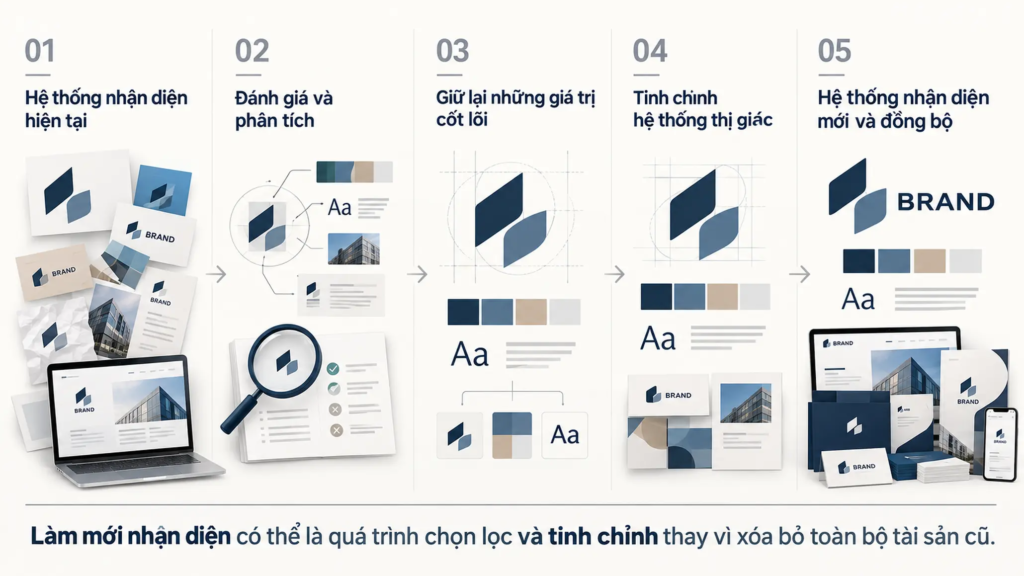
One of the major risks of an identity refresh is the “start over from scratch” mindset.
When a brand has existed long enough, customers may have built up certain associations with its name, colors, symbol, shape or identity structure. These elements form a recognition asset, and not all of them should be discarded just because the business wants to feel new.
What the business needs to change may not be the whole identity but the way its existing assets are organized and expressed.
LESS EFFECTIVE
- Treating rebranding mainly as a design project.
- Removing old elements without assessing their recognition value.
- Judging success by whether it feels “better looking” once the design is done.
- Changing the logo while leaving fragmented touchpoints as they are.
STRONGER
- Start by identifying the change in strategy and position.
- Decide which identity elements to keep, refine or drop.
- Judge the design by how well it expresses the positioning and can be implemented.
- Treat identity as a system rather than a single symbol.
“Evolution” is a balance between recognition and fit
An identity refresh always involves a two-way problem.
On one hand, the brand must be different enough to reflect the change. On the other, it must keep enough familiar signals not to lose the recognition value it has built up.
This is not a fixed formula. How much to change depends on the gap between the current image and the desired positioning, on the strength of the existing identity assets and on how much the business strategy has shifted.
PROCESS
- Diagnosis: Identify where the business has changed, what the current identity is helping or hindering, and where the gap lies between the desired positioning and current perception.
- Set the principles of continuity: Identify the elements that already carry recognition value and should be kept, rather than assuming everything old must go.
- Refine the system: Adjust the logo, colors, typography, imagery, layout and related components according to one consistent logic.
- Test the touchpoints: Put the new system into real environments such as the website, packaging, documents, signage, company profile and digital platforms to check that it works.
- Controlled rollout: Set the order and scope of change so that the investment in identity produces real, usable value rather than just a new set of design documents.
A new logo only matters when the system behind it works
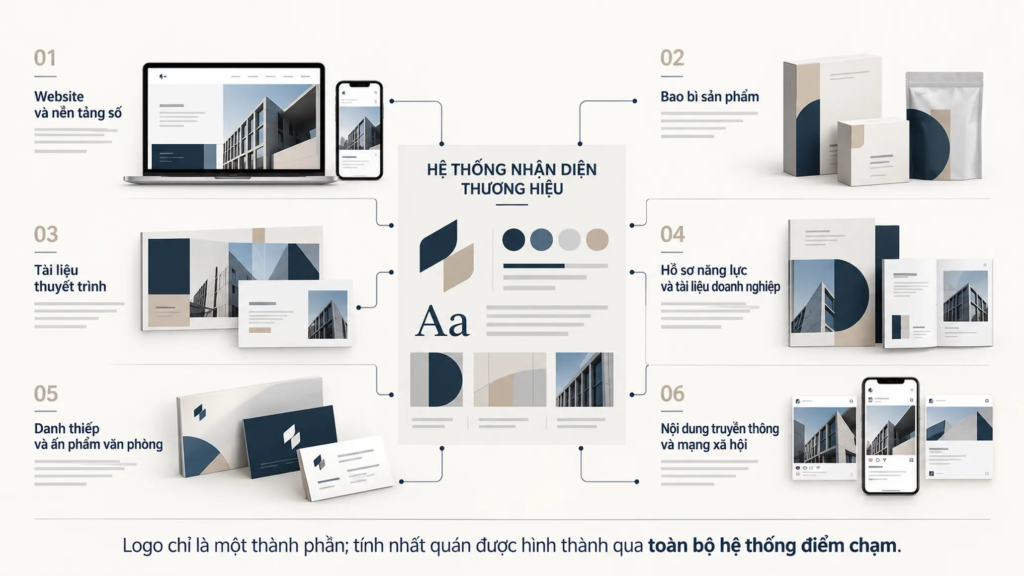
A logo can make a first impression, but the brand experience is shaped by many more touchpoints than that.
A customer may see the logo on the website, then meet a salesperson, receive a quotation, open the packaging, read a user guide or view a social media post. If each touchpoint interprets the brand differently, a new logo can hardly create consistency on its own.
A refresh should therefore be seen as a project to rebuild the brand’s infrastructure of expression.
FIELD NOTE
One sign worth noticing often lies not in the logo itself but in the versions of it that appear around it. When each department, supplier or platform handles the identity in its own way, the problem is usually more than a missing correct file. It shows that the identity system is not clear enough to be applied consistently in practice.
The ROI of a refresh lies in how usable it is
Any change of identity brings costs: replacing documents, updating packaging, adjusting spaces, updating digital platforms and briefing the teams who implement it.
So the question of return on investment should not be only “does the new design look better?”
The business needs to consider whether the new system will reduce fragmentation, support clearer positioning, work better across platforms and give it a base flexible enough for the next stage of growth.
WHAT WE LOOK FOR
In an identity refresh project, the first thing to look at is not the logo sketch but the reason the business wants to change.
- Is the business changing its strategy, or only its aesthetic preferences?
- Where does the gap lie between the current image and the desired position?
- Which recognition assets are valuable enough to carry forward?
- At how many touchpoints, and under what real conditions, will the new system have to operate?
These questions help separate a strategic decision from a purely visual one.
An identity that fits the positioning is part of competitive strength
In a market where many brands appear at once, clarity becomes an important value.
A good identity system does not have to grab attention at all costs. Its value lies in helping the business be recognized, interpreted correctly and experienced consistently across different touchpoints.
That also explains why a brand identity refresh should not begin and end in the design studio. It needs to begin with a change in the business and end with the new system working in practice.
CHECKLIST
The questions to ask:
- Is the business’s position today still accurately reflected by its current identity?
- Is there a gap between actual quality and the way the brand is perceived?
- Which recognition assets need to be preserved through the change?
- Is the current identity system fragmented across touchpoints?
- Is the cost of rolling out a new identity proportionate to the strategic problem the business needs to solve?
“A brand identity refresh does not begin with the question of what the new logo looks like, but with the question of how the business needs to be identified today.”
FRESHBRAND
If a business is facing a stage of growth, market expansion or a change in position, this may be the right time to re-examine the gap between its strategy and its brand image.
FreshBrand can begin with a strategic conversation to work out with the business where the problem lies: positioning, identity structure, touchpoint system or implementation. Once the gap is clearly identified, the decision to refresh or not rests on firmer ground.