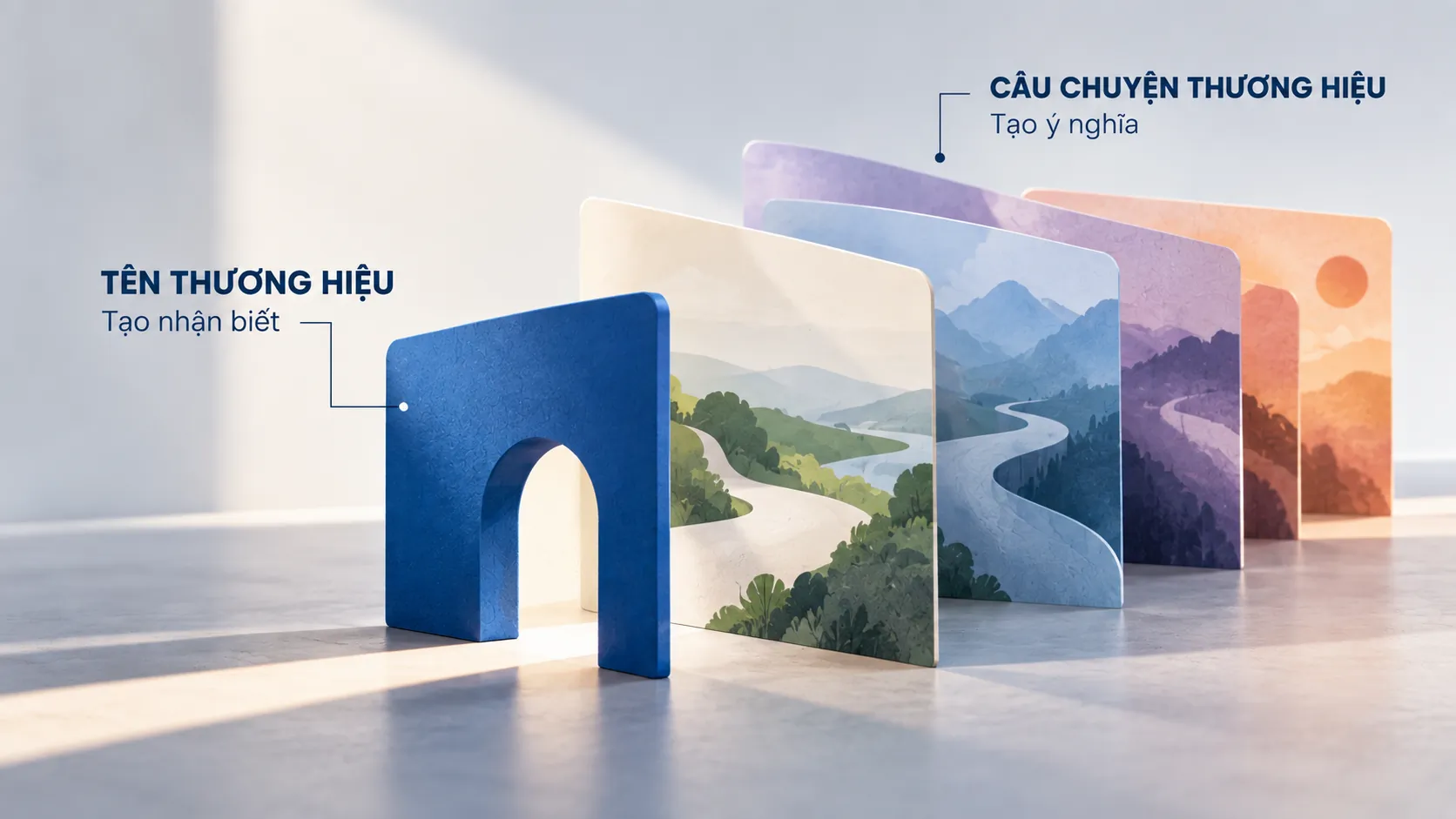
Unpacking the three layers: logo, identity system and brand
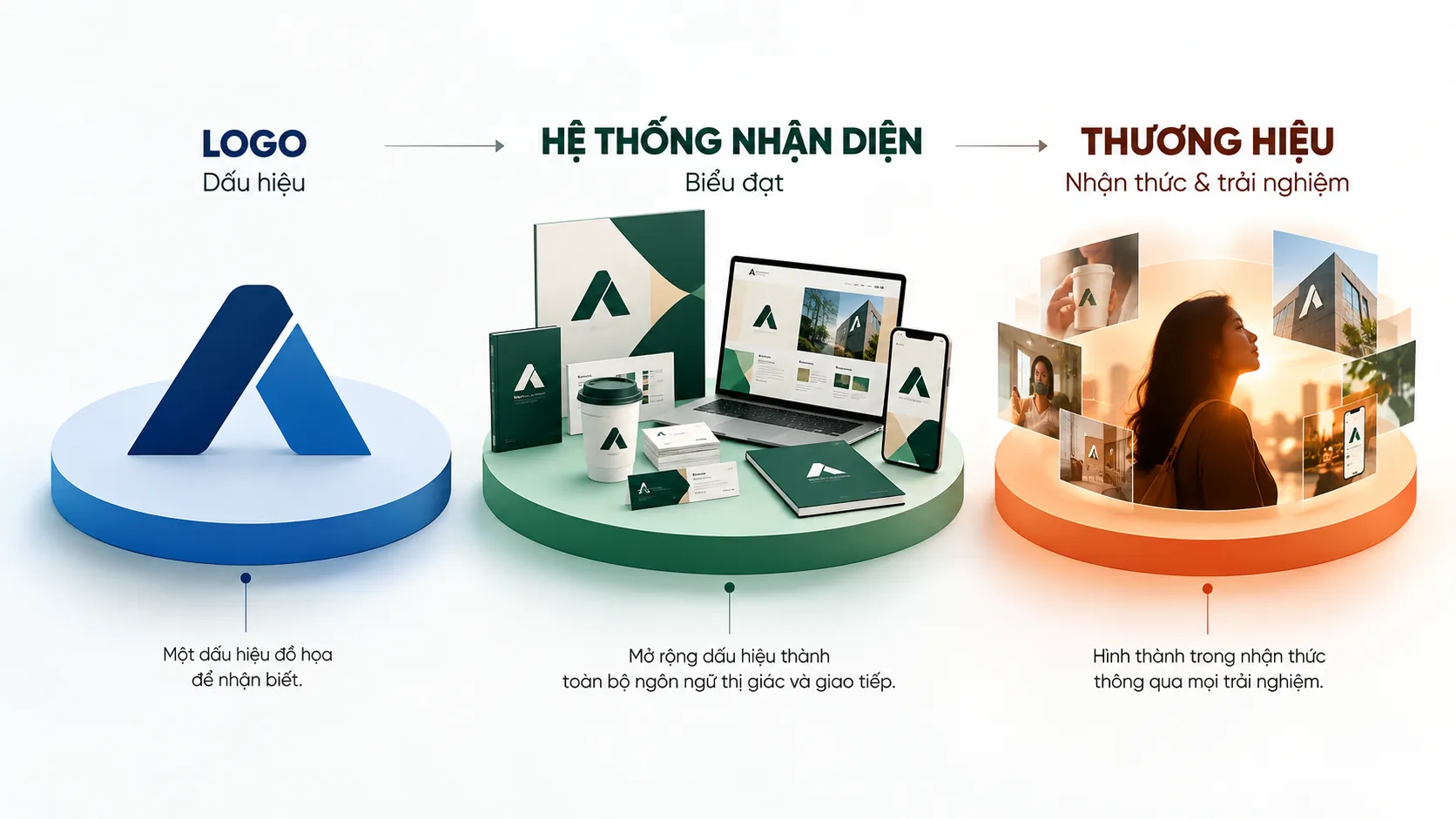
Many businesses start the brand conversation with a very specific question: “Is our logo attractive and professional enough?” But that is only a small part of the problem. Logo, brand identity system and brand are not three names for the same thing; they are three layers with different functions: one helps people recognize you, one lets your identity be expressed consistently, and one forms in the market’s perception.
KEY TAKEAWAY
The logo creates a mark of recognition; the identity system creates the way the brand appears; and the brand is formed by what the market actually recognizes, remembers and experiences.
Why do businesses so often confuse the logo with the brand?
In management practice, these three concepts are often lumped together as “doing the brand.” When a business needs to change its image, it may start by redesigning the logo; when it rolls out communications, it may keep changing colors, typefaces and imagery campaign by campaign; but without a shared structure behind them, those changes only produce disconnected visual assets.
The problem is not whether the logo looks good or bad. The problem is the scope of work the logo is expected to do.
A logo cannot replace a positioning strategy. An identity kit cannot replace product quality. And a brand strategy cannot be realized if the business has no expressive system clear enough to appear consistently in the market.
PRINCIPLE 01
Brand design should be seen as a system, not a collection of assets
Once the three layers are separated properly, a business can tell whether it is dealing with a recognition problem, an expression problem, or a problem of experience and perception. That is the difference between “redoing the image” and managing a brand as a long-term asset.
1. The logo: the minimal identifying touchpoint
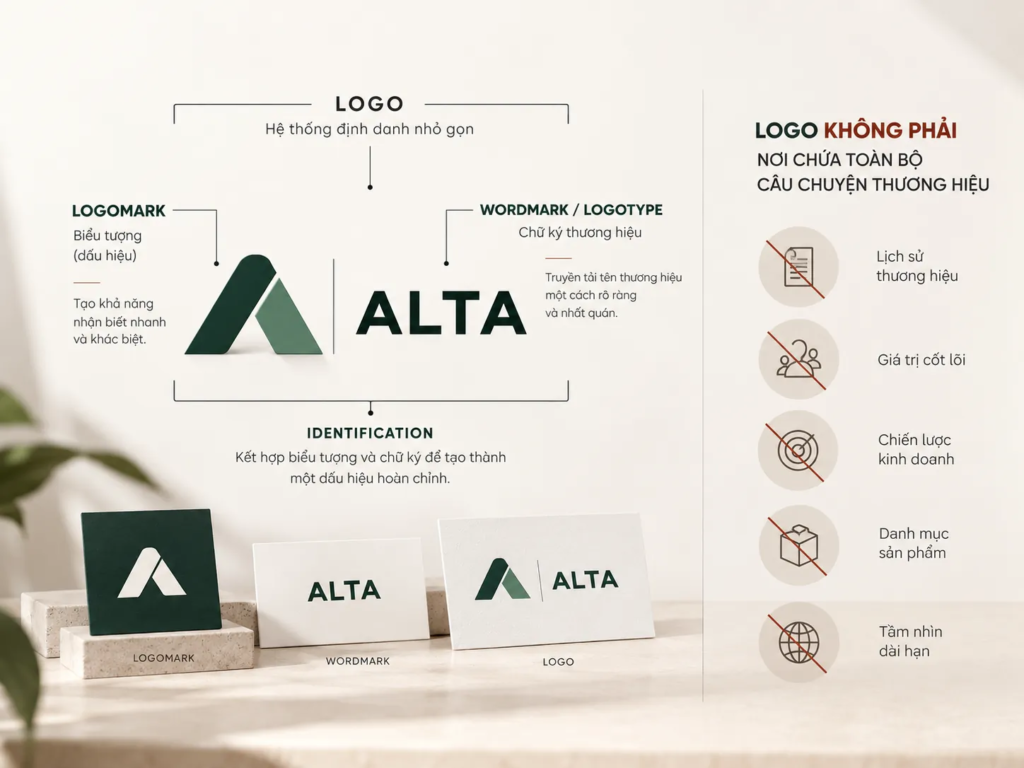
The logo is the most visible layer and usually the first asset a business thinks of when it talks about identity. Yet its core function is not to tell the whole story of the business, but to create an identifying mark so that the brand can be recognized and told apart.
A logo can have several components depending on the design system, but two are common:
- Logomark: the symbol or visual image that represents the brand.
- Wordmark (logotype): the brand name set in a distinctive lettering structure.
The key is not to force the logo to “say everything” about what the business does. The more a symbol tries to describe products, industry, values, history and ambition all at once, the more complicated and hard to use it becomes.
An effective logo should be evaluated in real conditions of use: recognizability, reproducibility, proportion, clear space, performance at many sizes and fit with the identity the business wants to express.
COMMON MISTAKE
“The logo has to show everything the business offers.”
Why it is not enough
A logo identifies before it explains. A good brand system does not place the whole burden of conveying information on a single mark. Meaning accumulates across the identity system as a whole, together with content, products, services and experience.
EXAMPLE
For example, a business with several product groups does not necessarily have to put each product into the brand symbol. If the logo has to change every time the product range expands, the identifying asset itself becomes unstable. A mark that is clear enough to stand on its own can provide a better foundation for extending the system later.
2. The identity system: turning identity into a language that can operate
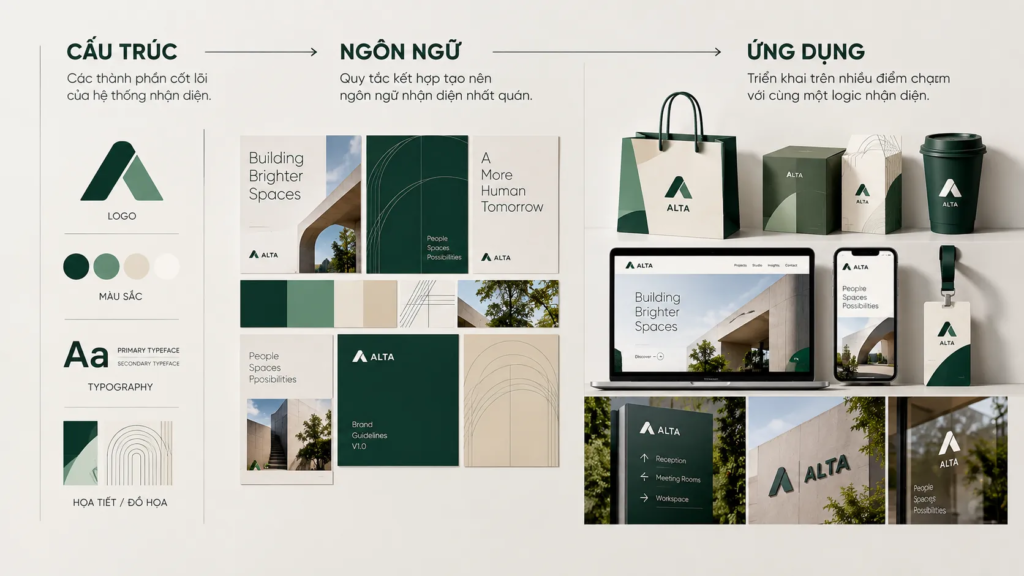
If the logo is a signature, then the Brand Identity System (Visual Identity System) is the visual language that lets a business keep a consistent appearance across many touchpoints.
This is the layer where a brand idea is turned into specific design principles. Beyond the logo, the system can include color, typography, layout grids, negative space, imagery, supporting graphics, icons, the way information is presented and rules for application.
The goal of a system is not to make everything identical. Consistency is not the same as uniformity. A good system is tight enough for viewers to recognize one brand, yet flexible enough to adapt to each context.
FRAMEWORK
The identity system as infrastructure of expression
- Structure Grids, proportions, spacing and visual hierarchy provide the organizing principles.
- Language Color, typography, imagery and graphics create the distinguishing features of the identity.
- Application Those principles are carried into packaging, documents, spaces, digital platforms, advertising and other touchpoints.
When these three layers are linked, identity no longer depends on the logo appearing everywhere. Other features of the system can also become signals that help the market recognize the brand.
How does the identity system create operational value?
The value of an identity system is not only aesthetic. For a business, a standardized system also solves an operational problem: everyone knows how the brand should appear, and no one has to start from scratch at every touchpoint.
First, a system reduces arbitrariness in production. In-house teams, communications partners, suppliers and implementers all have a common basis to work from.
Next, consistency gives a business an image with continuity. A customer may meet the brand on a website, on packaging, in a company profile or in a physical space at different times; an identity system lets those touchpoints still be felt as expressions of the same organization.
Finally, a good system must account for situations where the logo is not the most prominent element. When color, typography, imagery or graphic assets are distinctive enough, the brand has more ways to be recognized.
FIELD NOTE
A common sign of an incomplete identity system is a business that has a reasonably clear logo while every department uses a different style of color, typeface, layout and imagery. In that case the problem is not necessarily the logo; it is that the business does not yet have enough rules to turn the logo into a system that can actually operate.
3. The brand: what forms in perception and experience
The logo and the identity system are what a business creates deliberately. The brand is different.
A brand does not live in a design file or a brand guidelines book. It forms in the market’s mind through the sum of what customers, partners and the community notice, interpret, remember and experience when they come into contact with the business.
This creates an important difference between what the business intends and what the market perceives.
A business may want to be seen as trustworthy, professional or distinctive. But if its products, services, communication and real experience do not reinforce those attributes, an identity system, however well designed, cannot create the matching perception on its own.
FRAMEWORK
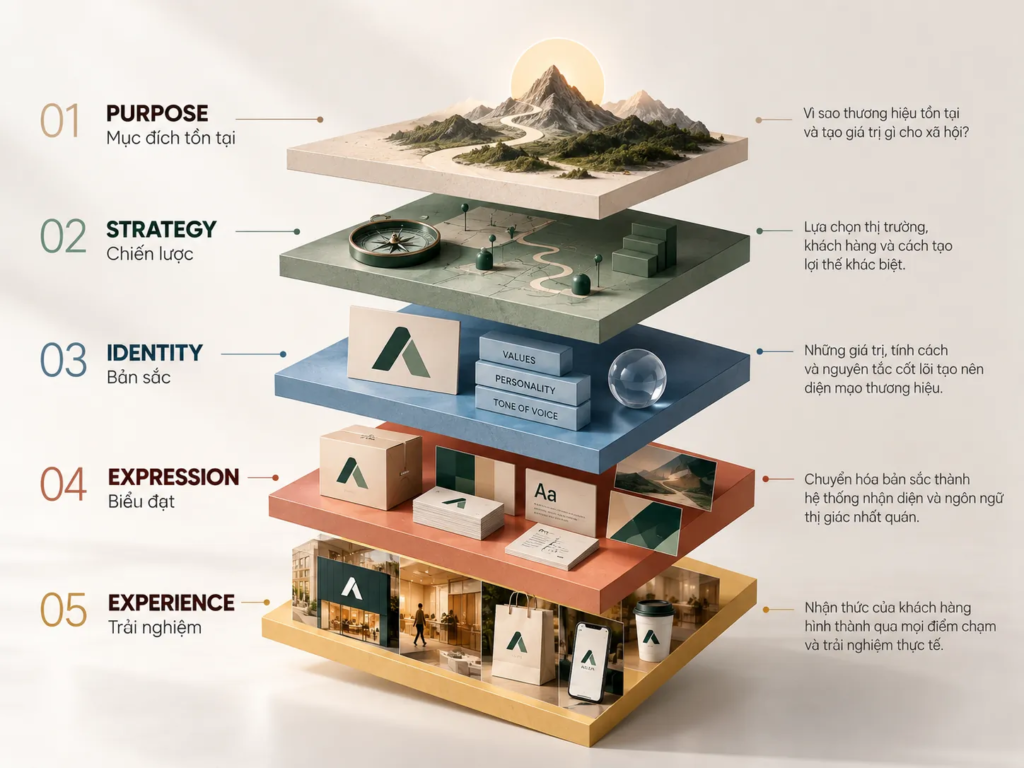
5 layers that make a brand consistent
- Purpose What problem does the business exist to solve, and what value does it create beyond revenue goals?
- Strategy Whom does the business choose to serve, how does it compete, and what does it deliberately choose not to do?
- Identity What kind of organization, with what character and set of values, does the business want to be recognized as?
- Expression How is that identity turned into words, imagery, design and brand signals?
- Experience How do customers actually see, use, interact with and judge the business?
In this structure, the identity system sits mainly in the Expression layer. It is very important, but it cannot replace the other four layers by itself.
4. How do the three layers connect?
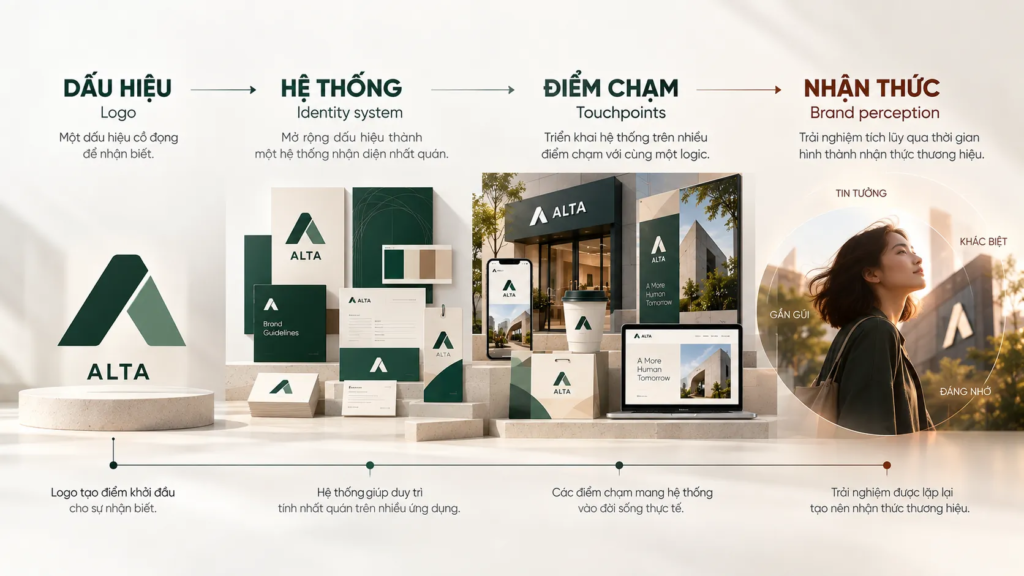
The three layers can be pictured as a sequence from mark to perception:
Logo → Identity system → Brand
But this is not a simple linear process.
The logo provides a mark of recognition. The identity system extends that mark into a consistent language. The business then brings that language into real touchpoints. The experiences and signals that accumulate across those touchpoints help form the perception of the brand.
So a good identity system has to answer two different questions:
“How does the business want to be seen?”
and
“How does the market actually recognize the business?”
The gap between the two answers is one of the key issues that needs to be managed.
LESS EFFECTIVE
- Treating the logo as the whole brand.
- Changing the design campaign by campaign without shared principles.
- Judging identity mainly by whether it looks good or bad.
- Expecting design to make up for a product or service experience that falls short.
STRONGER
- Define the role of the logo in the system.
- Set principles so that touchpoints share one language.
- Assess the design for recognition, distinctiveness and applicability.
- Check consistency between identity, expression and real experience.
5. Test the identity system before investing further
Having many design components does not by itself make a strong identity system. Executives and marketing leads need to look at whether the system solves the business’s specific problems.
FreshBrand can use four testing questions as a frame of reference:
5.1. Visual vision: what is the system expressing?
Every visual element needs a reason to exist. Colors, typefaces, imagery and graphics should not be chosen simply because they look “good,” but because they relate to the identity and to how the business wants to appear.
A system with too many decorative elements and no hierarchy adds complexity without necessarily improving recognition.
5.2. Distinctiveness: is the brand different enough to be recognized?
Being distinctive is not simply doing something eye-catching. An identity system has value when its features are clear enough to set it apart from other brands in the same industry and can be used consistently.
From an asset standpoint, a business should also consider whether the identity elements can be protected within the scope of its intellectual property. Design and protection are two related but different matters.
5.3. Recognition: how quickly can the market recall the brand?
An identity system needs to produce signals distinctive enough for viewers to connect them with the same brand.
This should not be reduced to a fixed number of seconds or years without a specific method of testing. The more important question is: when the logo is shrunk, placed in a competitive environment or does not appear at all, which elements still allow the brand to be recognized?
5.4. Applicability: can the system actually work?
A design can look good in a presentation and still run into problems in real implementation.
The system needs to be tested at many scales and in many contexts: from favicons, digital interfaces and office documents to packaging, signage, spaces and large-format communications. Adaptability is part of a system’s quality, not extra work that arises after the design is finished.
WHAT WE LOOK FOR
When evaluating an identity system, the first thing to look at is not “Is it beautiful?” but “Does it work as a system?”
- Do the elements share one logic, or are they simply gathered into a set of assets?
- When the logo does not appear, what other recognition signals does the brand have?
- Can in-house teams and partners apply the system without having to reinterpret it from scratch?
6. When does a business need a new logo, and when does it need to restructure its identity?
This is a distinction with a direct bearing on budget.
If the problem lies mainly in the identifying mark itself, for instance when the logo no longer fits the current direction or is hard to use at the sizes or in the contexts required, the business may need to consider redesigning or refining the logo.
But if the logo is fairly sound while every touchpoint is expressed differently, the problem may lie in the system, not the logo.
And if a business already has a fairly consistent identity system but the market still forms a perception that does not match the strategic direction, changing the logo may not reach the main cause. It is then necessary to look more broadly at positioning, products, services, experience and how the brand is being expressed.
CHECKLIST
Questions to ask:
- Is the business facing a problem with its mark of recognition, its system of expression or market perception?
- Is the current logo really the cause of the problem, or only the part that is easiest to see?
- Does the identity system have enough principles for teams and partners to apply it consistently?
- Does the real experience reinforce what the identity system is communicating?
7. Brand management starts with identifying the right problem
The most important point is not how much a business should invest in a logo or identity, but which problem it is investing to solve.
If a recognition problem is mistaken for a brand problem, a business may pay for a new design and still not fix the cause. Conversely, if an identity system has become inconsistent but the business keeps producing individual pieces one at a time, operating costs keep rising while consistency does not improve.
A better-grounded approach is to start from strategy, define the identity that needs to be expressed, and then build an identity system that can turn that identity into consistent signals. Finally, the business has to test those signals against the real experience of customers and the market.
A logo is a mark of recognition. An identity system is the infrastructure of expression. A brand is the perception formed through the whole experience.
Conclusion: Don’t use one asset to solve a problem bigger than itself
The logo matters, but it is only one part of the brand structure.
An identity system matters more than a standalone logo because it makes consistent operation possible. But even a well-built identity system cannot create a brand by itself if products, services and real experience do not reinforce what the business wants the market to remember.
So the question before starting an identity project should not be just “What will the new logo look like?” but:
“Does the business need to change the mark, change the system of expression, or change how the market perceives and experiences the brand?”
Once that question is answered, the scope of investment, the design criteria and the way to measure results become clearer.
FRESHBRAND
If your business is considering building a new identity system or restructuring an existing one, the first step is to pin down the gap between strategy, identity, expression and the experience you deliver today. FreshBrand can work through that problem with you to define the scope of what needs to change, rather than assuming every brand problem starts with a logo.