
The executive’s doubt: does an agency really understand the business’s “pride and joy”?

In business management there is a truth that any consultancy has to admit: no one understands a product as deeply as the people who created and developed it. So when a business considers an outside brand strategy partner, doubt is entirely natural: can an agency that does not manufacture, does not run a factory and does not live with the product every day understand enough to take part in an asset the business has spent years building?
KEY TAKEAWAY
An agency does not need to replace the business’s internal knowledge; the more important role is to help the business see, organize and turn its inherent values into a language the market can understand.
The gap between product quality and market language
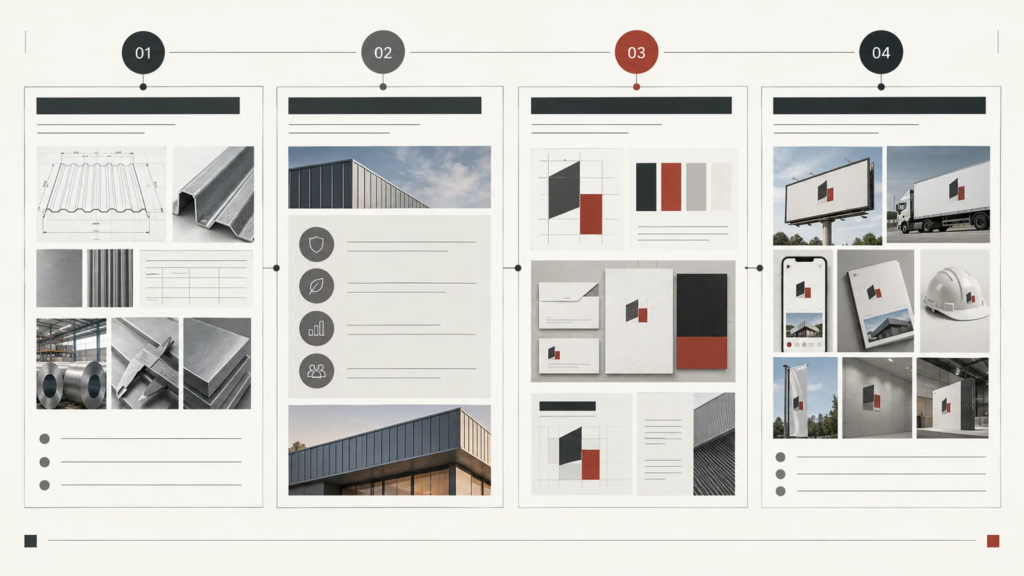
Every product or service, before it reaches the market, is the result of a long process: research, testing, operation, adjustment and accumulated experience. To an executive, it is not just a commercial product line but an asset tied to many of the company’s important decisions.
This explains why a founder or leadership team often asks very direct questions when working with an agency:
“They don’t make anything themselves, they just stand outside and watch. Do they really understand our product? Or will they impose a ready-made formula on something we spent years building?”
This is not simply a design question. It is a question about ownership of knowledge, about trust, and about how both sides take part in a decision that affects how the market sees the business.
PRINCIPLE 01
An agency should not try to be the one who understands the product best
The business holds deep knowledge of its product, technology and operations. The agency adds value by bringing in a perspective from the market, from user behavior and from brand expression, not by denying the knowledge the business has accumulated.
One of the most common gaps appears when product quality is not turned into a suitable market language.
Many businesses struggle not because their products are poor, but because they talk about the product in the language of an engineer or manufacturer. That language is full of specifications, processes and internal characteristics, which matter to the people who make the product but are not necessarily as easy for customers to understand.
Customers take in a brand through a different set of languages: emotion, reassurance, experience, imagery and the values they can recognize while making a choice.
LESS EFFECTIVE
- Focusing only on explaining the technical features the business is proud of.
- Using internal language to communicate with the market.
- Treating product quality as the same thing as customers recognizing it.
STRONGER
- Decide which values of the product truly matter to customers.
- Turn technical advantages into a brand language that is easy to take in.
- Build consistency between what the business can actually do and how that capability is expressed to the outside world.
This gap is exactly where brand strategy can create value. A strong brand does not only speak accurately about what the business has; it also helps the market understand why those values deserve attention.
Working with an agency is not replacement but removing blind spots
The worry that an agency will “impose its own taste” or “overstep” usually appears when the roles of the two sides have not been clearly set.
If the agency is expected to decide for the business on product, technology or operations, the relationship easily goes wrong. But if the business only asks the agency to restate what it already knows and never lets it ask questions from an outside perspective, part of the value of consulting can be lost as well.
FRAMEWORK
Two dimensions of value: depth and breadth
A more fitting approach is to see the relationship between business and agency as two kinds of knowledge complementing each other.
- The business, depth: Understands the product, the technology, the manufacturing process, real customers and the core characteristics built up through operations.
- The agency, breadth: Brings a more objective view of the market, user behavior, positioning, the brand system and design language.
- The intersection, transformation: Combines internal knowledge with expressive skill so that the values the business owns become clearer to the market.
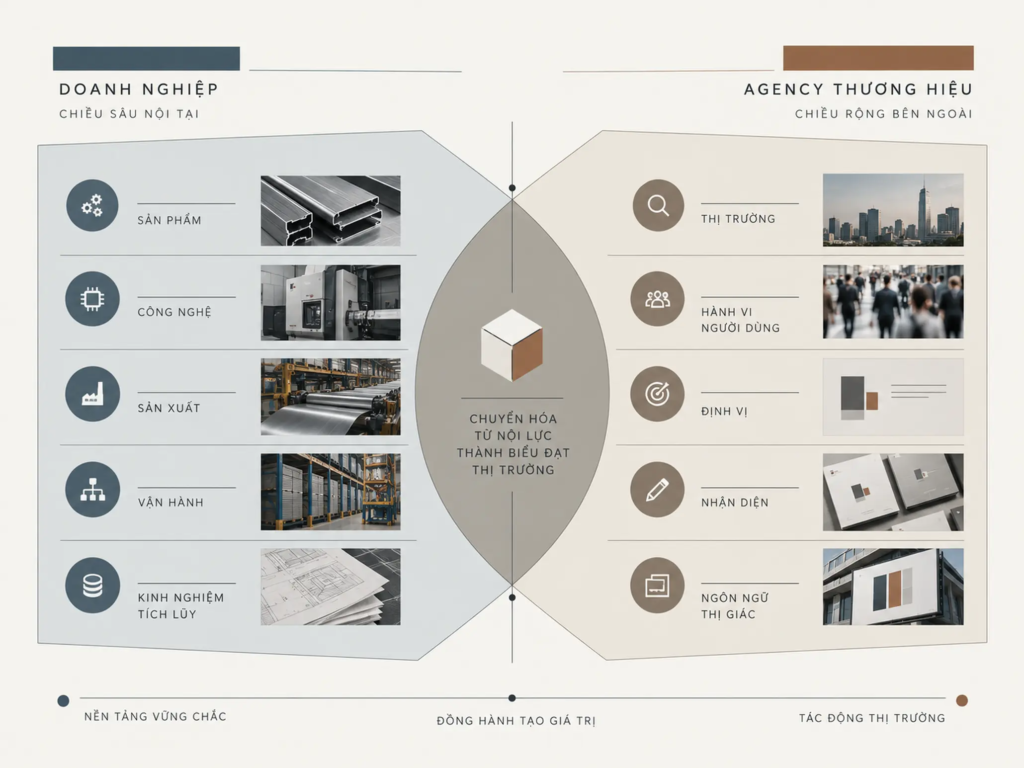
For this reason FreshBrand does not aim to teach a business how to make its product. Our role is to work with the business to find how the values that already exist inside it can be expressed consistently through the brand and its touchpoints.
WHAT WE LOOK FOR
In brand work, the first thing to see is not how the business wants to “look,” but what it actually owns and how the market currently understands it.
- What knowledge exists only inside the business?
- Which values can customers actually recognize?
- What gap exists between real capability and the way the brand is expressed?
Once these questions are clear, the new design has a basis to become an expressive system rather than just a collection of visual elements.
Co-creation: when the agency and the business build the answer together

A professional agency should not work on a model of taking a brief and returning a finished product in an industrial way. For complex brand problems, creating the answer requires the real participation of people who understand the business from the inside.
That is why FreshBrand approaches projects through co-creation. The agency brings an outside perspective, but the business’s internal knowledge remains an important part of finding and testing the answer.
Context: Ton Dong A is a brand in the steel sheet industry with a long accumulation of manufacturing and operating experience. Decision: FreshBrand accompanied the repositioning and the development of the brand’s expressive system. Problem: Its strengths in production capability and resilience needed to be turned into a brand language that expresses them more clearly. Lesson: Repositioning does not have to mean discarding the values already there; the process can start by listening, distilling and turning those values into a more fitting expression.
Ton Dong A: respecting the knowledge of heavy industry
In the project with Ton Dong A, FreshBrand did not change the core values or the steel sheet manufacturing knowledge the business had built up over many years.
Instead, the process began by listening to the voices from the factory and learning about the resilience behind the manufacturing. From those materials, the two sides co-created the sun and sail symbol and standardized the brand’s expressive system.
What stands out is not that an agency produced a new symbol, but how technical capabilities were turned into a more expressive brand language.
FIELD NOTE
In businesses with a long operating history, the important values sometimes do not sit in a brand document. They may sit in the factory, in the way workers talk about their jobs, in production standards, or in what leadership has stubbornly defended over the years. If a consulting process begins only at the design desk, this knowledge is easily missed.
Lasuco Group: turning agricultural knowledge into a brand architecture
For Lasuco Group, the story started from a different foundation: the pride of farmers and agricultural scientists tied to a long-established sugar group.
FreshBrand did not impose a lavish, glossy design language on the business. Instead, the engagement focused on distilling the spirit of “Everything is natural” and turning it into a more coherent brand architecture.
This points to an important principle: a brand language has value when it comes from the nature of the business, rather than being chosen only because a visual style is in fashion.
HADUCO: turning technical capability into trust
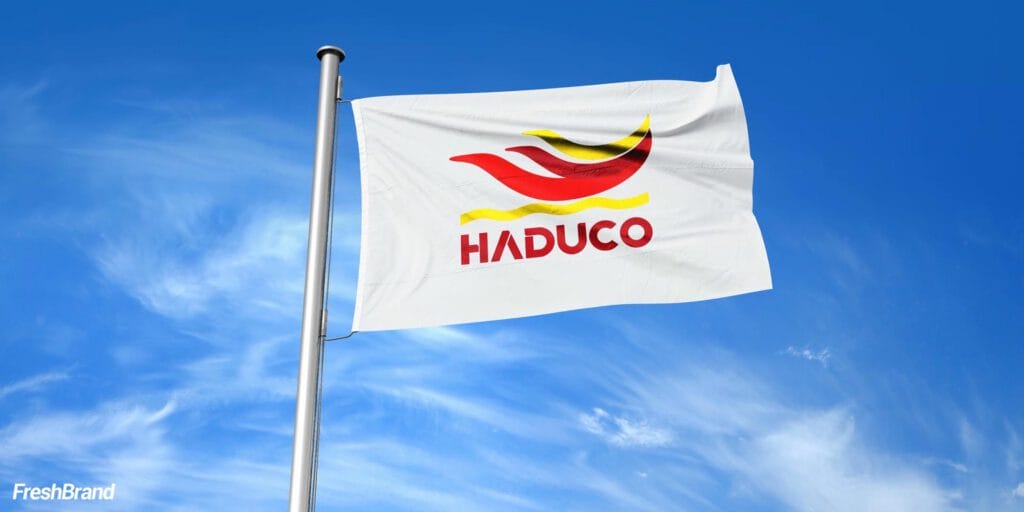
For HADUCO, the problem sat in a highly technical field. The company owns an oil and gas service fleet, and maritime language and operating standards carry a great deal of specialist information.
Together with the executive team, FreshBrand explored the story behind the offshore voyages and the requirement for international safety standards. From there, the two sides co-created a sturdy, powerful brand identity system to help the company’s internal technical capability be expressed more clearly to multinational oil and gas partners.
COMMON MISTAKE
“An agency has to understand the product more deeply than the business to build its brand.”
Why that is not enough
An agency can hardly replace all the knowledge built up through years of the business’s research, production and operations. What matters more is that both sides know which knowledge belongs to the business and what value the agency can add from the perspective of the market, behavior and expressive skill.
When understanding becomes the foundation of the brand system
An identity system only means something when it reflects the nature of what the business truly wants the market to recognize.
That requires brand work to go further than collecting information from a brief. The agency needs to ask, observe, listen and verify; the business also needs to share the knowledge that only people on the inside can have.
CHECKLIST
Questions to ask:
- Has the agency spent enough time understanding the product and the business’s operating context?
- What value does the business own that the market does not yet easily recognize?
- Where do the business’s view of itself and the customer’s view differ?
- Have both sides clearly agreed on the roles of internal knowledge and an outside perspective?
- Does the brand system reflect the nature of the business, or is it only creating a new look?
In the end, an executive’s doubt is not an obstacle to be removed. It is a signal of how much the business values its brand as an asset.
For an agency, the most convincing answer is not to claim it understands the business better than the business itself. It is to prove it can listen, ask the right questions, spot blind spots, and work with the business to turn its inherent values into a language the market can understand.
“No one understands a product as deeply as the people who created it.”
FRESHBRAND
If a business is facing the question of whether an outside partner can truly understand it, the next question may be: how will the two sides together define the boundary between internal knowledge and the market’s perspective?
FreshBrand works with businesses to understand, position and turn their core values into a brand system that expresses them more clearly and consistently.