
How to choose a brand identity design partner: an expert’s view

In a market saturated with design capability, businesses do not lack firms that can produce an attractive logo or an eye-catching identity set. What is harder is finding a partner who can understand the business problem, turn strategy into visual language and build an identity system that can run for the long term. Choosing a brand identity design partner should therefore not start with the question “how much?” but with this one: is this firm solving a brand problem, or only producing design deliverables?
KEY TAKEAWAY
A suitable identity design partner does more than create a better-looking image; it must help the business become clear, consistent and recognizable in practice.
Why choosing a design agency should not be a question of price
Brand identity design is often seen as a creative expense. In essence, though, it is a decision about an asset that will be used repeatedly for years: from the logo, colors and typography to packaging, offices, websites, sales materials and every customer touchpoint.
A wrong choice produces more than an unsuitable design. It can force the business to rework the system, change documents and adjust touchpoints, and, more important, leave the brand image inconsistent in day-to-day operation.
A good partner, by contrast, should help the business answer questions even before the design story begins:
- How does the business want to be recognized?
- What difference needs to be shown?
- Who needs to recognize and remember the brand?
- At which touchpoints must the identity system work?
- What needs to stay stable over the long term, and what can be flexible?
That is why thinking ability and a process for solving problems matter as much as skill in form-making.
PRINCIPLE 01
A design partner should be evaluated on problem-solving ability, not only on the quality of the output
A logo can be beautiful and still not fit the brand. An identity set can impress in a presentation yet be hard to roll out on packaging, signage, digital channels or sales materials.
A partner’s value lies in the ability to connect strategy → idea → system → implementation rather than stopping at an individual graphic product.
10 criteria to check before choosing a partner
1. The process must show they are doing strategy, not just design
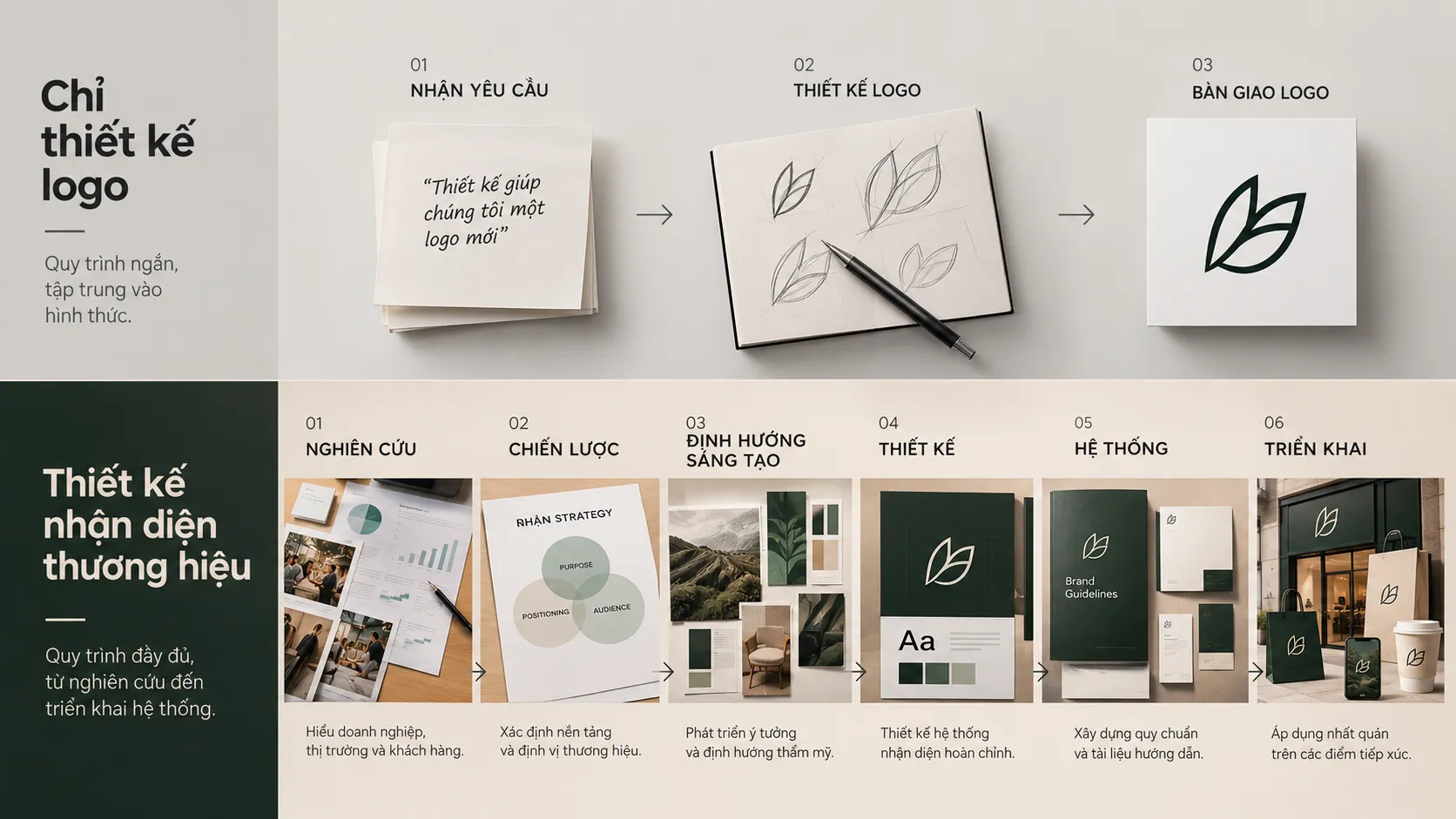
One of the first signs to observe is how the agency organizes its process.
A professional firm usually does not begin by sending over a few logo options right away. It needs time to study the business, the industry, the competitors, the customers and the competitive context before forming a solution.
A process that runs for several weeks leaves room for research, direction, idea development, challenge and refinement of the system. In its original framework, FreshBrand sets a reference point of 4–8 weeks, with research and discovery making up a significant share of the total work.
What to assess is not how many days an agency takes to draw a logo but how much effort goes into understanding the problem before designing.
COMMON MISTAKE
“An agency that delivers a logo fast shows it is professional and experienced.”
Why it is not enough
Speed may suit some simple design needs, but for a brand identity project it cannot be the only criterion. If a solution is produced before the agency understands the business, its competitors, its customers and its goals, the speed may reflect only how fast it produces graphics, not how well it solves problems.
2. The portfolio must prove the ability to solve real problems
The portfolio is one of the most important documents for verifying a partner’s capability.
But don’t look only at whether “the logo is beautiful.” Watch how the agency handles different problems: different industries, different business sizes, different levels of complexity and different touchpoint systems.
A good portfolio should show more than a series of well-presented images. It should help the business see:
- The context of the project.
- The problem to be solved.
- The logic behind the design direction.
- How the identity is developed into a system.
- How well it works at real touchpoints.
Be especially careful when judging hypothetical logos, which are logos designed for companies that do not exist. They may show skill in form-making, but they do not prove the ability to handle the real constraints of a business in operation.
3. Strategic thinking and the ability to ask the right questions
A brand identity partner should not only ask which colors the business likes, what style of logo it wants or which brands it takes as references.
The more important questions lie behind that:
Where is the business now? Where does it want to go? What position are competitors holding? How do customers see the brand? Which advantages need strengthening? What barriers make the brand hard to recognize or tell apart?
FIELD NOTE
In an identity project, the quality of the first questions often directly shapes the quality of the design decisions that follow. When the brief revolves around form, the project easily turns into an argument about taste. When the brief starts from a business problem, design has a basis for becoming a problem-solving tool.
4. The service experience must match the quality the agency promises
An agency can have a good portfolio, but it is the experience of working together that shows its real operating capability.
Watch from the very first interactions:
- Are their responses clear and to the point?
- Do they ask questions to understand the problem, or just take the request as given?
- Is the presentation logical?
- Is the schedule managed clearly?
- Are changes during the work kept under control?
- Is the handover complete and well organized?
Professionalism is not found only in the final design. It shows throughout the course of the collaboration.
5. Reputation must be verified with evidence, not just with introductions
Titles, awards or recognition from professional bodies can be a reference signal. A business should not, however, treat them as the only proof of capability.
What needs verifying is which problems the firm has actually solved and how its output is used in practice.
If an agency cites awards, certifications or recognized work, the business should check the source, scope and context of that recognition.
PRINCIPLE 02
The best reputation is one that can be verified
A list of awards can create initial trust. A clear project record, real clients and the agency’s ability to explain its own decisions are what give a business a deeper sense of real capability.
6. Character and working attitude are part of service quality
A brand identity is a project with many rounds of discussion, challenge and adjustment. The partner’s working attitude therefore directly affects the quality of the collaboration.
Reliability shows in things that seem small: being on time, preparing thoroughly, paying attention to detail, responding responsibly and honoring agreed commitments.
An agency that lacks discipline in its own working process will find it hard to persuade a business that the identity system it creates can be managed with discipline.
7. Testimonials must come from real partners
Testimonials are valuable when they come from clients who have actually been through the collaboration process.
A business can look into:
- Who is the client?
- In what context was the project carried out?
- What scope of work was the agency responsible for?
- How did the collaboration go?
- Is the identity system actually put into operation?
If necessary, the business can ask the agency for contact details of a few clients who can confirm their experience of working together, within the limits of confidentiality.
CHECKLIST
The questions to ask:
- Does the portfolio include real projects, or mostly hypothetical concepts?
- Can the agency explain the problem behind each project?
- Did the client actually roll out the identity system after handover?
- Can at least some of the testimonials or featured work be verified?
8. The cost structure must be transparent
A professional quotation should not be just a single total figure.
The business needs to understand what the investment includes: research, strategy, creative direction, design, the identity system, applications, guidelines, the number of revision rounds and other deliverables.
Transparent costs help both sides understand the scope of work from the start and limit arguments that arise during delivery.
More important, a business needs to tell low price from low value, and high price from high value. A quotation means something only when it is set beside the scope of work, the quality of the process and the capability of the partner.
9. Industry experience is an advantage, but should not be the only criterion
An agency that has worked in the business’s industry has a certain advantage in context. It may understand customers, competitors, touchpoints and market conventions faster.
Industry experience has a side to watch, though: if an agency leans too heavily on what is familiar, it may unwittingly repeat the common identity codes of the sector.
What to look for, then, is not simply “have they worked in this industry before?” but:
“Do they understand the industry deeply enough to avoid common mistakes, yet stay independent enough to find a direction that is fitting and different?”
10. Intellectual property and confidentiality must be settled from the start
Brand identity involves some of a business’s most important assets: strategic data, business direction, internal documents, designs and intellectual property.
The contract therefore needs to spell out the scope of confidentiality, the rights of use and the ownership of the delivered work.
The business should also define clearly what is delivered after the project and the terms of use for each item. This transparency helps limit disputes and protects both sides during the collaboration.
FRAMEWORK
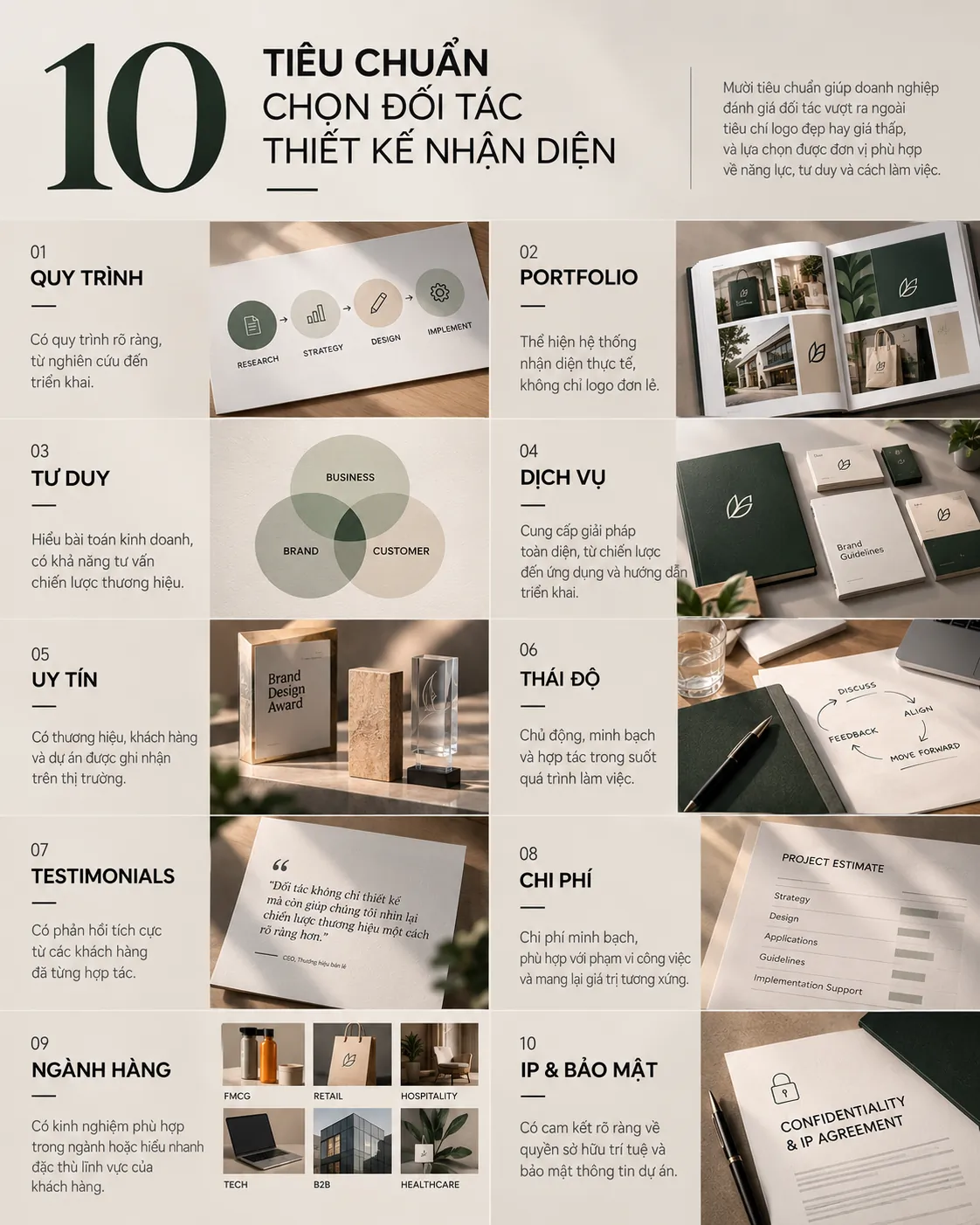
10 criteria for evaluating a brand identity design partner
- Process: Is there research and strategy before design?
- Portfolio: Are there enough real projects to verify capability?
- Thinking: Can the agency question the business problem?
- Service: Are communication and project management consistent?
- Reputation: Can the work, certifications or awards be verified?
- Attitude: Is the team disciplined, reliable and attentive to detail?
- Testimonials: Do real clients confirm their experience of working together?
- Cost: Are the scope of investment and the deliverables transparent?
- Industry: Does the agency understand the industry context and still create difference?
- IP & confidentiality: Are ownership and confidentiality clearly set out?
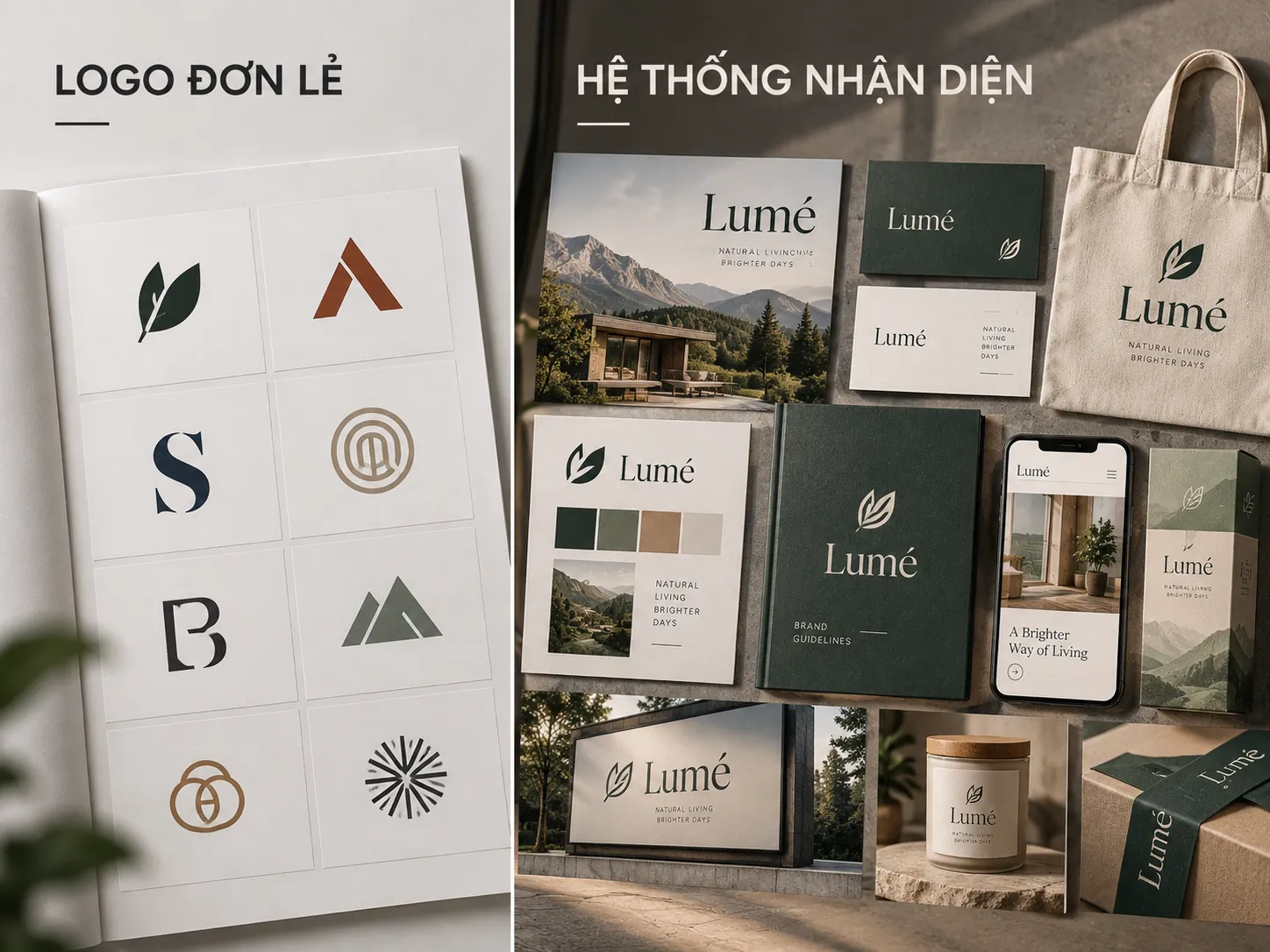
Don’t choose an agency just because it can make a beautiful logo
One of the most common mistakes in choosing an identity partner is to judge the agency by its product without judging the process that produced it.
A beautiful logo can be the result of good form-making skill. But a suitable identity system takes more: research, analysis, positioning, systems thinking, design and the ability to implement.
LESS EFFECTIVE
- Choosing a partner mainly on price.
- Judging the portfolio only by aesthetic impression.
- Starting the project by asking the agency to “sketch a few options.”
- Caring only about the logo and ignoring the application system.
- Treating the contract and intellectual property as a final formality.
STRONGER
- Judge the value of the investment by the scope and the quality of problem-solving.
- Read the portfolio through context, problem and implementation.
- Start by clarifying the brand problem before choosing a design direction.
- Assess how the whole identity system will operate.
- Settle ownership and confidentiality from the start.
A good partner should help the business see more than design
WHAT WE LOOK FOR
When evaluating an identity partner, we usually look first at how they approach the problem, not only at the final image.
- Are they curious enough to ask deeply about the business?
- Can they explain why a solution fits the problem?
- Do they think in systems, or focus only on individual assets?
These questions help tell a firm that supplies design services from a partner capable of engaging with brand problems at a strategic level.
Where does FreshBrand start from on this problem?
Fifteen years on, hundreds of projects have passed through FreshBrand’s work, from businesses seeking to establish their position to organizations already established in the market.
Experience working alongside businesses and brands such as Phan Bon Ha Lan, Camimex, Lasuco, Saigon Commercial Bank (SCB), Qui Phuc, Ton Dong A, Morethan17, Haduco and GOCHARM is part of that process.
FIELD NOTE
What matters is not how many design options an agency can produce but whether it can take a business from a problem full of open questions to an identity system with a logic. Once the strategy is clear, the design no longer has to “shout”; it can become clearer and more consistent at every touchpoint.
FreshBrand does not approach brand identity as a mere change of “appearance.” Every decision about the image has to be set in relation to positioning, customers, the competitive context and how the brand will be run after the project ends.
Choosing a partner is also choosing how the business will build its brand
In the end, the most important question is not “how well does this agency design?”
But:
“Does this agency have the capability to understand the business, pose the right problem and turn it into an identity system that can be used for the long term?”
A suitable partner is not necessarily one whose portfolio matches the business’s current aesthetic wishes. What matters more is that they have a method for finding what the brand really needs.
CHECKLIST
Questions to ask before signing the contract:
- Does the partner understand the business goals behind the identity project?
- Does the process allow enough time for research and direction?
- Does the portfolio prove capability through real projects?
- Can the agency explain the logic of its design decisions?
- After handover, can the identity system work at real touchpoints?
- Are the scope of work and the cost clearly defined?
- Have intellectual property and confidentiality been settled?
- Can the business verify the experience with clients who have worked with them?
FRESHBRAND
If a business is facing a repositioning or needs to rebuild its identity system, the first step is not necessarily to look for a new design template. Start by defining the problem the brand actually needs to solve.
This is also how FreshBrand approaches identity projects: start with a strategic dialogue, clarify the problem and only then turn it into a design system suited to the business’s direction.