
7 pillars of brand building: from strategic vision to market position
A business can have a quality product, a professional identity system and a sizable communication budget, and still fail to win a clear position in the market. The cause usually lies in the missing links between the elements that make up a brand. Brand building is therefore not only an investment in image or promotion; it is a question of strategy, management and customer experience.
KEY TAKEAWAY
A strong brand is built when quality, positioning, adaptability, communication, leadership, long-term vision and internal culture all support one consistent strategic direction.
Brand building is building a system
A brand is not simply a name, a logo or a visual identity. It is also the perceptions and expectations that customers and partners form through their activities and experiences with the business.
A good identity system helps a business get recognized. But to be chosen and to keep customers’ trust, the business has to create real value, establish a distinct position and keep what it promises consistent with what customers experience.
This matters most when a business is scaling up, expanding its product range or reaching new customer segments. Decisions that suited the early stage may no longer meet the demands of the next one.
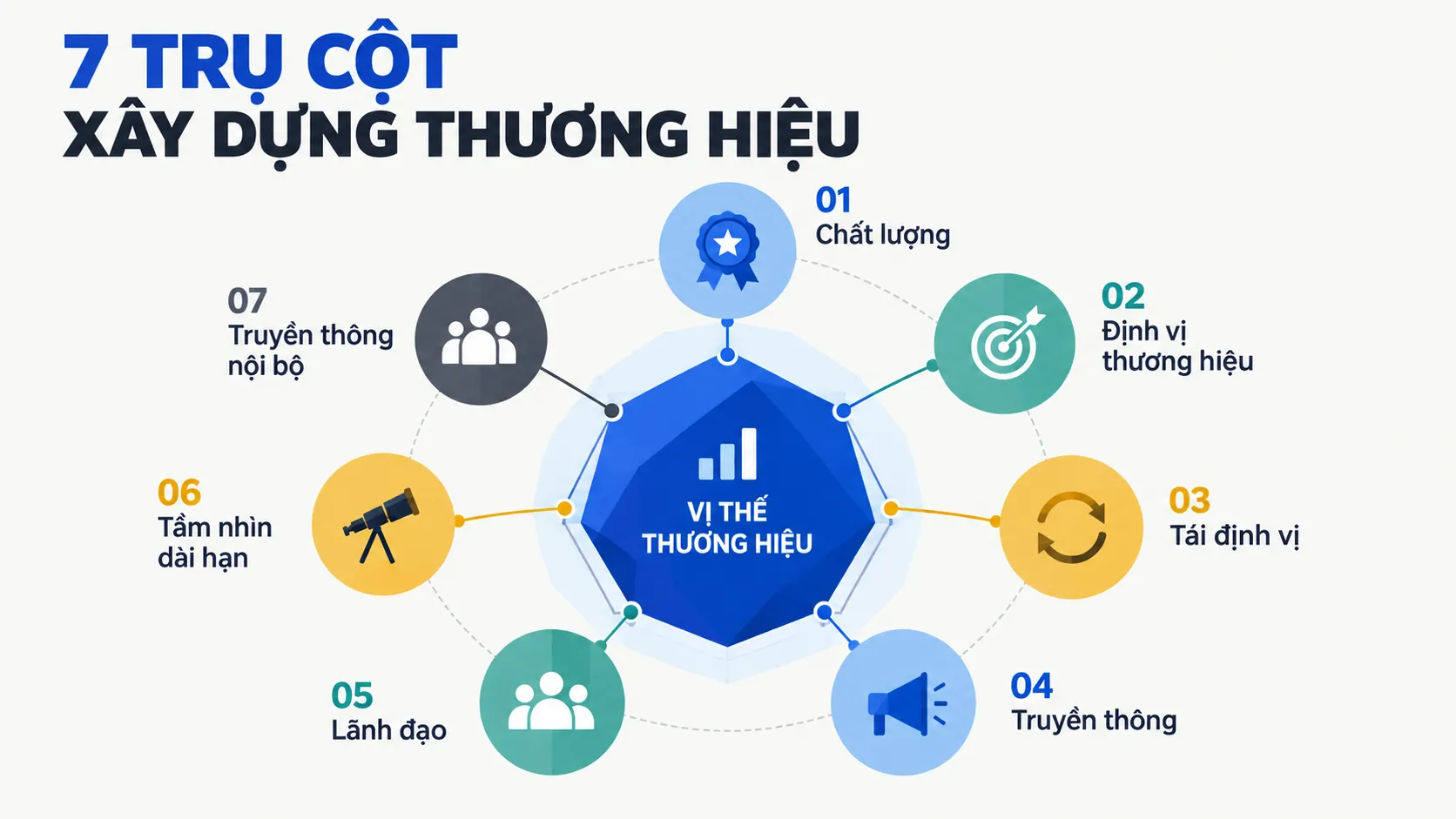
The seven pillars below give an overall view for assessing which factors are supporting or hindering the brand-building process.
1. Quality: the foundation of brand trust
Product and service quality is the foundation on which a business keeps its promises to customers. However appealing the communication strategy, a brand will struggle to keep trust if the real experience repeatedly falls short of expectations.
Good quality, however, does not automatically make a brand distinct.
In many industries, businesses can reach comparable technical standards. Customers then judge a product by more than its features or performance: they also consider convenience, support, reputation and how well it fits their personal needs.
Brand building therefore requires a business to solve two problems at once: creating real quality and helping customers recognize the value of that quality.
Take a business that provides professional services and has an experienced team. If its working process is opaque, its response times are unreliable or its deliverables are hard to evaluate, clients can still feel a lack of trust.
Conversely, when professional expertise shows up in a clear process, consistent service standards and verifiable results, quality becomes the basis of brand credibility.
PRINCIPLE 01
Quality must show in the real experience
Quality creates value when a business maintains its operating standards and helps customers recognize that value at the important touchpoints.
For executives, investing in quality should not stop at improving the product. The business also needs to look at the whole customer experience, from research and purchase to use and after-sales support.
This is what lets quality become a sustainable competitive advantage rather than just a claim in communication.
2. Brand positioning: choosing a competitive position
Brand positioning is the process of deciding which distinct values, compared with competitors, a business wants its target customers to recognize it by and choose it for.
A common mistake is to try to build a brand that meets every need of every customer group.
When a business pursues too many advantages at once, its message loses focus. Customers may recognize the brand but find no clear enough reason to choose it first.
Positioning requires strategic choices: whom to serve, which problem to solve, what value to create and on which dimensions to accept not competing.
FRAMEWORK
Three questions for establishing brand positioning
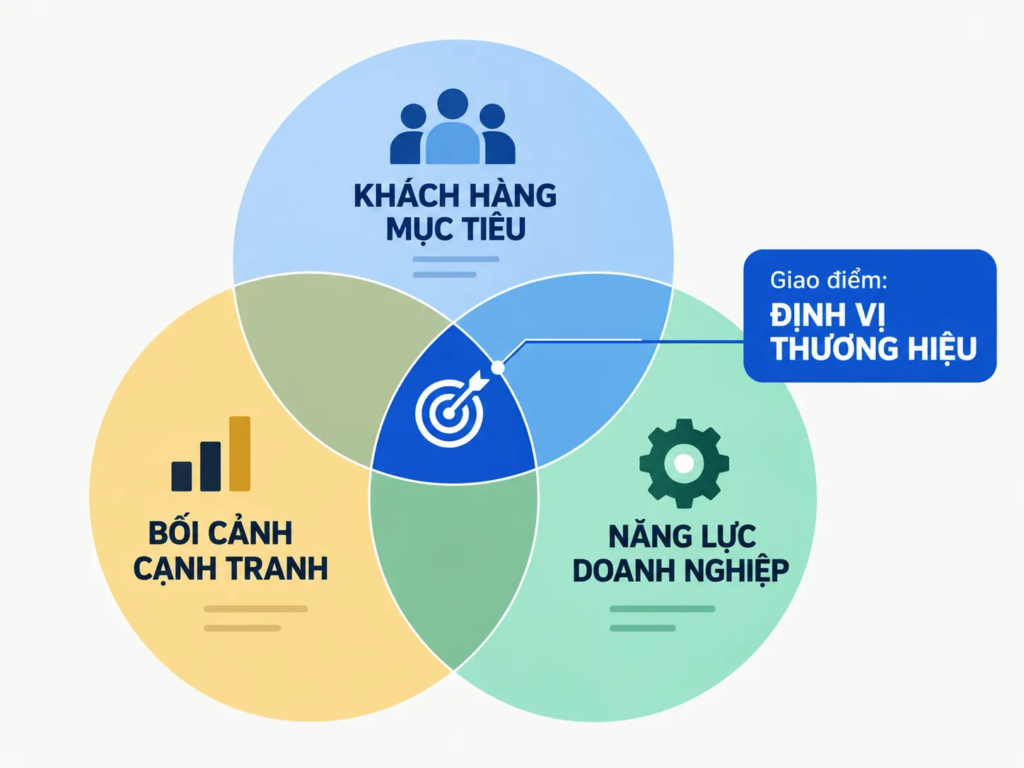
A well-founded positioning should be examined through three factors:
- Target customers Which customer group does the business serve, what do they need, and which criteria influence their choice?
- Competitive context What values are competitors offering, what do they have in common in the market, and which needs remain underserved?
- Business capability What strengths does the business have that are relevant enough to customer needs and can be sustained in operations?
The intersection of these three factors is where a business can look for a fitting competitive position.
An effective positioning does not have to rest on an entirely new attribute. The difference can come from how a business chooses its customers, organizes its service, designs the experience or solves a specific problem better than the existing options.
More important, positioning has to be turned into real decisions.
If a business positions itself on convenience, its distribution system, purchasing process and customer service must reflect that commitment. If it pursues professional expertise, it has to show that expertise through the quality of its advice, its working method and what it delivers.
Positioning does not only determine what a business says about itself. It also guides how the business allocates resources, develops products, sets pricing policy and organizes the customer experience.
3. Brand repositioning: adapting to change
A positioning that once brought success will not necessarily keep fitting when the market, the customers or the business itself change.
As the business grows, the product range widens or the business model shifts, the gap between the current brand image and the company’s real capabilities can keep growing.
This is the moment for a business to reassess its positioning.
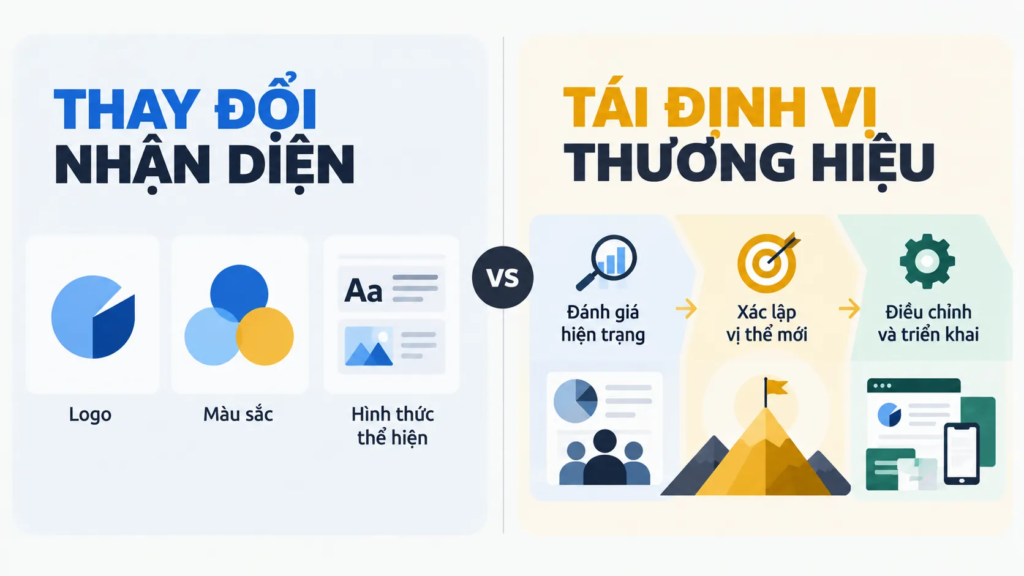
It helps to distinguish brand repositioning from rebranding. Repositioning adjusts the position a business wants to hold in customers’ minds, while rebranding has a looser scope and may include changes to strategy, name, messaging, identity system and the way the brand is expressed.
The two processes can happen together, but they are not the same thing.
A business can reposition without completely changing its identity system. Conversely, redesigning the logo or changing colors is not enough to create a new position if the values and the customer experience stay the same.
COMMON MISTAKE
“Changing the identity means the brand has been repositioned.”
Why that is not enough
The identity is the means of expressing brand strategy. If a business has not defined its target customers, its distinct value and the position it wants, changing its look may only solve an aesthetic problem and leave the strategic cause untouched.
Repositioning should begin with an assessment of changes in the business environment and the gap between current perceptions and the intended direction of growth.
PROCESS
- Current-state assessment Review the brand’s position, customer perceptions, business capability and changes in the competitive context.
- Establishing the new positioning Decide which values to keep, which elements to adjust and the position the business wants to move toward.
- Implementation and validation Adjust the messaging, identity system and related touchpoints, then track feedback to judge how well the new positioning fits.
Repositioning does not mean denying past achievements. In many cases the most important task is to identify the brand assets worth preserving while changing what no longer fits.
The end goal is not to create a new image but to help the brand keep reflecting the business’s values and direction of growth.
4. Brand communication: keeping consistency across every touchpoint
Communication is how a business conveys its positioning, values and brand identity to the audiences that matter.
Communication effectiveness, however, does not depend only on frequency or budget size. What matters is whether customers receive a clear, consistent message across many interactions.
A business may convey a professional message on its website yet use inconsistent language in its sales materials. A brand may promise dedicated service in its advertising and fail to show it in its customer care process.
These differences make the brand experience uneven, even when each communication activity is well executed on its own.
EXAMPLE
Hypothetical example: a B2B business positions its brand on in-depth consulting capability and transparency.
To express this positioning, the website has to present capabilities and working methods clearly. The company profile must give consistent information. The sales team has to be able to explain the value of the service, and the consulting and reporting process must let clients follow progress and understand the basis for each recommendation.
This example shows that brand communication is not just promotion. Every touchpoint either reinforces or weakens the expectations the brand has created.
Even so, consistency does not mean using an identical message or form of expression on every platform.
A website, social media, a company profile and face-to-face conversations each have different characteristics. A business should adapt how it communicates to each context while keeping the same direction in values, tone and identity.
The communication system should therefore be built on a clear brand strategy, rather than letting each department or campaign decide its own way of expressing the brand.
5. Leadership: bringing brand strategy into business management
A brand cannot be built and sustained by the marketing department alone.
The brand’s most important commitments usually bear directly on decisions about product, people, finance, operations and business strategy, all areas shaped by leadership.
So the role of leadership is not only to approve the brand strategy but to turn that strategy into management principles and real decisions.
For example, if a business chooses service quality as its competitive advantage, leadership needs to consider investment in training, quality control processes and the capacity to serve customers.
If a brand pursues innovation, that direction must show in how the business allocates resources, develops products and evaluates new initiatives.
When brand strategy is not backed by management decisions, a gap gradually opens between what is promised and what can be delivered.
FIELD NOTE
One issue to examine when assessing brand strategy is how closely the direction set by leadership matches the way each department carries out its work. If departments understand the core values or competitive priorities differently, the business can deliver inconsistent experiences even with a brand strategy that looks clear on paper.
Leadership also shows in the ability to hold a direction through periods of change.
As a business scales, changes its structure or enters new markets, leadership must decide which brand principles have to be held firm and which elements can be adjusted.
A brand with sound governance should not depend entirely on the personal image of one leader. Instead, vision and values need to be turned into management systems so that the organization can carry on through many stages of growth.
6. Long-term vision: building brand value over time
Brand building is a long-term process. Short-term communication can draw attention, but building trust and a clear position usually takes many consistent experiences over time.
A long-term vision helps a business define the role the brand aims to play in the future, and so make the right investment decisions today.
This does not mean a business must keep every brand element for a long time regardless of how the market changes.
Conversely, a clear vision helps a business tell apart the principles it must hold firm from the methods it can adjust flexibly.
A business might, for example, change its communication platform, refine its identity system or develop new product lines. These decisions still need to support the chosen brand direction rather than produce disconnected changes.
PRINCIPLE 02
Hold the direction firm, stay flexible in how you carry it out
A long-term vision does not require the brand to keep every form of expression unchanged. Its value lies in giving the business a shared direction so that it can adapt without losing what is essential.
From a management standpoint, a long-term vision also helps a business balance immediate business goals against building up brand assets.
Decisions such as widening the product range, entering a new segment or running a promotion should be judged not only by short-term results but also by their effect on positioning and customer expectations.
An activity can bring revenue in the short term while weakening the distinct value the business is building. Conversely, an investment in customer experience or operational capability may not produce results right away, yet it strengthens credibility over the long run.
A brand vision should therefore be used as a basis for decisions, not just a statement about the future.
7. Internal branding: turning strategy into action
A brand is not shaped only by what a business communicates to the market. How employees understand, carry out and represent the brand values also directly affects the customer experience.
Internal communication in brand building, or internal branding, is the process of helping people understand the direction, the values and the behaviors needed to deliver on the brand’s commitments.
This work should not be limited to circulating the vision or introducing a new identity.
Employees need to understand what the brand strategy means for their own work. A shared direction is only valuable when it can be turned into standards and actions that fit each department.
For the sales team, it may be how they advise and explain the value of a product. For customer care, it is how issues are received and resolved. For HR, it is how the company recruits, trains and builds a working environment that fits its values.
When departments share an understanding of the brand strategy and carry it out, the business is better placed to create a consistent experience.
Internal communication, however, is only one part of this process. The business also needs management policies, coordination mechanisms and evaluation criteria that let employees act on the values they have been given.
CHECKLIST
Questions to ask:
- Do employees understand whom the brand serves and what distinct value it creates?
- Have the brand values been turned into specific behaviors for each department?
- Do operating processes and management policies help employees keep the brand’s commitments?
- Does the business have a way to capture feedback from employees and customers to improve the experience?
Effective internal communication narrows the gap between the strategy as planned and what actually happens in the organization.
It is also a factor to emphasize when a business repositions. A new strategy is hard to roll out in step if the internal team still operates on old perceptions and priorities.
How the 7 pillars relate in a brand-building strategy
The seven pillars are not independent operating items. They are closely related and should be managed as parts of one system.
Quality provides the basis for brand commitments. Positioning defines the distinct value and the customers the business chooses to serve. Communication carries that value to the market, while internal communication helps the organization understand and keep the commitments it has made.
Leadership and long-term vision set the direction and keep brand strategy connected to the business. When circumstances change, repositioning lets a business review and adjust its position so that it stays relevant to the market.
Not every business needs to invest in all seven pillars to the same degree at every moment.
A newly founded business may need to prioritize establishing its positioning and perfecting product quality. A business that is scaling up may find it harder to keep departments and touchpoints consistent. A business entering a period of transition may need to reassess its current positioning and brand system.
The key is to identify correctly the factors limiting competitiveness, rather than launching many brand-building activities at once with no order of priority.
Where should a business start building its brand?
Before investing in identity design or launching new communication campaigns, a business should assess how clear and consistent its current brand strategy is.
The assessment should begin with questions that bear directly on customers, competitive position and the capacity to deliver.
FRAMEWORK
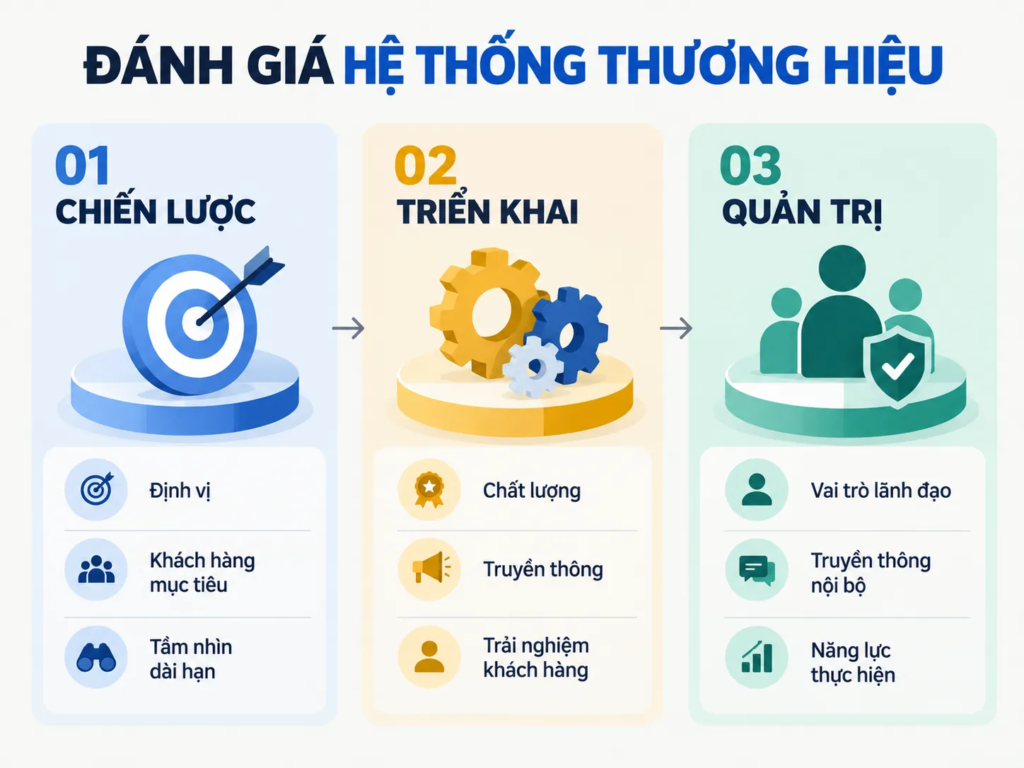
Three levels for assessing a brand system
To set priorities, a business can look at its brand system on three levels:
- Strategy Are positioning, target customers and long-term vision clearly defined, and do they fit the business’s capabilities and direction?
- Implementation Do product quality, communication and customer experience reflect the values the brand promises?
- Governance Do leadership and the internal team share an understanding of the brand strategy, support it and carry it out in daily work?
These three levels help a business tell whether a problem lies in strategy, implementation or management capability.
If the problem lies in positioning, putting more money into communication may only increase the exposure of a message that is not yet distinct enough.
If the strategy is clear but the customer experience is inconsistent, the business should first improve its processes and delivery capability before expanding promotion.
If a business has changed its direction but its brand system still reflects an earlier stage, assessing whether to reposition may become a necessary task.
Brand building therefore does not start with the question of how a business should change its image. It starts by working out what problem the brand has and which changes matter for the business goals.
Conclusion: a strong brand needs strategy and execution to connect
The seven pillars of brand building offer an overall view of the factors a business needs to manage to form and hold its position in the market.
Yet a brand’s strength does not come from having all seven factors as separate items. The real value lies in how they connect.
A clear positioning needs real quality behind it. A consistent communication strategy needs a matching customer experience. A long-term vision has to be turned into specific management decisions and actions across the whole organization.
When these factors point toward the same goal, the brand can grow from an identity system into a strategic asset of the business.
FRESHBRAND
Does the current brand system still reflect the business’s real capabilities and direction of growth?
Reassessing strategy, positioning and the identity system is the first step toward deciding what to keep and what to change. FreshBrand approaches the brand question from a strategic angle, helping businesses examine the link between the position they want and the way the brand shows up in the market.