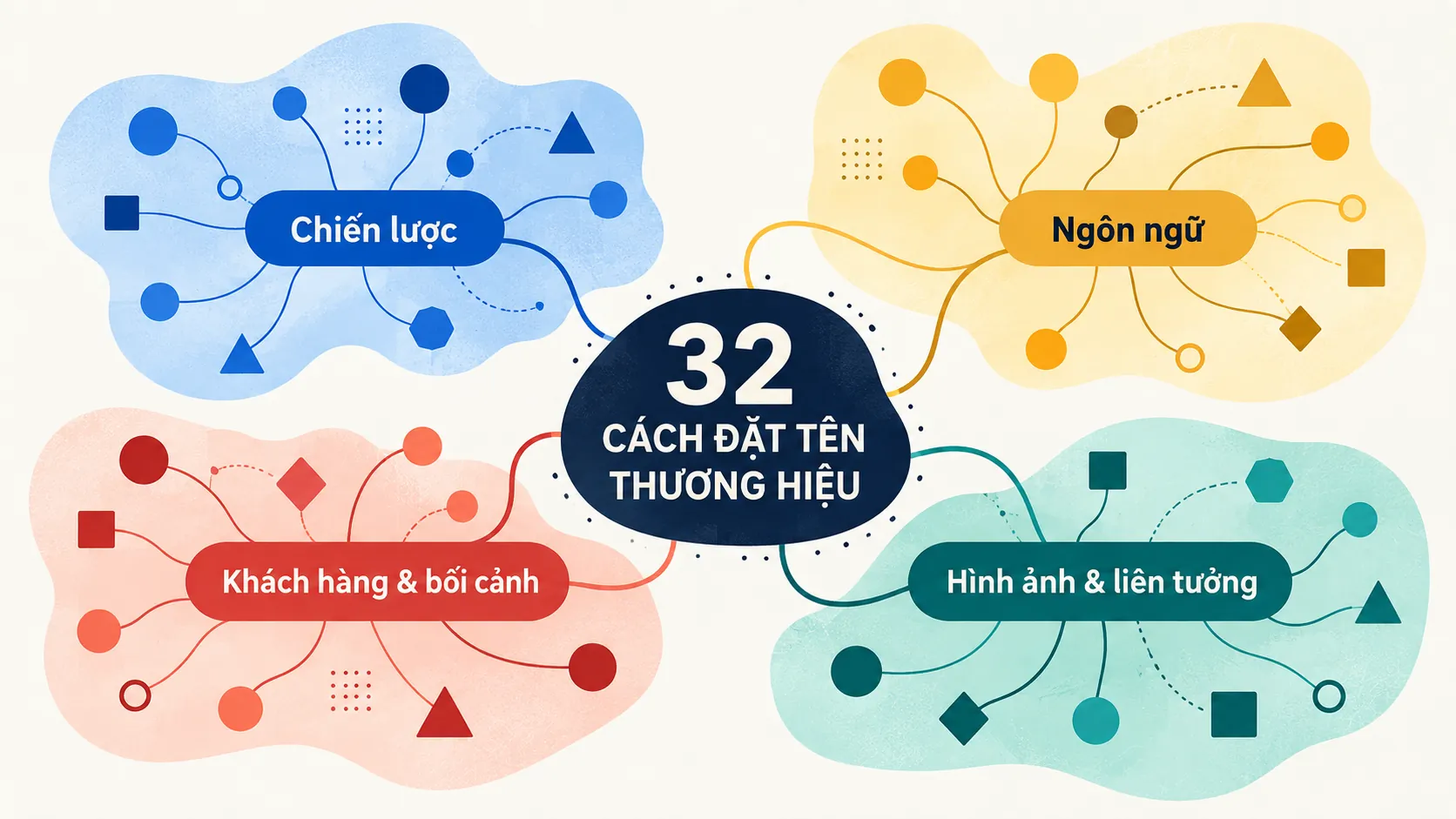
Strategic identity: the weight of a company name

In business, a name is more than what a company is called. It is one of the first touchpoints between a brand and the market, appearing before the logo, before the packaging and often before the product experience. So the naming question should not begin with “Which name sounds good?” but with a harder one: Which name can carry the company’s strategy into the customer’s mind?
KEY TAKEAWAY
A strategic name is not made to sound good in a meeting room; it has to be true to the position the business wants to build and able to live long in the market’s mind.
Why is naming a strategic decision?
Many businesses put a great deal of resources into product, operations, technology and sales, yet treat the brand name as an item to settle at the end. This approach easily leads to a paradox: the company has a clear business strategy but uses a name that cannot express it, or even gets in its way.
A brand name appears in many contexts: when a customer hears someone mention it, when they search online, when they see it on packaging, when an employee introduces the company, when a partner puts it in a document or when the brand expands into a new product.
This gives a name an important characteristic: it is not only a communication asset but also a component of the brand system.
If a name is too long, the business may struggle to communicate it. If it is too generic, its power to differentiate is weak. If it is tied too tightly to a current product, place or business model, it can become a limit when the business expands.
By contrast, a name built on the right strategic foundation can become an anchor around which the other components of the brand develop.
PRINCIPLE 01
A brand name has to solve the business problem before it solves the aesthetic one
A name can be easy to read, easy to remember and pleasant to hear, and still not be a good name if it does not fit the business’s direction, position, target customers and potential for growth.
A name is not “beautiful,” but “right”
 alt=”Diagram of four naming criteria: minimal, distinctive, speed of recognition and systemic.” class=”wp-image-35348″/>
“Beautiful” is a judgment of feeling. “Right” is a judgment against a frame of reference.
This is an important distinction when a business begins naming. A name may be loved by many people inside the company, but that alone does not prove it has strategic value. Conversely, a name that looks plain at first can grow stronger once it is set in the right positioning context.
So instead of starting with a list of attractive-sounding words, the naming process needs to first define what the name must be able to do.
FRAMEWORK
Four layers of testing for a strategic name
- Minimal: A name should avoid unnecessary complexity in pronunciation, recall and display. Simplicity makes a name easy to use again and again across many touchpoints.
- Distinctive: A name needs to stand out within its industry and, at the same time, be considered for how protectable it is. “Different” here does not mean strange; the aim is a name with room of its own to be recognized.
- Speed of recognition: People need to be able to read, hear or sense the name without much effort to process it. Part of a name’s value lies in how quickly it is recognized and associated.
- Systemic: The name must be able to become a foundation for the logo, typography, colors, packaging, space, brand language and other touchpoints. A good name does not make the identity system hard to develop.
These four layers do not work separately. A name can be highly distinctive but hard to pronounce; memorable but too narrow in scope; or meaningful but unable to provide a flexible visual foundation.
So the naming problem is not finding a word that is perfect on every criterion taken separately. It is finding the balance point that fits the brand strategy.
Smart naming starts from strategy
One common mistake in naming is starting with language too early.
The business asks the agency for “a few dozen names” and then picks the ones that sound best. This turns a strategic problem into a popularity vote on taste.
But before there is a name, some foundational questions need answers:
- What does the business want to be known for?
- Where does the brand need to stand out?
- What should the target customers feel when they hear the name?
- Should the name point directly to the industry, or can it carry a broader layer of meaning?
- Does the business plan to expand its products, services or markets?
- Will the name be used mainly by reading, seeing, writing or a mix of all three?
- How can the name grow into an identity system and a brand architecture?
These questions help change how naming is seen.
Instead of asking “Which name do we like?”, the business starts asking “Which name best serves the position we are building?”
COMMON MISTAKE
“A name that’s easy to remember and sounds good is enough.”
Why that is not enough
Being memorable is only part of the problem. A name also has to fit the positioning, create differentiation, avoid becoming a limit as the business grows and be able to integrate into the whole identity system. If a business optimizes only for first impressions, it may pay for it in later stages.
Corbett Canyon: a lesson in connection
 alt=”Landscape of a central California canyon evoking the name Corbett Canyon.” class=”wp-image-35349″/>
In the wine industry, a name often competes not only on memorability but also on the story, origin and impression it creates.
Corbett Canyon is an example used to look at a different approach: instead of trying to craft a name that sounds impressive or fancy, a name can be tied to a geographic feature and the story of a place.
The “Canyon” in Corbett Canyon evokes a canyon and the land of central California. What stands out here is not how beautiful the name is as language, but the relationship between the name and the context the brand wants to occupy in the customer’s mind.
EXAMPLE
Picture a consumer encountering the name Corbett Canyon in the context of wine. The name does not serve merely as a label that tells products apart. It can open up an association with a place, a land and an origin.
This points to an important principle of naming: the meaning of a name does not have to sit entirely in the words themselves; it can be formed from the link between the name, the brand story, the product and the experience the business keeps building.
A name therefore does not need to “tell the whole story” from the start. It needs to provide a foundation suitable enough for the brand to deepen that story over time.
FIELD NOTE
In brand-building practice, customers rarely judge a name in isolation. They see it together with the logo, packaging, product, space, message and experience. A name that has meaning but is not supported by the brand system can quickly lose its early advantage; conversely, a fairly simple name can become rich in meaning when it is used consistently.
Name and identity system: why can’t the two problems be separated?
A brand name usually appears before, or together with, the visual identity. So how well the name translates into imagery is an important criterion.
A well-structured name can open up many directions in typography, logo, symbol, color or visual language. An overly complicated name can make these elements heavy.
That does not mean a name has to be “easy to design a logo for.” That view is too narrow.
A better question is: Does the name provide a clear enough foundation for the identity system to grow without constantly having to explain itself?
This is also why naming should come before a business rushes into logo design. When the name, positioning and strategy are unclear, design often has to carry a task beyond its ability: trying to explain what brand strategy has not yet defined.
WHAT WE LOOK FOR
In the naming process, what deserves attention first is not which name sounds the most “impressive,” but which name still holds up when placed in real-use situations.
- Is the name easy to take in when spoken aloud?
- Is the name clear when written across touchpoints?
- Does the name create unnecessary confusion with another industry or brand?
- As the business expands, does the name still fit?
A good name has to be able to live through many stages of a business
A business does not stand still.
A brand may start from one product and later widen its range. A company serving one group of customers may move into a new segment. A business operating in one market may grow into another.
So name identity needs to look beyond the launch.
A name should be tested in at least three states:
A NAME OPTIMIZED FOR NOW
- Describes the existing product or service very closely.
- Easy to understand in today’s context.
- May become limiting if the business scope changes.
A NAME WITH ROOM TO GROW
- Fits the current position but does not lock the brand into a single product.
- Has room to build meaning through communication and experience.
- Can support expanding the brand system as the business grows.
This difference matters especially for businesses investing in their brand for the long term. A name must solve not only the problem of “launch” but also stay with the business through its next decisions.
Name identity is not a contest of verbal creativity
 alt=”Diagram of the naming process: foundation, name territory, development, testing and due diligence.” class=”wp-image-35350″/>
There is another misunderstanding to clear up: the belief that naming is mostly a search for lots of new words.
Wordplay is only the visible part.
The harder part is working out what the business needs that name to do.
Only from there can different naming directions take shape: based on meaning, association, language structure, product features, place, brand values or ideas the business wants to own.
A good process does not try to prove that the creative team can come up with a great many names. It has to help the business understand why one name direction deserves to be chosen over another.
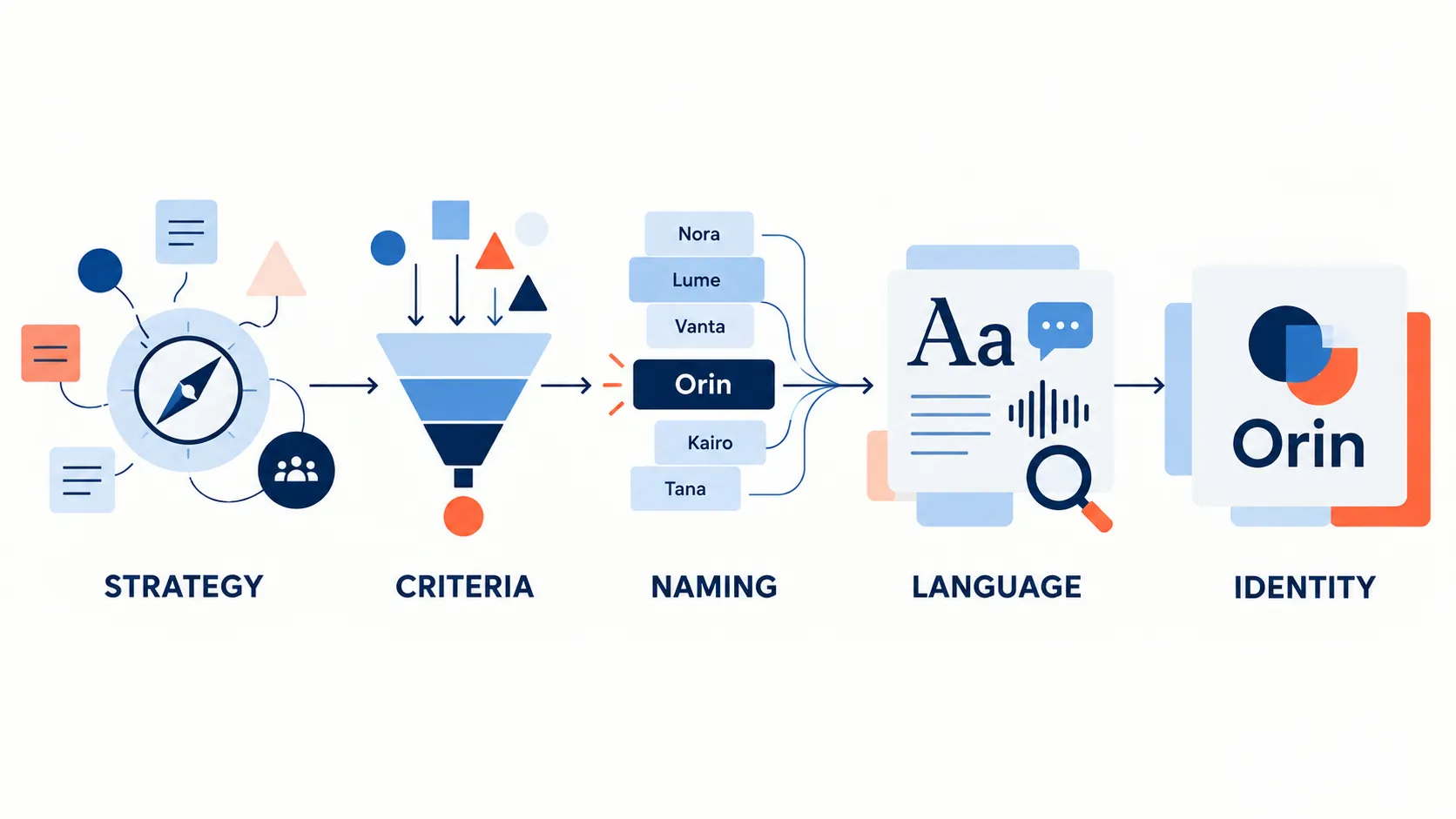
PROCESS
- Define the foundation: Clarify the positioning, audience, differentiation and growth direction before searching for names.
- Build the name territory: Define the fields of meaning and association the brand can own.
- Develop options: Generate and screen names against strategic, linguistic and usability criteria.
- Test the system: Place the name in real-use contexts to judge how well it can grow into an identity and a brand experience.
- Due diligence: Review the conditions for use and protection before making the final decision.
This process shows one thing: naming is not the step of finding a word; it is the process of reducing risk before the business invests in building meaning for that word.
When a name becomes a brand asset
When a name first appears, it has little value of its own. That value forms gradually through what the business does under that name.
Customers buy the product, experience the service, hear the brand mentioned, see the identity appear and form new associations. Over time, the name becomes the place where those memories and perceptions gather.
This is why you should not expect a new name to carry all of the brand’s value on its own.
A name can create a starting point.
It is the business that builds the name’s meaning, through what it does.
CHECKLIST
Questions to ask:
- Which brand position is this name serving?
- Can customers read, hear and recognize the name with ease?
- Is the name distinctive enough in its industry?
- Can the name grow with the business in the future?
- Can the name become a foundation for the identity system and the brand experience?
- Has the business checked the necessary conditions before deciding to use it?
The FreshBrand view: Creating, not just naming
FreshBrand sees naming as a problem at the intersection of business strategy, customer perception and the brand system.
So the goal is not to produce a list of “good” names. It is to find names with a clear reason to exist: names that fit the business direction, leave room to differentiate and are flexible enough to grow with the brand.
A distinctive name is not valuable just because it is different. It is valuable when that difference serves a clear purpose.
When evaluating a naming option, the final question is usually not “Do people like this name?” The more important question is: if the business really uses this name for many years, does it have enough of a foundation to build brand assets around it?
That is the difference between coming up with a name and establishing a name identity.
From a name to a position
A name cannot replace a business strategy. Nor can it create a strong brand on its own.
But it can become the starting point for how the market recognizes, names and remembers the business.
When a name is chosen well, the business has a language foundation on which to build identity, communication and experience. When it is chosen on feeling alone, the investments that follow may have to work harder to make up for an unsuitable foundation.
Strategic name identity is therefore not about finding the “most beautiful” name.
That means working out the name that best fits the business you are building, and the business you want to become.
FRESHBRAND
If a business faces the task of naming a new brand, a new product or a repositioning, the first question is not necessarily “What should we call it?”
Start from the question: “What does this brand need to be remembered for?”
That is the starting point for a name to move from a choice of words to a well-founded naming decision.