Brand naming process: 10 steps to lay the foundation for a brand
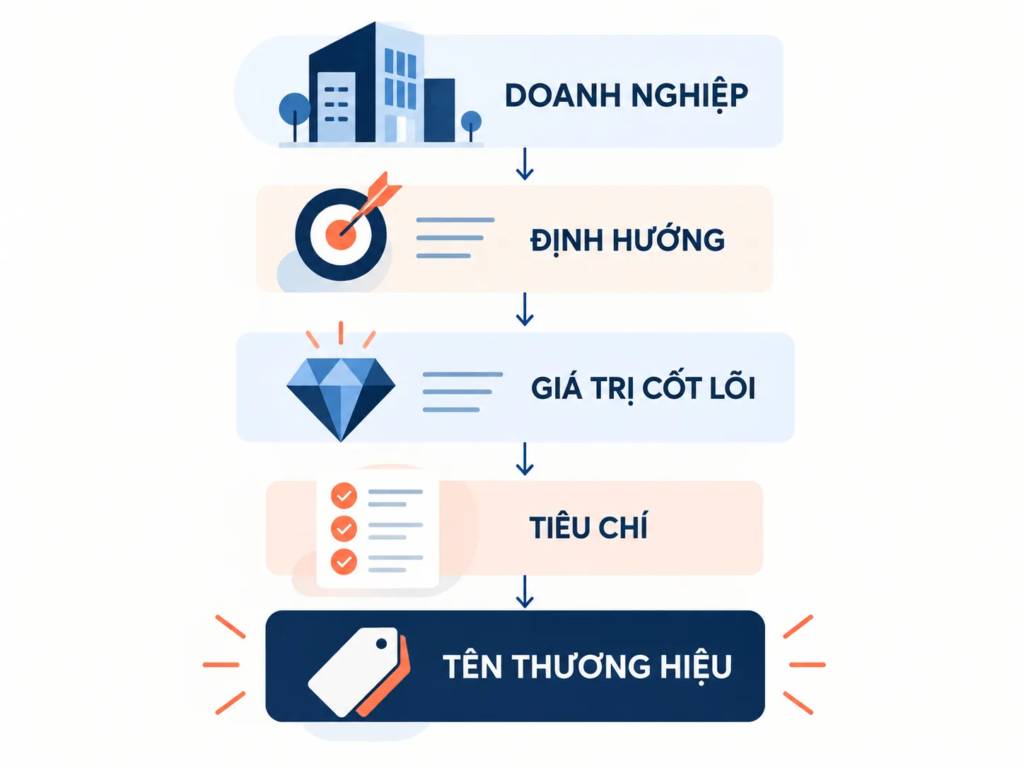
A brand name should not be created from instinct alone, a list of keywords or a few ideas that merely sound “good”. When a business prepares to launch a new brand or renew an existing one, the more important matter is to decide what it wants to be known for, whom it serves and how it creates value. Only on that foundation does the naming process have enough to go on to move from strategy to the choice of a name, an identity and a brand system.
KEY TAKEAWAY
A good brand name does not start with coming up with a nice name, but with clarifying what the business wants to stand for.
Why must brand naming start from clarity?
In brand building, clarity helps a business align how it sees itself with how it wants the market to recognize it. When purpose, direction and core values are made clear, customers, employees and other stakeholders also have a better basis for understanding what the business is pursuing.
This matters especially for brand naming. A name can be short, memorable or pleasant to hear and still be unsuitable if it is not tied to the brand’s long-term direction.
So before looking for names, the key stakeholders, budget, scope of work and the project’s foundational documents need to be identified. This part is often overlooked, yet it determines the quality of every step that follows.
PRINCIPLE 01
Strategy must come before the name
A brand name is an expression of strategy, not the starting point of strategy. When it is not yet clear what the brand wants to stand for, naming easily becomes an argument over personal taste.
10 steps of brand naming and brand renewal
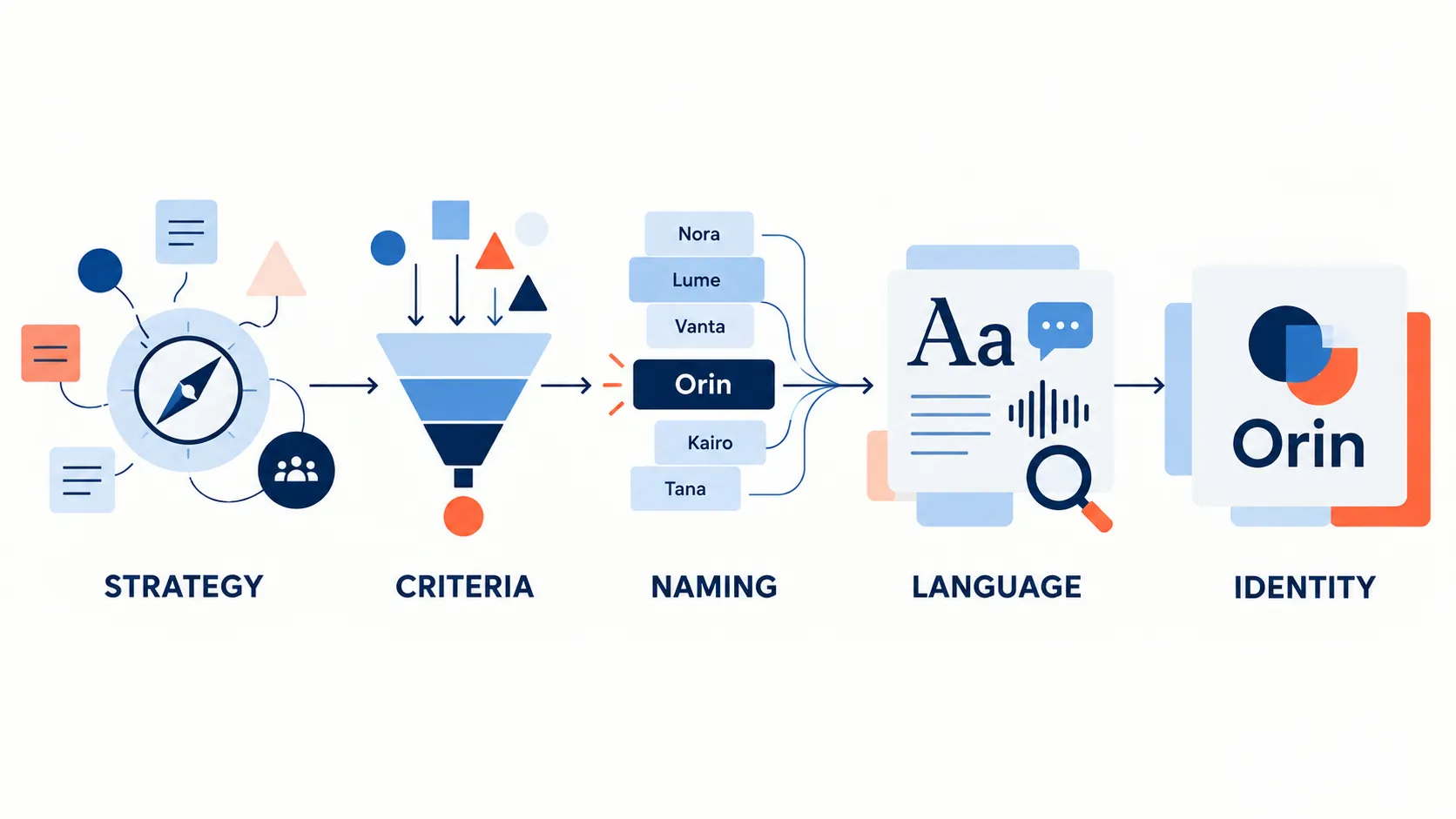
A brand naming process can be organized into 10 steps, from gathering information, strategic analysis and setting criteria to developing names and identity and finalizing the handover system.
1. Gather: Collect foundational information
The process begins with a formal meeting with stakeholders. The goal is not to find a name immediately but to understand where the business stands, what the current problem is and what the project needs to achieve.
At this stage, the business may already have a few favorite names. There may also be names that were considered but could not be used because of trademark conflicts, domains that were already registered, or other reasons. In some projects the problem runs the other way: the team has spent too long searching for names without knowing which criteria to judge them by.
Documents such as the business plan, creative brief, presentations or other related marketing materials can all help the working team understand the project’s goals better.
At this step, the most important thing is to listen, gather information and ask the right questions.
PROCESS
- Gather information — Collect the business context, existing ideas, marketing materials and the project’s constraints.
- Define the scope — Clarify stakeholders, budget, timeline and key milestones.
- Clarify the problem — Determine whether the business needs a new brand, a new name or a broader brand renewal.
2. Analyze: Identify the crux
Once enough background information is in, the next step is to analyze the essence of the business.
A common mistake is to start right away with the question: “How are competitors naming themselves?”. Competitive analysis has value, but first it is necessary to understand what space the business is really competing in.
Apple is an example often used to illustrate this approach. If Apple is seen only as a “computer” company, its positioning is limited by its direct rivals in the computer industry. A broader view of the values the brand wants to stand for allows the business to build a more distinctive position.
The key point here is not to equate the brand with the product or service the business sells.
EXAMPLE
Picture a business offering a professional service. If the brand is described only by its industry and type of service, the name can quickly end up resembling many competitors. But if the business defines clearly how it creates value, the experience it wants to deliver and the core attributes it needs to be remembered for, there is far more room to create a name.
This shows that naming is not simply finding a new word. It is the search for a way of calling the brand that connects with its ultimate benefit, value proposition and core strengths.
3. Specify: Write the creative brief
Once the crux is identified, those insights need to be turned into a clear creative brief.
A brand name may need to feel strong, bold and fresh. Another brand may need to be perceived as trustworthy and consistent. Some brands want to spark curiosity; others need to convey information directly.
So the creative brief should clarify:
- Brand personality and temperament.
- How the brand wants to be perceived.
- Primary and secondary target markets.
- Messages likely to suit each audience group.
- How the brand name needs to support overall positioning.
This document gives the project team a common reference point before entering the creative phase.
FRAMEWORK
A good creative brief needs to answer three layers of questions
- Who is the brand? — Personality, direction and how the brand wants to be recognized.
- What does the brand want to say? — The promise, message and attributes to be conveyed.
- Who is the brand speaking to? — The target audience and the kinds of messages likely to suit them.
4. Prioritize: Create brand criteria
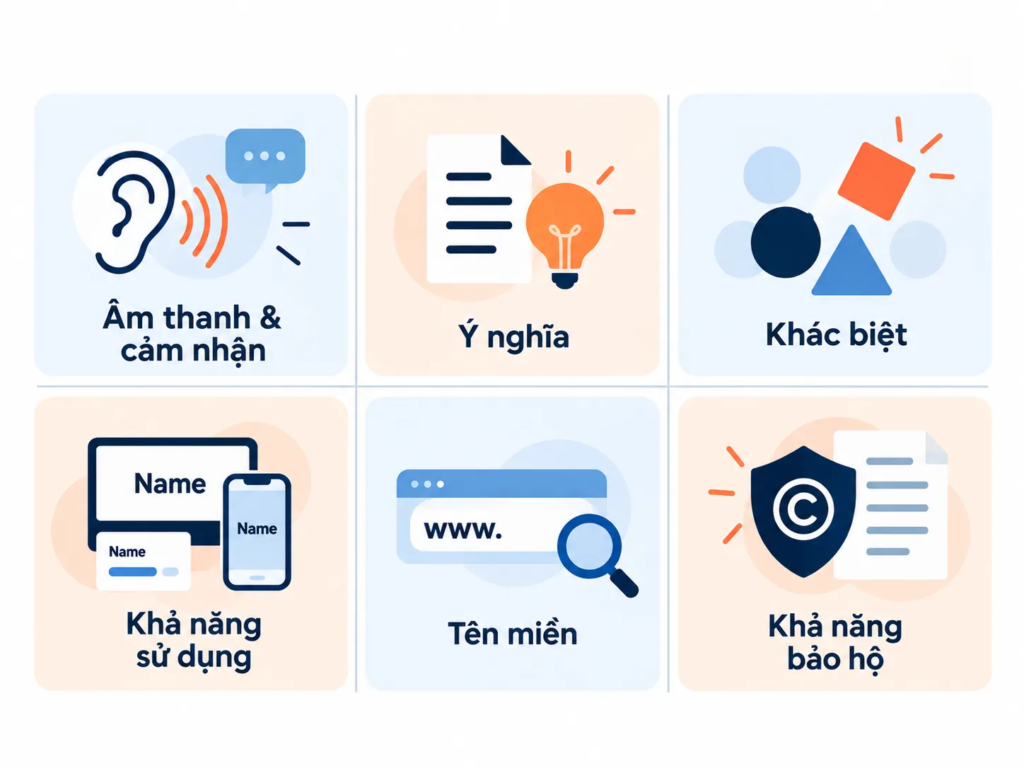
Once there is a direction, it is necessary to decide which criteria matter most for the brand name.
It may be the sound and feel of the name. It may be the meaning. It may be the degree of originality. In some projects, being able to own a suitable domain can also become an important criterion.
The issue is that these criteria do not always carry equal priority.
Without deciding in advance, the team may let a minor factor drive the whole decision. For example, a name with a very pleasant sound may be favored even though it does not fit the positioning or is hard to use in the markets the brand is aimed at.
COMMON MISTAKE
“A name that sounds good is enough.”
Why that is not enough
Personal feeling is only one part of evaluating a name. A suitable name has to be considered in relation to positioning, meaning, usability, distinctiveness and the practical conditions of the project. Setting criteria first helps the team depend less on personal taste and gives it a shared basis for choosing.
5. Ideate: Concept and development of the brand name
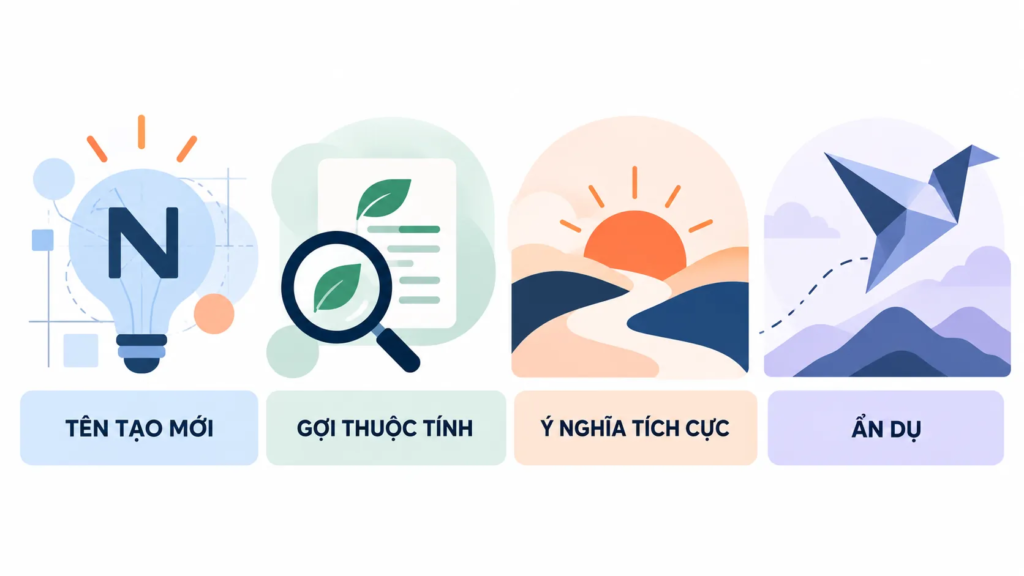
This is the stage of moving from strategy to creativity.
There are several different naming strategies. A brand may choose a newly coined name that carries no direct meaning at first, as in the Xerox example in the source material. Another name may directly evoke the attributes of the business, or use words with positive associations, such as OnStar and TruGreen. Others rely on metaphorical imagery, such as Jaguar or Amazon.
No single naming strategy suits every business. The choice depends on what the brand needs to convey and how direct or indirect the name should be.
Once the direction is set, the creative team can explore hundreds or thousands of possibilities to find names that meet both the strategic goals and the brand criteria.
A shortlist may be around 12–15 names to take into the evaluation round. Each name should come with a short explanation of the idea, how it can support positioning, domain information, and a preliminary check of protectability within the scope of the project.
FIELD NOTE
In practice, a long list of names does not mean a good creative process. The value lies in being able to explain why a group of names deserves consideration, which direction each serves and how it meets the criteria that were agreed on.
6. Select: Evaluate and refine
After the first presentation round, the process does not end with a vote for the favorite name.
Discussion among stakeholders often produces new perspectives. Someone may spot an association no one had seen. A name may open up a new interpretation. Or a name that first went unnoticed may fit better once it is placed in the strategic context.
That is also why the naming process needs rounds of evaluation and refinement.
The aim of this stage is to find the essence of the brand and to check whether the story behind the name is becoming clearer.
7. Choose: Pick the best-fitting name
Typically, the process may need one to three rounds of names to find a suitable candidate. The final name does not always appear in the first round.
A name needs to be tested in many real situations:
- How is it used in a sentence?
- Where will customers see it?
- Is it easy to say and remember?
- Can it be used in different brand contexts?
- Can it grow into a way of calling things, or a verb, in the brand’s language?
- Will it still fit if the business expands its products or services?
At this step, the name is no longer evaluated as a stand-alone word. It is placed into the system it will live in.
Depending on the scale and requirements of the project, the business can also carry out brand research, name validation or linguistic evaluation to have more grounds before deciding.
LESS EFFECTIVE
- Choosing a name only because the decision maker likes its sound.
- Evaluating the name apart from brand positioning.
- Testing the name only as a stand-alone word.
- Treating the choice of a name as a purely aesthetic decision.
STRONGER
- Evaluating names against the agreed criteria.
- Naming within the strategic context and target market.
- Check how the name works in a sentence and across touchpoints.
- Weighing meaning, feel and usability together.
8. Develop: Build the brand’s language foundation
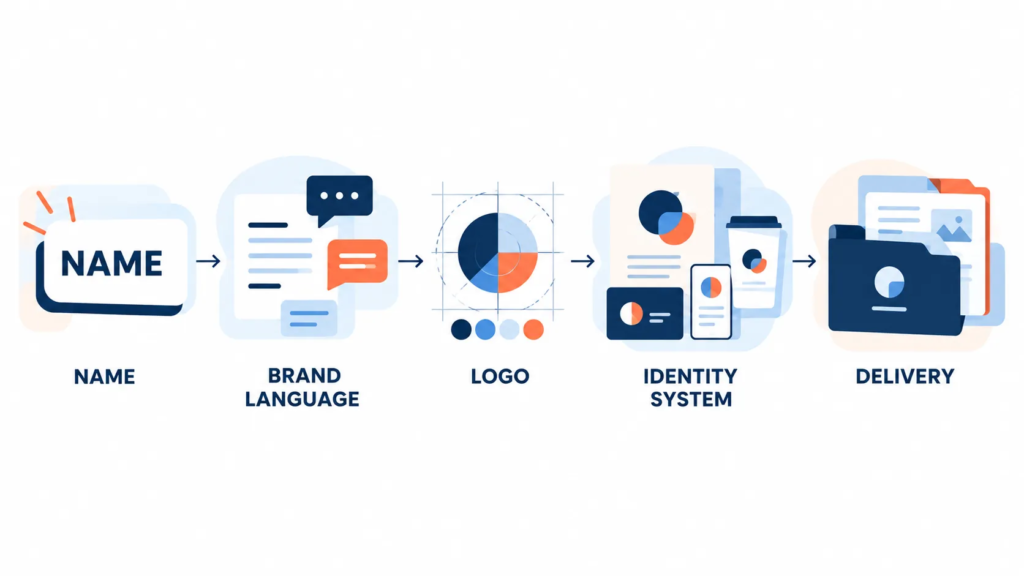
A brand name should not be the end point of the language process.
Once there is a name, a marketing “vocabulary” needs to be developed so that later messages share the same direction.
In the source material, the example of a client in medicine centers on ideas such as standing up for clients, defending their cause and putting yourself in their position. For a client in financial planning, the language system instead revolves around ideas such as reaching goals, climbing higher and having a higher vantage point.
Such groups of words and ideas give the brand more material to develop headlines, advertising messages, website content and other touchpoints.
The key point is that the language system must come from the brand’s strengths and direction, not just be a list of loose slogans.
9. Visualize: Develop identity and logo
Once the brand name, language direction and domain are settled, the next step is to develop the visual identity.
The logo at this point should not be seen as a standalone design exercise. It needs to reflect how the brand wants to be perceived and support the message defined in earlier steps.
One approach is to look at logos the business admires in other industries to understand the visual direction it wants. The design team can then develop several logo directions, gather feedback and keep refining.
The source material describes providing roughly three to five logo directions in each round, then selecting and refining based on feedback.
Some projects focus on strong visual expression. Others need to put a sense of trust and credibility first. So the logo treatment should come from the brand’s specific requirements, not from one fixed style applied to every project.
WHAT WE LOOK FOR
In a brand process, the first thing to look at is not whether the logo is “beautiful”, but what the logo is helping the brand express.
- Does the logo suit the message that was defined?
- Does the visual treatment suit the brand’s personality?
- Can the identity system keep working beyond the logo alone?
10. Finalize: Standardize and hand over the system
Once the logo is approved, the project moves to finalization and handover.
Graphic files need to be prepared in formats suited to different uses such as print, web design and signage fabrication. Information about the logo’s typeface and its PMS colors also needs to be specified, so there is a reference for later use.
The necessary domain information is also handed over so the business can continue to implement.
This is the step that turns strategic and creative decisions into assets that can be used in real operations.
CHECKLIST
Questions to ask before completing the brand naming process:
- Has the brand defined clearly what it wants to be known for?
- Have stakeholders agreed on the goals and the criteria for evaluating names?
- Does the chosen name fit the brand’s positioning and personality?
- Has the name been tested in real usage contexts?
- Have domain and protectability issues been considered within the scope of the project?
- Has the language system behind the brand name been developed?
- Do the logo and identity reflect the brand’s direction accurately?
- Have the necessary assets and guidelines been standardized for handover?
Brand naming is a strategic decision, not an idea contest
A good brand naming process does not need to produce thousands of names to prove its creativity. Its value lies in helping the business understand what kind of name it needs, why that name fits and how it will work across the whole brand system.
From gathering information to analysis, from setting criteria to ideation, selection, and developing language and identity, each step has its own role. When the steps are connected, the brand name is no longer a word chosen at the end of the process but part of the foundation for positioning and expressing the brand.
FRESHBRAND
If a business is preparing to choose a new name or renew its brand, the first question is not necessarily “Which name is good?”. The more important question is: what does the brand need to be remembered for, and how will the name make that clear?
FreshBrand can start from that strategic question to set the naming direction, the evaluation criteria and the link between the brand name and the identity system that follows.