32 ways to name a brand: from strategy to creative naming techniques
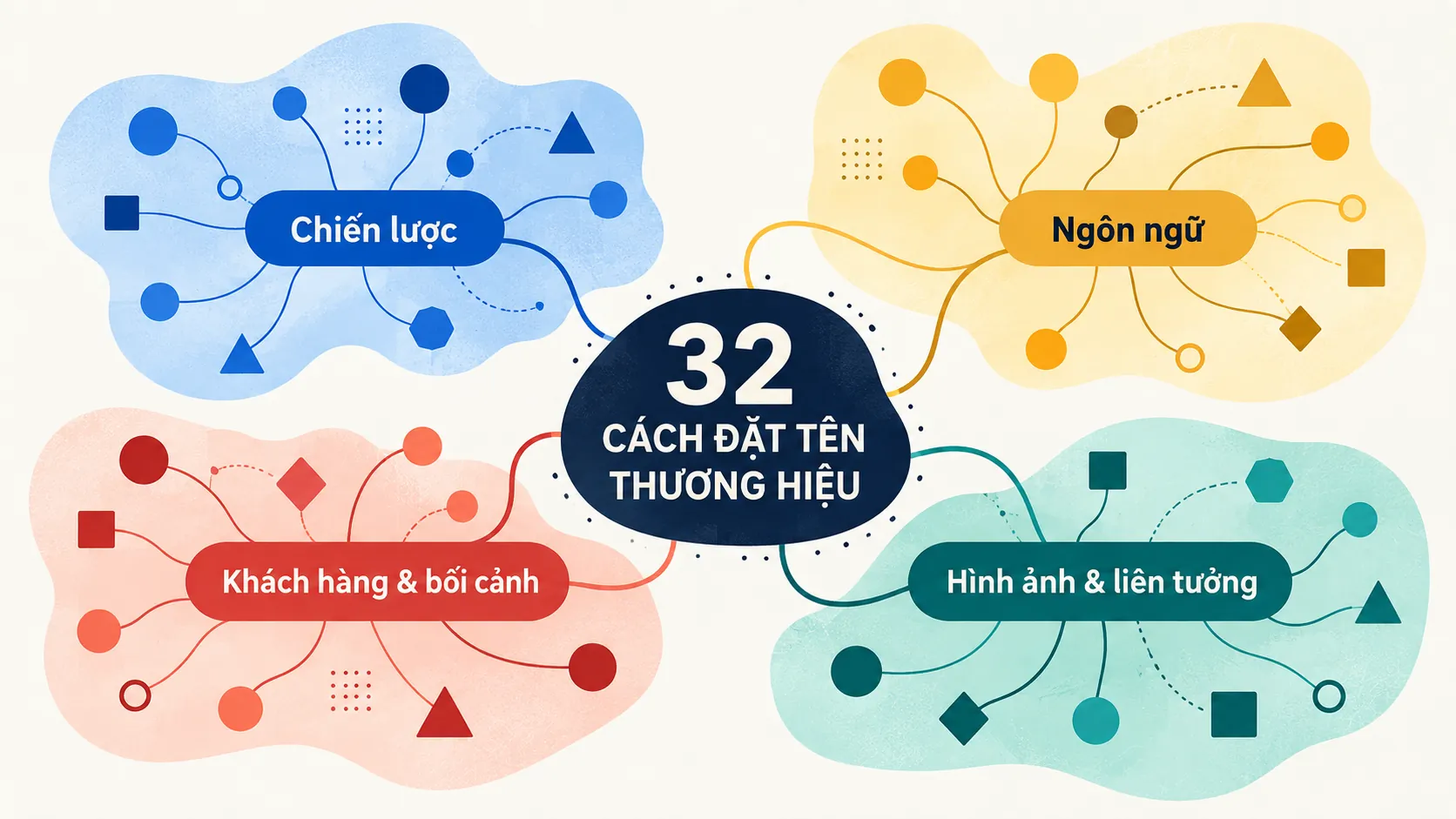
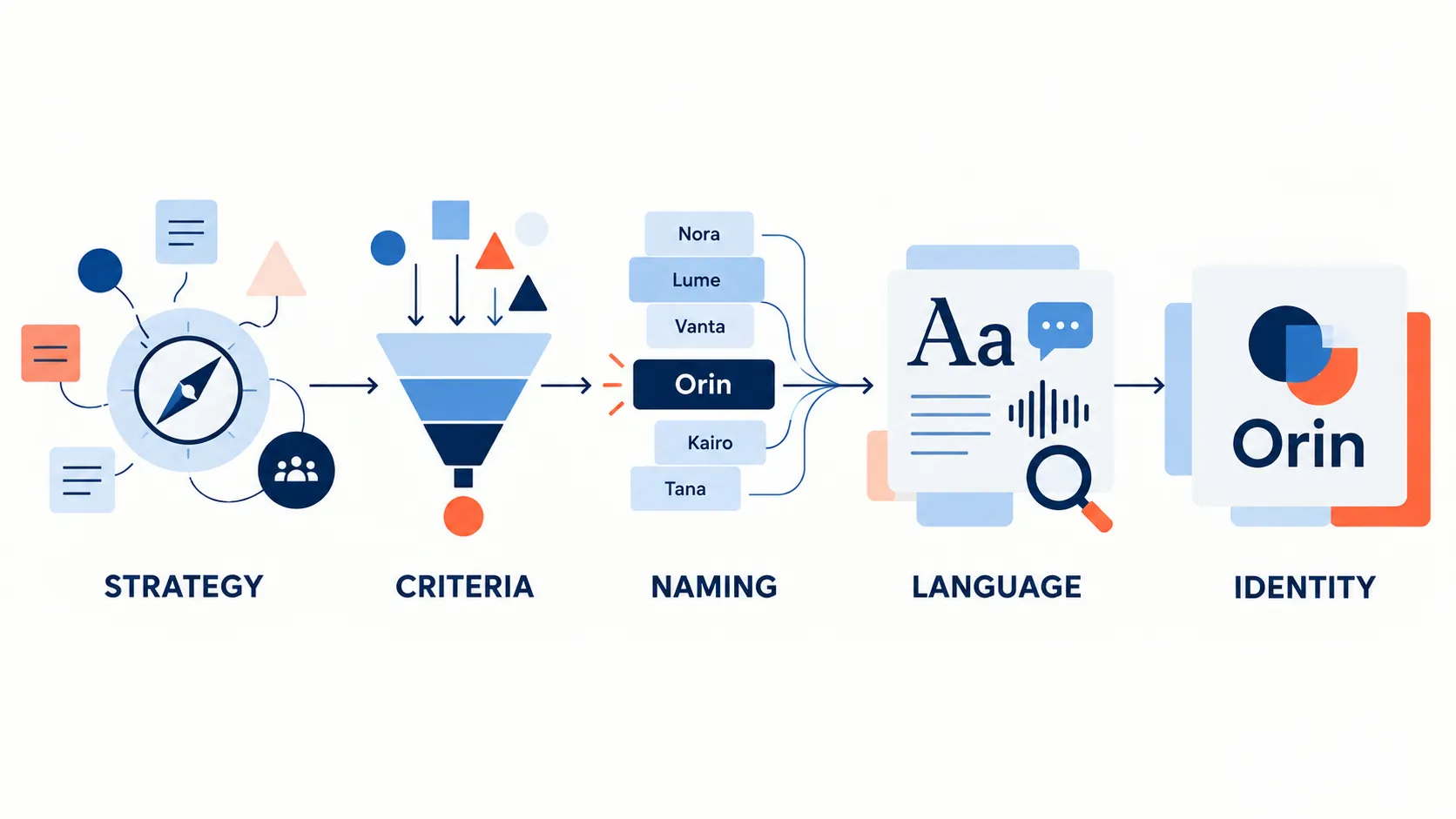
Naming a brand is often treated as the search for one great word, but the real difficulty lies elsewhere: the name has to fit the business direction, be easy to recognize and use, and stand apart in a competitive field. A good naming process therefore does not start by trying to think of the “perfect name”; it starts by setting criteria, opening up as many creative directions as possible, and only then evaluating.
KEY TAKEAWAY
A good brand name needs more than creativity; it must create associations that fit what the business wants to be remembered for.
1. Start from strategy, not from a list of names
Before thinking about unusual spellings, compound words or foreign borrowings, answer one basic question: what should this name help the brand convey or evoke?
You can begin by writing a short sentence describing the positioning strategy, an advertising headline or a product introduction. Once the business idea is clear enough, the name becomes a way of condensing that idea, rather than a creative exercise detached from strategy.
For instance, if an instant coffee wants to stress the experience of people who know good coffee, a name like Taster’s Choice can evoke the choice of connoisseurs. For a skin care product, a name like Cares directs attention to the idea of care.
What matters is not copying these ways of naming. The value of the examples lies in the link between the business idea and the association the name creates.
PRINCIPLE 01
A name needs a specific ROLE
Before judging a name as good or bad, decide whether it needs to evoke a benefit, a personality, an audience, a context of use or some other strategic association.
2. Find difference in the industry’s own conventions
One useful way to find names is to observe competitors.
If most businesses in an industry use names with a technology ring, a name that feels friendly or human can create contrast. If an industry is full of serious, descriptive names, a name rich in imagery may be easier to recognize.
One example is a maternity care center in Arkansas. While competitors used direct names such as The Maternity Center or The Birthing Center, the name Stork & Company took a very different route: instead of describing the type of facility, it used the image of a stork, tied to the story of newborn babies.
The same principle applies to sound structure. When many car models share three-syllable names ending in “a”, such as Achieva, Aurora, Bravada, Celica, Corolla, Cressida, Integra, Maxima, Miata or Previa, continuing the same pattern can make a new name disappear into the crowd.
Being different here does not mean being deliberately odd. A business needs to identify the industry’s conventions first, then decide which to keep and which can be broken.

FRAMEWORK
Three questions before creating names
These three questions turn naming from a matter of personal taste into a problem with clearer criteria.
- What is the market doing alike? Observe the structures, sounds, vocabulary and kinds of association common in the industry.
- What do customers truly value? Identify the benefit, experience or meaning the name should support.
- Where can the business be different? Find a gap that is distinct enough yet still fits the positioning and the context of use.
3. When creating names, quantity comes before evaluation
A common mistake is to come up with a few options and immediately argue over which name is best. That approach narrows the creative process too early.
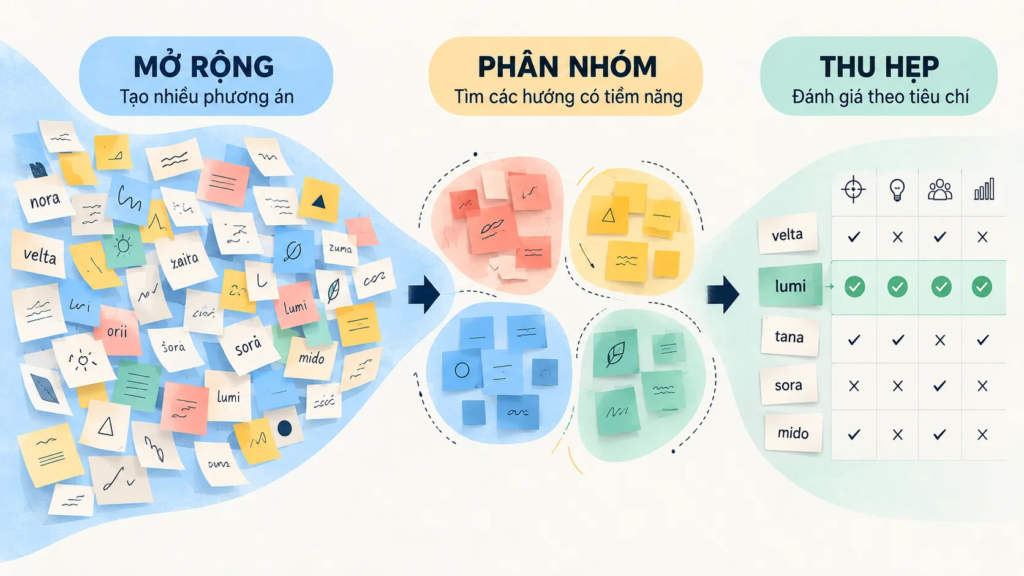
In the early stage, the goal should be to generate many different possibilities. Write down every option that appears, including unfinished names or ones that seem hard to use. Evaluation should come after the field of ideas is wide enough.
This principle matters most when working as a team. A remark like “this idea is bad” does not widen the problem. A more useful reaction is to ask: if we do not use this option, what other directions could we create?
Do not place too much hope in a list of only a few names. Most of the options produced during naming will end up being rejected. That is not a sign of an inefficient process; elimination is part of the process.
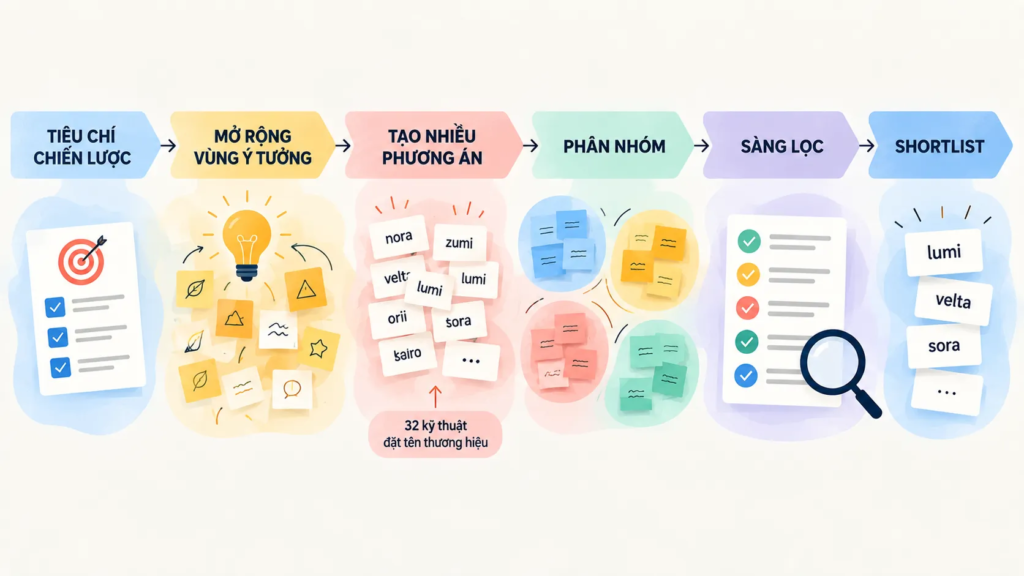
PROCESS
- Set the criteria Clarify what the name needs to support and which limits must be respected.
- Widen the options Create many groups of names with different techniques, without evaluating too early.
- Screening and testing Compare each option against strategic and linguistic criteria and the real context of use.
4. Change the spelling of a familiar word
A familiar word can become distinctive when its spelling is changed on purpose. Jell-O, Froot and Toys “R” Us show that spelling can sometimes become part of a name’s identity.
However, changing the spelling is worthwhile only when readers can still recognize, read and remember the name. If the new spelling makes customers keep asking how to pronounce or spell it, the difference can become an obstacle.
The creative consultant Roger von Oech proposed deliberately bringing random elements into the search for ideas. You can open any page of a dictionary, pick a word, and try to find a connection between that word and the naming problem.
A sports team, an object, a verb or any image can become the starting point.
The aim is not to take that random word as the name straight away. The value lies in forcing thinking away from overly familiar associations.
6. Create names from initials
A name can be formed from the initials of a phrase. VISTA comes from Volunteers In Service To America, and MADD from Mothers Against Drunk Driving.
This works especially well when the abbreviation itself forms a memorable word or one with a fitting meaning. By contrast, a string of letters that is hard to read usually adds to the burden of memory.
This also explains why abbreviations should not be assumed to be the safe choice.
7. Step out of the familiar working environment
Not every naming session has to take place in front of a screen or in a meeting room.
A relaxed environment can help participants break out of repetitive thought patterns. Walking, changing the setting or leaving the phone behind for a while can sometimes make room for new associations to appear.
This is not a formula that guarantees creativity. It is simply a way of changing the conditions of thinking when a team is stuck in the same loop of ideas.
8. Observe names in everyday life
Local shops, restaurants, small services and street signs can be a rich source of reference.
Names such as Banana Republic, One Night Stand for a formalwear rental service, or Creature Comforts for pet care show that a name can use idioms, images or familiar expressions to create association.
Instead of only recording names, analyze the mechanism behind them: what meaning is the name playing with, where does it create surprise, and why might listeners remember it?
9. Combine words to create a new word
A common method is to combine two or more existing components into a new name.
Caravan, Newsweek, Citibank, NutraSweet, Sunkist, Bridgestone, KitchenAid and Waterpik all illustrate different kinds of combinations. Nabisco was formed from National Biscuit Company.
Compounding has the advantage of letting a business create a new name while keeping the semantic cues that help listeners guess its meaning.
FIELD NOTE
When combining words, the problem is usually not how many combinations can be produced but which of them still sound natural. A name that is logical on paper but hard to say in conversation can quickly become inconvenient once it is in use.
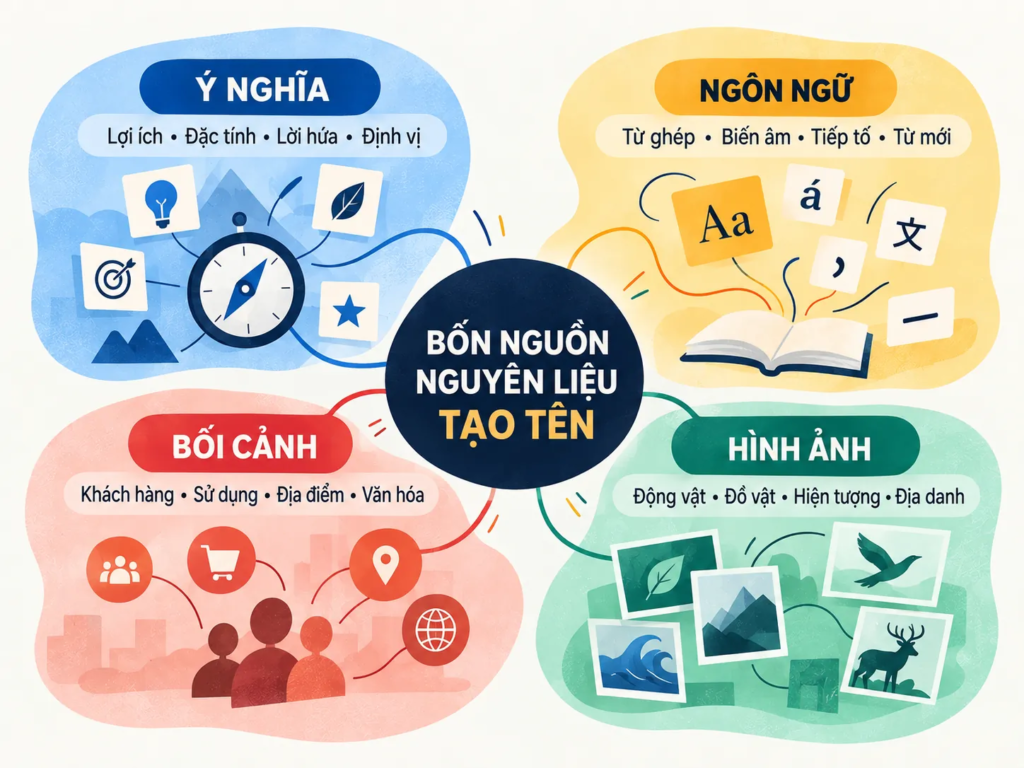
10. Find a representative image
Instead of starting from words, start from images.
What animal, color, landscape, object or shape might the company or product bring to mind? A concrete image often opens a wider field of association than trying to find adjectives that describe it directly.
A very thin DC motor from Kollmorgen was once named The Pancake. The association is direct: the product’s most notable physical trait is its thinness.
Another example is Throat Tamer for a throat spray. The name draws on the image of “taming” pain rather than describing ingredients or function in technical terms.
11. Choose a level of vocabulary that suits the user
A name does not exist independently of the person who reads it.
Overly academic vocabulary may suit some specialist fields but becomes a barrier for mass-market consumer products. Conversely, a name that is too colloquial may not suit industries that call for a high degree of formality or trust.
So the question is not which word is “better”, but which way of using words suits the customer, the context and the brand’s position.
12. Think about why customers use the product
Do not ask only what the product is. Ask what customers want to feel or achieve when using it.
The name Reebok refers to an African antelope, while Puma evokes a large wild cat. The associations of speed, agility and movement fit the context of sports products.
A name can therefore start from a perceived benefit or a state the product wants to evoke, rather than from the product category itself.
13. Observe where and when the product is used
The context of use can also become a source of names.
A handheld voice recorder was once named Commuter when it was noticed that the product could be used on the way to work and back home.
This shifts the focus from “what does the product have?” to “where does the product appear in the user’s life?”.
14. Borrow a word that already has meaning
Not every new name needs a new word.
Sears used DieHard for its car batteries to express durability. Close-Up used a familiar turn of phrase to create an association that suited a toothpaste. Spic and Span, an idiom for being spotlessly clean, also became the name of a household cleaning product.
When a word or idiom already carries a network of associations, a brand can draw on that meaning instead of building everything from scratch.
15. Use dictionaries and thesauruses as creative tools
A dictionary is not only for checking meanings.
A full dictionary can help widen the vocabulary field and uncover word origins, variants and less obvious uses. A thesaurus also helps you get past the first few words the group tends to reach for.
Sources such as the Oxford English Dictionary, Webster’s Third New International Dictionary, March’s Thesaurus or J.I. Rodale’s The Synonym Finder have been used as resources for mining vocabulary.
Tools may change today, but the principle still holds: do not look for just one word; explore the whole field of meaning around it.
16. Find inspiration in culture, history and familiar texts
In 1878, Procter & Gamble developed a white soap that floated on water. Harley Procter is said to have found the inspiration for the name Ivory on hearing a passage from Psalm 45 that mentions “ivory palaces”.
This example shows that a name sometimes appears when the namer comes into contact with cultural sources outside the product category.
The lesson is not “go to church to find a name” but to widen the range of observation: literature, history, art, daily life and language can all supply material.
17. Listen to how customers speak
Customers’ own language can reveal ways of naming that the business never thought of.
In the early 1900s, the pharmacist George Bunting sold a skin cream. According to the story behind the name, after a customer said the product helped her eczema, the name Noxzema was formed as a play on the sound of “no eczema”.
Not every customer response should become a name, but the way customers describe a product can supply noteworthy words, benefits and associations.
18. Think of a name as a promise
A name can carry the benefit or state the product wants to evoke.
NyQuil combines sounds that suggest night and quiet. Sure suggests confidence. In cases like these, the value of the name lies not only in its sound but in the set of associations it activates.
This also sets a requirement: the promise a name evokes must match the real experience. A name cannot make up for a product that fails to deliver what the brand leads customers to expect.
19. Explore words in other languages
Foreign languages can significantly widen the stock of words.
Diamante relates to “diamond”; Volvo comes from Latin; Sanka was formed from the French phrase sans caféine. An expression such as travail du coeur can also become a source of inspiration when its meaning fits the story you want to tell.
However, choosing a foreign word should not rest on sound alone. Check the meaning, the pronunciation and the associations the word may create in the markets concerned.
20. Use computers to widen the combinations
Computers can produce large numbers of options by combining vocabulary components.
A simple way is to build two or more groups of words and then create combinations between them. Tools can help people move faster during the stage of widening the options.
But the ability to generate names is not the same as the ability to evaluate them. A tool does not fully understand marketing strategy, linguistic nuance or the competitive context unless those factors are built into the evaluation criteria.
This principle matters even more with generative tools: the speed of generating options does not replace the ability to choose.
21. Consider buying back a name that already exists
Not every name already owned by someone else is permanently out of reach.
There have been cases where businesses bought, or asked for the right to use, a name from another owner. When an option is truly valuable but the rights already belong to someone else, negotiation may be a direction worth considering.
This is a business and legal decision, not merely a creative one. That a name is rarely used also does not mean other businesses are free to use it.
22. Actively listen to everyday conversations
Names sometimes come from very ordinary remarks.
A greeting, “Night, all”, is recounted as the inspiration for the name Nytol. What deserves attention is not the chance story but the habit of observing language in everyday life.
While working on a naming project, pay attention to how people speak, to phrases that recur, and to pronunciations that could turn into names.
23. Do not assume initials are the safe choice
A string of letters can be short without being easy to remember.
Names such as UST, SPX or NCH raise a problem: if listeners do not know the business, these characters offer very few clues about how to read them, what they mean or what to remember.
Abbreviations can suit some cases, but “short” and “memorable” are two different criteria.
COMMON MISTAKE
“The shorter the name, the easier it is to remember.” Why that is not enough
Memorability also depends on sound, structure, degree of difference and the associations a name creates. A meaningless string of three characters can be harder to remember than a longer word that is easy to read and rich in association.
24. Say the name aloud
A brand name does not appear only on screens, packaging or signage. It is also spoken in meetings, on calls, in stores and in conversation.
So read each option aloud.
A small change in sound structure can make a name noticeably easier to say. For example, Calida and Calidus derive from the idea of “warmth”, but their different endings create a different rhythm of pronunciation.
A name that looks good in writing but is often mispronounced is a sign that it needs another look.
25. Experiment with affixes
Affixes can change the feel and structure of a new name.
Elements such as -oid, -ex or -elle have appeared in many product and brand names. They can help create a distinctive sound or evoke certain associations.
However, affixes should not be treated as a mechanical formula. A syllable that once felt modern in one period can become dated in another.
26. Start from the benefit the product brings
When naming a product, service or publication, look for names in similar fields and then analyze them more deeply.
For a newsletter, say, familiar names such as Times, Herald or Gazette show the conventions of publishing. But simply copying the conventions leaves little room to stand out.
A more useful question is: what benefit does the user get, and is there a way to put that benefit into the name without turning the name into a long description?
27. Start with an uncommon letter
How often a letter appears affects how familiar or unfamiliar a word feels.
George Eastman was especially fond of the letter K and finally chose Kodak, a short name with a strong, distinctive sound.
The point here is not that choosing K, X, Z or Q will produce a good name. An uncommon letter is only a starting point for creating a sound structure different from what is common.
28. Use rhythm and repeated sounds
A name has rhythm too.
Coca-Cola is a clear example of a repeating sound structure. Names with matching consonants, vowels or syllable rhythm are sometimes easier to read and to hold in memory.
When testing, do not look at the name on paper alone. Listen to how it sounds when said quickly, said inside a sentence, and repeated after some time has passed.
29. Look at maps
Place names can become raw material for naming.
The name Weejun was formed from the sound of “Norwegian”. Fig Newtons is tied to Newton, a town in Massachusetts.
A map offers thousands of names of rivers, mountains, cities, regions and landmarks, with very different sound structures. When using a place name, however, consider its cultural meaning and its real connection to the business, so you do not create a misleading origin story.
30. Reverse the familiar order
Language sometimes produces interesting results when components are swapped around.
General Ambrose Everett Burnside was famous for his side whiskers. The term “burnsides” was later reversed into sideburns.
A business can also try reversing the order of familiar components to find a new structure. Instead of accepting the first combination, try swapping the position of nouns, verbs, adjectives or sound elements, then read the result again.
31. Borrow the mechanism, not the result
Ideas rarely appear in a vacuum.
A creative can observe how another industry solves a problem, how a brand uses language, or how a field turns a concept into an image, and then carry that way of thinking over to their own problem.
What is worth borrowing is not the final name. It is the method that produced it.
If one good name was formed by combining words, try the compounding technique with your own brand’s raw material. If another drew on a place name, check whether the geography is genuinely relevant to the business’s story.
32. Do not judge a name only by asking “is it good?”
After the creative stage, the task shifts from generating options to evaluating options.
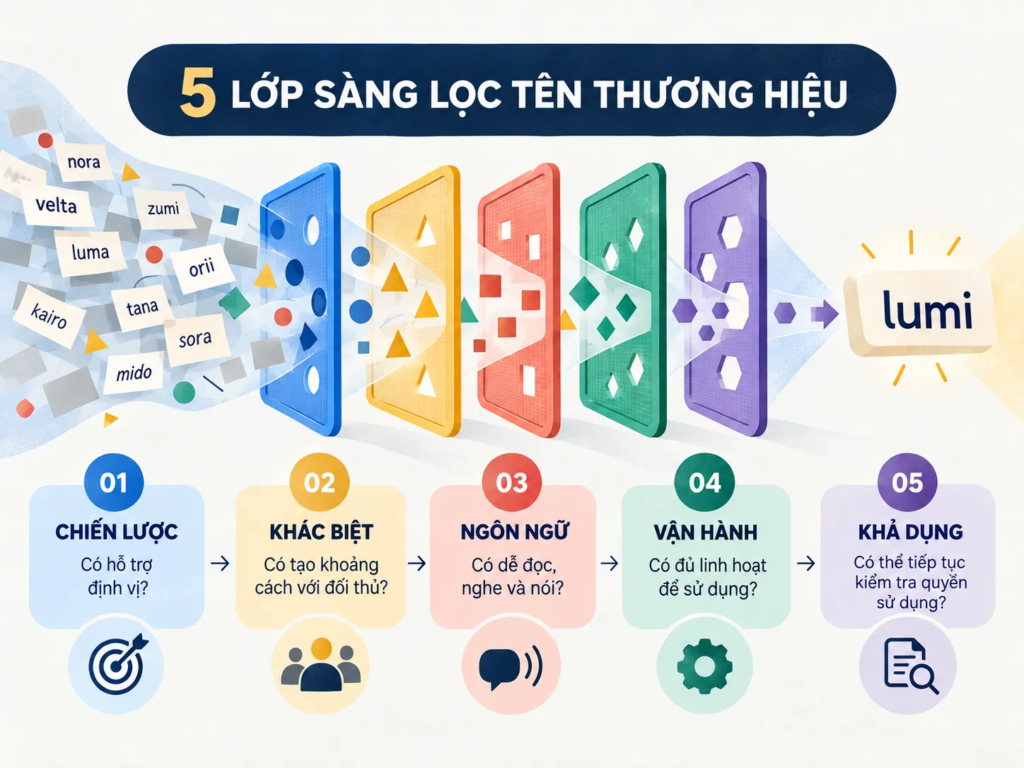
This is where the original criteria become important. A name can be interesting yet wrong for the positioning. A name can be right strategically yet too hard to pronounce. Another option can be memorable yet too close to a competitor’s naming pattern.
Instead of asking the group “do you like this name?”, move to more specific questions.
CHECKLIST
Questions to ask:
- Does the name have a reasonable link to the positioning, benefit or association the brand wants to build?
- Is the name distinct enough from the conventions common in the industry?
- Can listeners read, pronounce and repeat the name with relative ease?
- Does the name create unintended associations in the relevant languages or markets?
- Does the name work when spoken aloud, written down and placed in a real context of use?
- Are there legal or ownership issues to check before choosing?
From 33 ways of thinking to a disciplined naming process
The longer the list of techniques, the easier it is to feel that naming is a language game. But techniques solve only part of the problem.
You can change spelling, combine words, look for images, use place names, draw on foreign languages, try affixes or use tools to generate hundreds of options. No technique guarantees on its own that the final result suits the brand.
What the useful methods have in common is that they help widen the search space. Strategy and evaluation criteria then help narrow it.
LESS EFFECTIVE
- Start by asking everyone which name they like.
- Create just a few options, then defend a favorite name.
- Judge names mainly by how new they feel.
- Use a name generator with no screening criteria.
STRONGER
- Clarify the role of the name before creating.
- Create many directions through different language mechanisms.
- Evaluate names in the competitive context and in real use.
- Check the strategy, the language and the related conditions before deciding.
A brand name should therefore not be seen as a single flash of inspiration. It is the result of two complementary abilities: the ability to generate many possibilities and the ability to eliminate them for good reasons.
A good process does not necessarily help a business find a name that makes an impression the first time it is heard. It helps the business understand why one option deserves to be kept, why another should be dropped, and which strategy the final name is serving.
FRESHBRAND
If you have many name options but no clear basis for choosing, the problem may lie in the criteria rather than in the number of ideas.
FreshBrand approaches naming in relation to positioning, brand structure and how the name is used within the brand system, rather than treating a name as an independent creative element.