
Owning a word in the customer’s mind

In a market where too many brands talk about quality, technology, service and value, the question is no longer how much a business can say about itself. The more important question is what customers will remember when the brand name comes to mind. A strong brand usually does not own all the attributes of its industry; it holds one idea that is clear, distinct and consistent enough to become the natural association when a customer thinks of a specific need.
KEY TAKEAWAY
Building a brand is not trying to own every word in the customer’s mind; it is choosing one valuable idea and building a position strong enough that the brand is the first one remembered when that idea comes up.
1. A strong brand is usually tied to one clear word
Picture someone who is thinking about owning a Mercedes.
Many associations may come to that person’s mind: an expensive car, a German car, good engineering, reliability, luxury and more. But among all those associations, one word may stand out from the rest: “prestige.”
What is notable here is that “prestige” is not Mercedes’ only attribute. A Lamborghini can also be seen as expensive. Audi is also a German car brand. Honda may be associated with mechanical quality. Toyota is often mentioned in connection with reliability.
But what makes a brand position powerful is not whether the brand is, in an absolute sense, the only one in the market that holds that attribute.
The more important point is this: when a word comes to the customer’s mind, which brand is named naturally?
That is the difference between having an attribute and owning an association.
PRINCIPLE 01
The value of a word lies in its place in the customer’s mind
A brand can have many strengths, but if customers do not clearly link those strengths to the brand, they are unlikely to add up to a strong position.
So the brand problem is not only “What are we good at?” but also “What will customers think of us for when they need something?”
2. Why can’t a business own everything at once?

A common mistake in brand building is trying to put everything good into a single message.
A business wants to be high quality, good value, creative, reliable, modern, friendly and professional all at once. Internally, this seems reasonable. No business wants to admit that it is strong in only a few respects.
But the customer’s mind does not work like a company profile.
Customers do not necessarily remember dozens of a brand’s features to the same degree. Exposed to hundreds or thousands of brands, they tend to form more condensed associations. A brand remembered through one word or one clear idea can be triggered more easily than a brand trying to convey a long list of strengths.
FRAMEWORK
From attribute to association
Three levels can be distinguished when evaluating a brand word:
- Attribute: What the brand really has or provides, such as quality, technology, design or service.
- Message: What the business deliberately says about that attribute in its communication.
- Association: What customers actually remember and connect to the brand when they think of the relevant need.
A strong brand does not stop at owning attributes or talking about them at length. The deeper goal is to turn an attribute into a clear association in the customer’s mind.
EXAMPLE
Suppose an industry has many businesses all claiming that their products are “high quality.” If everyone uses the same language, “quality” gradually becomes a baseline requirement rather than a reason strong enough for customers to tell them apart.
Then the business needs to ask a different question: beyond the attributes any competitor could claim, what idea could become the brand’s own mark of recognition?
This does not mean a business should ignore quality. Quality can still be the foundation on which a brand keeps its promise. But in the customer’s mind, the brand needs a clearer definition of who it is and what it stands for.
3. Mercedes and Volvo: two ways of taking a position
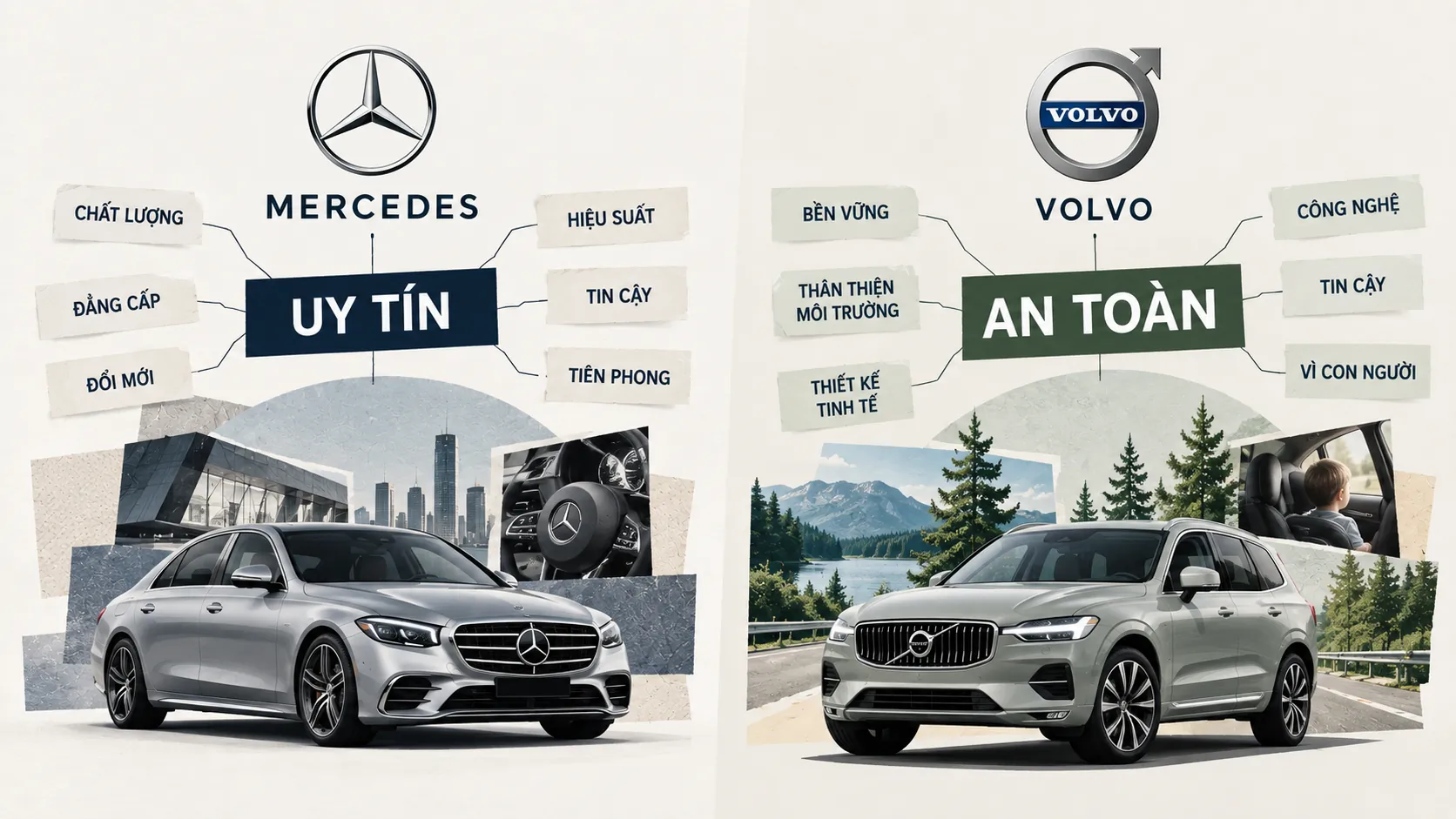
In the car-industry example, Mercedes is linked with the word “prestige,” while Volvo is linked with “safety.”
The point to note is that the two brands do not have to deny their other attributes. A Mercedes can still be associated with engineering quality, German origin or a high price. Volvo can have many other features too.
But once a brand has created a standout association, that association is what sets it apart from a crowd of very similar attributes.
LESS EFFECTIVE
- Trying to put as many attributes as possible into one message.
- Treating all of a business’s strengths as equally important in the customer’s mind.
- Confusing “we have it” with “customers remember it.”
STRONGER
- Identify an idea that is valuable to customers.
- Focus on building that association across many touchpoints.
- Judge the brand by what customers associate with it, not only by what the business wants to say.
Volvo is the example used in the source material to illustrate how a brand can tie itself to one very clear word: safety.
By this argument, Volvo’s position on “safety” was not built from advertising alone. The source material stresses the role of promotion, particularly around the seat belt and a body structure designed to absorb impact. It is specific elements like these that give a fairly abstract concept a basis on which customers can associate it with the brand.
FIELD NOTE
In brand-building practice, a word is only valuable if the business can make it believable in real experience. If a brand says “safe” but its products, services and touchpoints do not reinforce that impression, the word will live only in advertising. When the promise and the evidence customers can actually encounter point the same way, the brand association has a better chance of lasting.
4. “Owning a word” does not mean using only one word in advertising
There is an oversimplified reading of this principle: to own a word, a business only needs to repeat it again and again in its advertising.
That is not the core problem.
A brand word is not a slogan pasted onto every piece of communication. It is a condensed statement of the position a brand wants to hold in the customer’s mind.
If a business wants to be associated with “safety,” for example, the next question must be: what is the brand doing to give customers a reason to believe in that association?
To own “prestige,” a business must ask whether its decisions about product, service, experience, communication and brand behavior reinforce that impression.
COMMON MISTAKE
“Just find a good word and put it in the slogan, and you own the position.”
Why that is not enough
A word does not create a brand position by itself. It is only a condensed expression of an association that has to be built and reinforced. If the product, the experience and the communication do not point the same way, repeating the word may make the message more visible without making the association any stronger.
5. A good word has to meet several conditions

Not every word is suitable to become a brand word.
A word that is too generic is hard to make distinct. A word unrelated to customer needs is hard to turn into a reason for the brand to be remembered. And a word a competitor has already tied closely to its own brand is even harder for a new business to take.
So before choosing a word, a business needs to look in three directions at once: the customer, the competitors and its own capacity to deliver.
FRAMEWORK
Three questions for testing a brand word
- Do customers care? The word has to connect to a need, concern or criterion that matters in the customer’s decision.
- Has a competitor already taken it? The more strongly another brand owns a word in the customer’s mind, the harder it is to compete head-on.
- Can the brand prove it? The business must be able to turn the word into a consistent experience, product, service or body of evidence.
These three questions help avoid a common problem: choosing a word that sounds very appealing from the inside but carries no real weight in the market.
6. The word has to be built by the whole brand system
If the word is treated as a destination, every touchpoint of the brand has to help lead customers to the same association.
This covers advertising, content, products, services, how employees communicate, the brand environment, packaging, the website and many other experiences. They do not all have to be identical, but they need to be consistent in meaning.
This is also why brand building cannot be understood simply as designing a logo or writing a slogan.
A logo can help with recognition. Color can help with recall. Packaging can help a brand stand out at the point of sale. Advertising can put a message into the market.
But no single element can replace a brand position.
WHAT WE LOOK FOR
In a positioning problem, the first thing to look at is not how many identity elements a brand has but which association they are reinforcing together. If the logo says one thing, the advertising says another and the experience creates a different feeling, the brand may be recognized yet struggle to form a clear position.
- Check what the brand wants to be remembered for.
- Check whether the touchpoints reinforce the same association.
- Check whether what the business wants to own is really different from what competitors already own.
7. Difference does not necessarily come from being better in every way
A business may think that to compete it must be better than its rivals in every respect.
That is a goal that is both hard and not necessarily needed.
In the customer’s mind, a brand does not need to win on every criterion to be memorable. What matters is that it has a clear enough reason to be chosen in a specific context.
That could be safety, prestige or another idea that suits the market and the business’s capabilities.
So the strategic question should not be only:
“Where can we be better than our competitors?”
But also:
“What do we want customers to remember us for that competitors would find hard to replace?”
This change in how the question is asked is important. It moves the focus from a contest over the number of attributes to a contest over position in the mind.
8. Owning a word is a long-term process
A word does not become a brand asset after a single campaign.
Customers need many encounters with a brand to form, reinforce and maintain an association. Positioning therefore has to be expressed over time and across many different touchpoints.
It also places a harder demand on a business: it must know how to let go of unnecessary messages.
Once a position is chosen, a business cannot change how it wants to be remembered every month. One campaign about price, the next about quality, another about technology or lifestyle can produce many separate messages without necessarily adding up to one coherent image.
CHECKLIST
Questions to ask:
- When customers think of the brand, which word or idea do we want to appear first?
- Does that idea really matter in the customer’s decision?
- Which competitor is already strongly associated with this idea?
- What real evidence do we have to support the position we want to own?
- Are the product, service and communication reinforcing the same association?
- If you removed the brand name from the message, would customers still recognize the position the brand wants to build?
9. What matters is not what a business says but what customers remember
Brand building often begins with a very natural wish on the business’s part: for customers to know everything it does well.
But brand strategy demands a different discipline. Not everything a business wants to say is equally valuable in the customer’s mind.
In the example above, Mercedes can be tied to many attributes. So can Volvo. But the strength of a brand position comes from making one association stand out and be triggered when a customer thinks of a specific need.
So instead of asking “What else can we say?”, a business should start with a harder question:
“If customers remembered only one thing about the brand, what would we want it to be?”
The answer is not the whole brand strategy. But it can be the starting point that makes the strategy more focused.
FRESHBRAND
A clear brand starts with a clear position in the customer’s mind. If a business has not decided what it wants to be remembered for, its decisions about messaging, identity and experience easily become disconnected activities.
The next step is to check whether the brand word being considered is distinct enough, meaningful to customers and can be proven by the whole brand system.