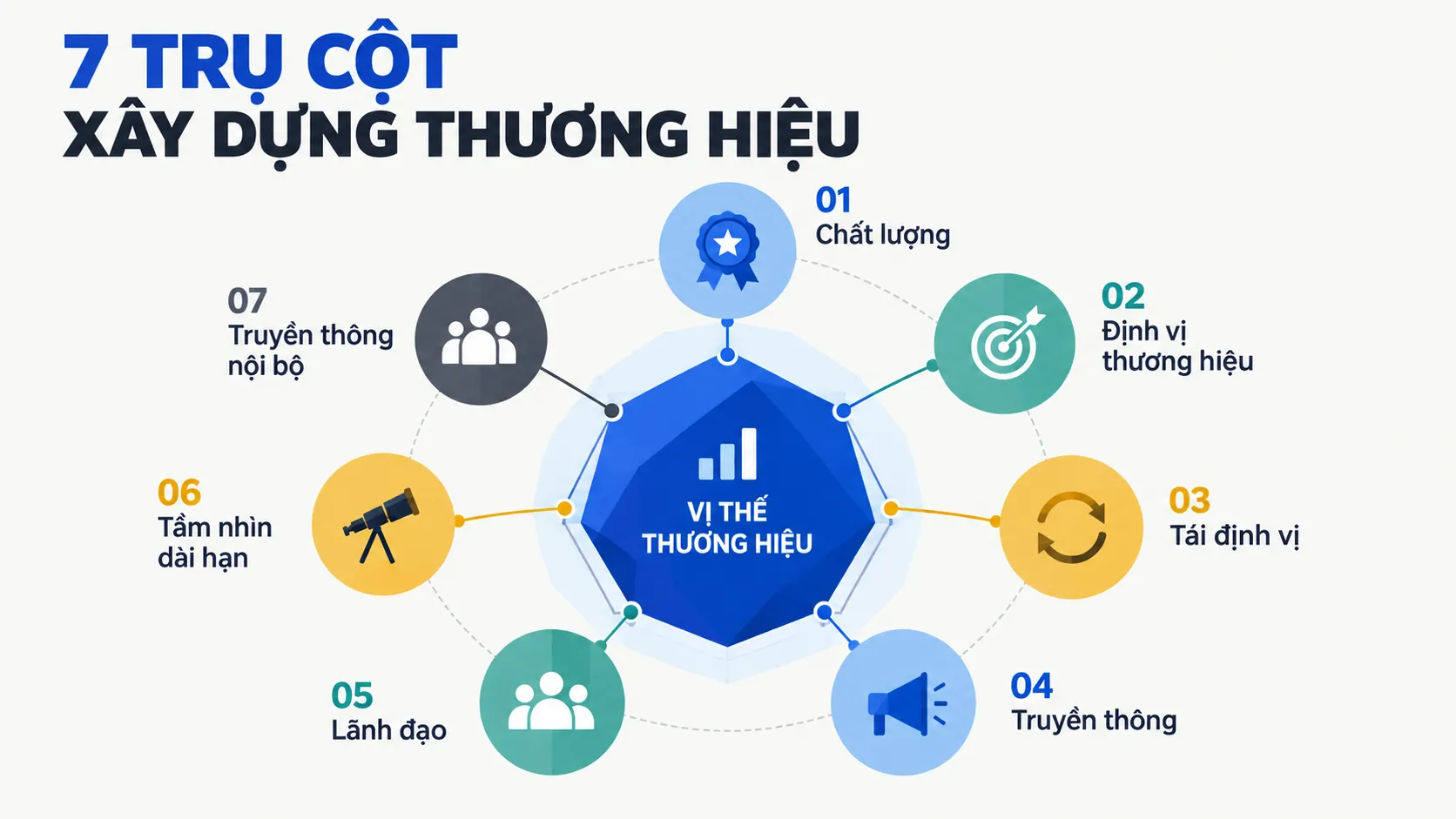
Brand strategy: when quality is no longer the only anchor

In many businesses, product quality is still seen as almost enough to build a strong brand. The logic is easy to follow: if the product is better, customers will notice and choose it. But in markets where quality is increasingly an expected baseline, a more important question arises: when many competitors can meet the same quality standard, what makes customers still remember, trust and choose one particular brand?
KEY TAKEAWAY
Quality helps a brand be accepted; clear positioning gives it a place of its own in the customer’s mind.
When “a good product” is no longer enough to create difference
A business can invest heavily in raw materials, technology, production processes and quality control. These investments are necessary, but they do not automatically create a brand with a distinctive position.
The point is this: quality is an attribute of the product, while a brand is how the market interprets the value of that product.
A watch can be judged by accuracy, durability, materials or movement. But the choice in the premium segment is not formed from those technical criteria alone. The buyer is also choosing a symbol, a style, a signal of taste or the status they want to associate with themselves.
Likewise, in photography, technical specifications let users compare the capabilities of devices. Yet a brand like Leica is recognized not only by the specifications of each product, but also by its history, design language, user experience and the position it has built in the minds of its community of users.
This does not mean quality does not matter. On the contrary, quality is the foundation for sustaining trust. But a foundation is not the whole structure of a brand.
PRINCIPLE 01
Quality is a necessary condition; brand position determines how quality is perceived
If every business can say its products are “high quality,” that message will find it harder and harder to create difference. A brand begins to have strategic value when the business has decided what it wants to be remembered for, for whom, and where it differs.
The trap of “the product is everything” thinking

Product-centered thinking often starts from a belief that is reasonable but incomplete:
“As long as we do better than our competitors, the market will notice.”
The problem is that the market does not operate like a laboratory, where customers always have enough time, information and motivation to analyze every specification before deciding.
In practice, customers meet a brand through many signals: the name, the identity, packaging, space, the way staff communicate, content, the website, sales materials, the after-purchase experience and even what other people say about the brand.
Every touchpoint helps answer one question:
“Who is this brand, and what does it mean to me?”
If a business focuses only on proving the product is good while other touchpoints send inconsistent signals, the market will have to finish the answer for itself.
That is the moment a brand gap forms.
COMMON MISTAKE
“We have a good product, so we don’t need to invest much in the brand yet.”
Why this is not enough
A good product creates real value, but that does not guarantee the value will be recognized, remembered and correctly distinguished in the customer’s mind. When a business does not define its own position, other factors such as price, promotions, specifications or how competitors communicate can become the main basis on which the market compares.
Brand gap: the space between real value and perceived value

There is a gap that brand management often overlooks: the gap between what the business actually has and what the market perceives about it.
A business may have strong production capacity, an experienced team, rigorous processes and a reliable product. But if those values are not turned into a clear system of expression, customers may not see the difference.
Conversely, a brand with a sharp way of expressing itself can make a complex capability easier to understand and remember.
This changes how branding is understood.
Branding is not simply a matter of making a nicer logo, a new color palette or a consistent set of imagery. Those are only the outward expression of a deeper decision:
What position does the business want to hold in the market’s mind?
Only from that question can we determine how the brand speaks, how it appears and how it organizes the whole experience.
FRAMEWORK
From “product quality” to “brand position”
This process can be seen through three linked layers:
- Real value: The products, services, operational capability and quality the business actually delivers.
- Interpreted value: How the business turns those capabilities into messaging, identity and an experience that is easy to understand.
- Remembered position: What customers ultimately associate with the brand and use to tell it apart from other choices.
If the first layer is strong but the other two are weak, the business may have good capabilities but not yet turn them into a brand advantage.
A brand is part of the business infrastructure

Seen from this angle, branding no longer sits at the end of the process as a “beautifying” activity after the product is finished.
It becomes part of the business infrastructure.
Picture a business selling a high-value solution. Before the customer reaches a buying decision, they may encounter the website, the company profile, a proposal, emails, the sales team, the meeting space and many other materials.
If each touchpoint speaks a different language, customers have to spend extra effort assembling them into a single picture of the business.
Conversely, when brand strategy is clearly defined, those touchpoints can serve one purpose: to make the value of the business easier to recognize, understand and trust.
FIELD NOTE
In brand work, the problem is often not that a business “has nothing to say,” but that it wants to say too much at once. When every capability is put forward as a highlight, none becomes a strong identifying mark.
1. Optimizing touchpoints
No touchpoint should be treated as an independent communication asset.
A website is not only for providing information. A company profile is not only for presenting capabilities. Packaging is not only for holding the product. Identity is not only for decoration.
They are all opportunities to reinforce the same brand position.
When messaging and expression are organized consistently, customers do not have to keep “decoding” the business. They can quickly understand what it stands for.
This is especially important in high-consideration decisions, where trust and clarity play a significant part in the process of choosing.
2. Vouching for credibility before a transaction happens
A brand also has the job of creating signals of trustworthiness before customers fully experience the product or service.
This is easy to see in B2B.
A potential partner may never have worked with a business, yet may already have seen its website, company profile, sales materials or the way it presents its capabilities. These elements do not replace actual quality, but they help form the first expectation.
This is why an inconsistent brand can create a gap between real capability and perceived image.
Conversely, a clear brand system lets a business present its capabilities in a more structured way.
3. Building an intangible asset
This is the most important point.
Products have life cycles. Technology can change. Competitors can learn your processes. Features can be copied or surpassed.
But a brand position built over time is not easily replaced by a change in features alone.
What a business needs to accumulate is not only the sales of each product, but also consistent associations in the mind of the market.
That is why a brand can become an intangible asset: it accumulates through many encounters and many customer decisions, rather than existing only in one particular product.
LESS EFFECTIVE
- Using product quality as the only message of difference.
- Listing as many strengths as possible to prove capability.
- Treating brand identity mainly as the final cosmetic layer.
STRONGER
- Identify which value the market needs to remember.
- Choose one clear position instead of trying to represent everything.
- Build a system of touchpoints that reinforces that position.
From “proving we are good” to “making clear how we are different”
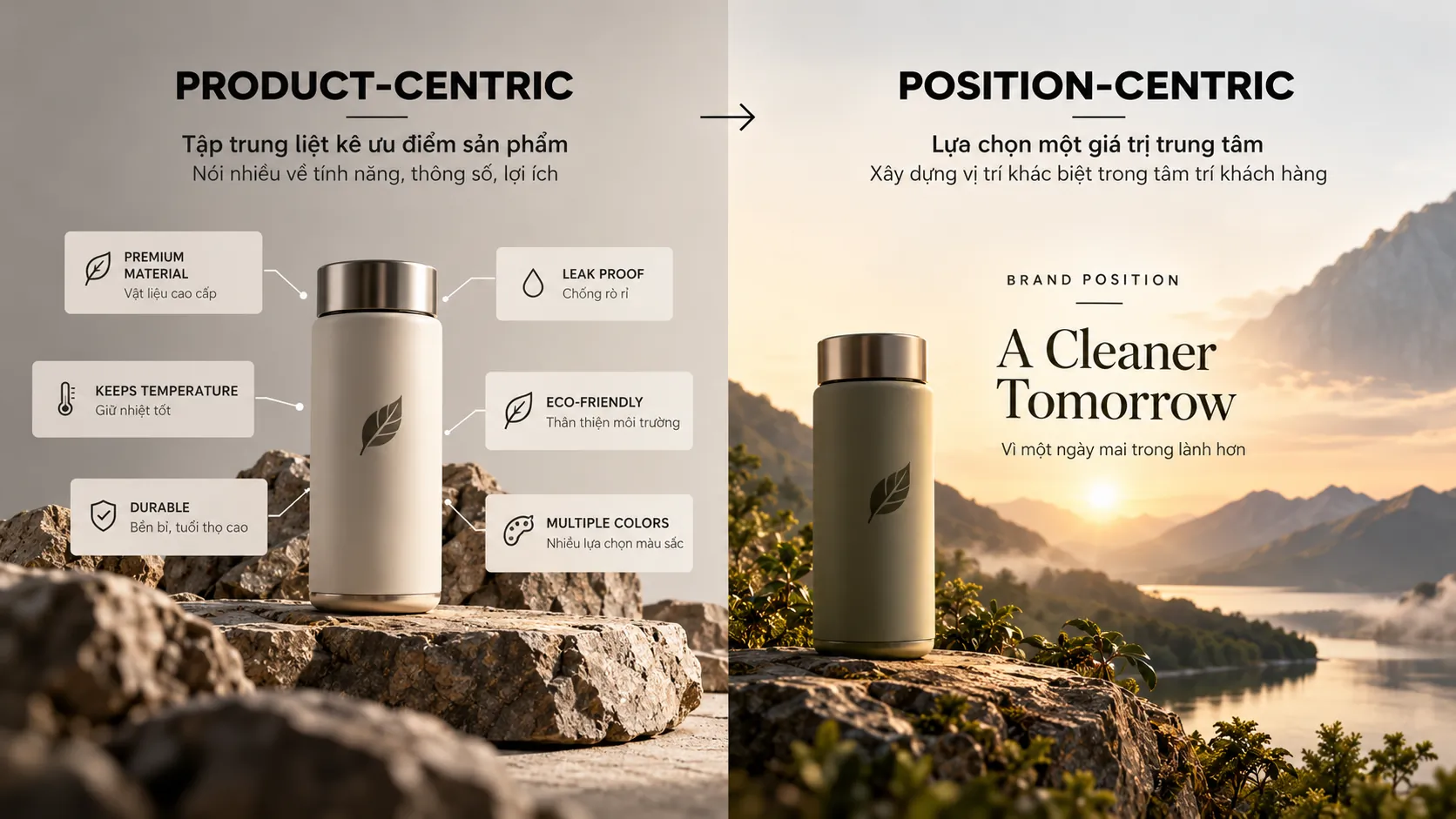
An important shift in brand thinking is changing the question.
Instead of only asking:
“How do we prove our product is good?”
Businesses need to ask other questions too:
“What is good about it?”
“What does that strength mean to the customer?”
“What makes customers remember us instead of another option?”
“If you took the logo off a touchpoint, could people still recognize the brand?”
These questions take branding out of the scope of design and return it to its real nature: a problem of perception, choice and position.
EXAMPLE
Suppose a business wants to be seen at once as high quality, creative, friendly, high-tech, trustworthy and serving every segment.
None of these claims is necessarily wrong. The problem is that when they are all placed on the same level, it is hard for customers to know what matters most to remember.
A clear brand does not necessarily have to say less about its capabilities. It needs to know which capability should be at the center of the story, which plays a supporting role, and which does not need to appear at every touchpoint.
That moves a brand from “telling everything we have” to “making clear why we deserve to be chosen.”
When identity becomes the operating system of strategy
If strategy answers where the business wants to go and what position it wants to take, brand identity turns that direction into signals that can be seen, read and experienced.
That is why an effective identity system should not be judged by this question alone:
“Does the design look good?”
It should be judged by more practical questions:
- Does it reflect the position the business wants to build?
- Does it help customers recognize the brand faster?
- Does it create consistency across touchpoints?
- Is it flexible enough to work in different contexts?
- Does it help distinguish the brand from competing options?
At that point, identity is no longer a set of separate visual assets. It becomes a system that lets strategy be expressed consistently in practice.
WHAT WE LOOK FOR
In a brand problem, the first thing to look at is not whether the logo looks good or bad, but the gap between the position the business wants and the position the current brand system is communicating.
- If strategy has changed but the identity still expresses the old position, the system of expression needs another look.
- If the product is already different but the market still sees only generic attributes, positioning needs another look.
- If many touchpoints speak different languages, the brand architecture and its rules of consistency need another look.
Quality still matters, but it cannot do the brand’s work for it
The opposite extreme should be avoided too: believing that branding can replace quality.
It cannot.
A brand can create expectations, but the actual experience still has to be able to meet them. If the expression goes beyond real capability, the brand only creates another gap: the gap between promise and experience.
So the right relationship is not quality or brand, but how quality is interpreted and reinforced by the brand.
Quality lays the foundation for trust. A brand gives that foundation a clear meaning in the mind of the market.
A strong business does not only need to do well. It also needs to help the market understand what it does well, for whom, and why that is worth choosing.
CHECKLIST
Questions to ask:
- What do customers currently remember the brand for?
- Does what they remember match the position the business actually wants to build?
- Are the current points of difference clear enough to set the business apart from competitors?
- How is product quality being turned into brand value?
- Are the identity system and touchpoints reinforcing the same position?
A strong brand does not necessarily say more; it says it more clearly
As the market fills with products that meet a good standard, the advantage no longer lies simply in how many features, benefits or proofs a business can add to its message.
The advantage lies in the ability to choose.
Choose what should be remembered. Choose whom to persuade. Choose which difference is worth owning. And most important, choose a position clear enough that the whole business can move toward it together.
Quality lays the foundation for trust; the brand determines how the market remembers that foundation.
A question for leaders: is your brand proving or positioning?
A mature brand does not necessarily keep saying that it is better.
It creates a system clear enough for customers to recognize for themselves what the business stands for.
If most of your brand effort still goes into explaining how good the product is, it may be time to look more broadly: what position is being built in the customer’s mind, and is the current brand system supporting that position?
FRESHBRAND
Start by examining the gap between the value the business actually holds and the value the brand is communicating. From there, the business can tell which part is a product problem, which is a positioning problem and which is a problem of the identity system, before deciding to change any brand asset.