
A strategic frame of reference: on quality and brand positioning

In brand building, “quality” is often treated as a foundation beyond debate. Businesses invest in better products and better service and expect the market to recognize that value on its own. But the quality a business creates and the quality customers perceive are not always the same. When every competitor can claim to be good, the strategic question shifts from “how do we do better?” to “what will we be recognized for as a different choice?”
KEY TAKEAWAY
Quality gives a brand a reason to exist; positioning gives customers a reason to remember, choose and tell that brand apart from the rest of the market.
Quality does not live only in the product
Business people usually approach quality from the company’s side: better ingredients, better technology, tighter processes, more services. These are important for creating real value. But they do not automatically become brand value.
Customers do not experience quality as a table of technical specifications. They take it in through everything the brand lets them see, understand and feel while choosing and using.
This creates a notable gap between real quality and perceived quality. A product may receive heavy investment, but if the market does not recognize its strengths, they are unlikely to become a positioning advantage.
PRINCIPLE 01
Quality creates brand advantage only when the market recognizes it
A business can control product standards, but it cannot fully control how customers interpret the value of that product. Building a brand is therefore not only raising quality on the inside but also organizing how quality is recognized on the outside.
A strong brand does not have to prove it is better in every respect. What matters more is establishing one criterion that means something to customers, which the brand can own consistently.
When “better” quality is no longer enough to differentiate
One common trap in competition is the assumption that a better product will naturally win a better place in the customer’s mind.
The problem is that markets rarely stand still. When an attribute becomes important and commercially valuable, competitors tend to invest to match it. Technology improves, service quality rises, processes are standardized and brand promises gradually come to look alike.
At that point, “high quality” becomes a condition for entering the game rather than a reason strong enough for customers to choose.
COMMON MISTAKE
“If the product is truly good, the brand will build its own position.”
Why it is not enough
Product quality is the foundation but not a substitute for positioning. If the standout benefit is not encoded into a clear, distinctive perception, customers may rate the product highly and still have no specific reason to remember the brand.
This is also why the Nokia story is often cited when discussing how competitive standards in the phone industry shifted. Nokia was once widely known for durable products and notable technical capability. But the arrival of the iPhone helped change how the market saw the value of a phone: from criteria centered on the device to an experience tied to the interface, the ecosystem and the way people interact with technology.
The point here is not the conclusion that a “good” brand will lose to a “better” one. The strategic lesson is that the standard by which value is judged can change.
FIELD NOTE
In practice, businesses often spend a lot of time listing what they do well. The more strategic question is this: what criteria will customers use to tell you apart from the other options? The two questions sound almost the same but lead to very different ways of building a brand.
From product quality to perceived quality

You can picture brand advantage in three layers:
FRAMEWORK
Three layers of quality advantage
This frame helps a business separate what it creates, what customers recognize and what actually has the power to build a position.
- Real quality — The values and standards the business actually creates in its product or service.
- Perceived quality — How customers understand, interpret and remember those values.
- Positioning — The perceptual space the brand wants to occupy, distinguished by a reason that is clear enough.
If a business focuses only on the first layer, it may create a good product and still struggle to form a brand with a clear position. Conversely, perception cannot replace real quality: a strong promise that experience does not prove quickly loses its value.
So brand strategy needs to connect two sides: the value must be good enough to back the promise, and the promise must be clear enough for the market to recognize the value.
The trap of “doing more” thinking

Another belief that often appears when businesses seek to expand is that the more products, services or categories they offer, the stronger the brand becomes.
From a management view, diversification can open different business opportunities. But from a brand view, every expansion also raises a question: what does this brand still clearly stand for?
When one name is used across too many fields with no clear connection, the brand’s meaning may grow broader and blurrier at the same time. Customers know the brand “does many things” but struggle to say where it truly stands out.
LESS EFFECTIVE
- Expanding the range simply because a business opportunity exists.
- Using one brand across many different fields without considering the effect on perception.
- Treat the breadth of the range as direct proof of credibility.
STRONGER
- Define in advance the positioning space the brand needs to protect.
- Evaluate each expansion opportunity by how well it fits the brand’s meaning.
- Treat focus as a tool for reinforcing expertise and memorability.
The law of expansion and the power of focus
The law of expansion poses an important paradox: when a brand tries to stand for more and more, the strength of its original meaning can be dispersed.
This does not mean every business must sell a single product or operate in only one industry. The issue is the relationship between the scope of the business and the meaning the brand owns in the customer’s mind.
A brand can have a broad range and still hold its positioning, provided the brand architecture, the role of each brand and the relationships between fields are clearly organized. Conversely, expansion without strategy can make the parent brand itself hard to define.
WHAT WE LOOK FOR
In brand strategy work, one of the first questions to examine is not “what else can we expand into?” but “how far can we expand before the brand’s meaning starts to thin out?”
- What is the brand currently remembered for?
- Does the new product or category reinforce that perception or change it?
- Is the business expanding for a strategic capability, or only for a short-term revenue opportunity?
Specialized does not mean small
Focus is often misunderstood as a limit on growth. In fact, focus is first of all how a brand chooses the competitive space in which it wants to become meaningful.
A business may be able to supply many things without having to use all of that capability to define its brand. This is the difference between what the business can do and what the brand should be known for.
EXAMPLE
For example, a business may have capabilities in production, distribution and consulting and offer several product groups. That is valuable operationally, but if all of it goes on the brand’s front line with equal weight, customers have to work out for themselves what the brand really stands for.
What a brand needs to do is not deny its other capabilities but decide which capability plays the central role in market perception. The others can remain behind the business system without having to become the main positioning message.
This example shows that focus does not mean doing less in terms of capability. It means selecting what the market should remember.
When walking away from an opportunity is also a brand decision
Every expansion opportunity has potential business value. But short-term opportunity and long-term brand assets do not always point the same way.
If a new product raises revenue but leaves customers unsure what the brand stands for, the business needs to weigh both sides of the decision. The question is not only “will the market buy it?” but also “once the brand sells this too, how will customers understand the brand differently?”
CHECKLIST
Questions to ask:
- What perception does the brand currently own in the customer’s mind?
- Does the new expansion opportunity relate naturally to that perception?
- If a new product or service is put under the same name, does the brand’s meaning become broader but less clear?
- Is the business optimizing for short-term revenue, or protecting a position of long-term value?
This is where brand strategy differs from a pure product-portfolio decision. A decision can be sound commercially and still need to be reconsidered from a positioning perspective.
Difference needs to be built before expanding
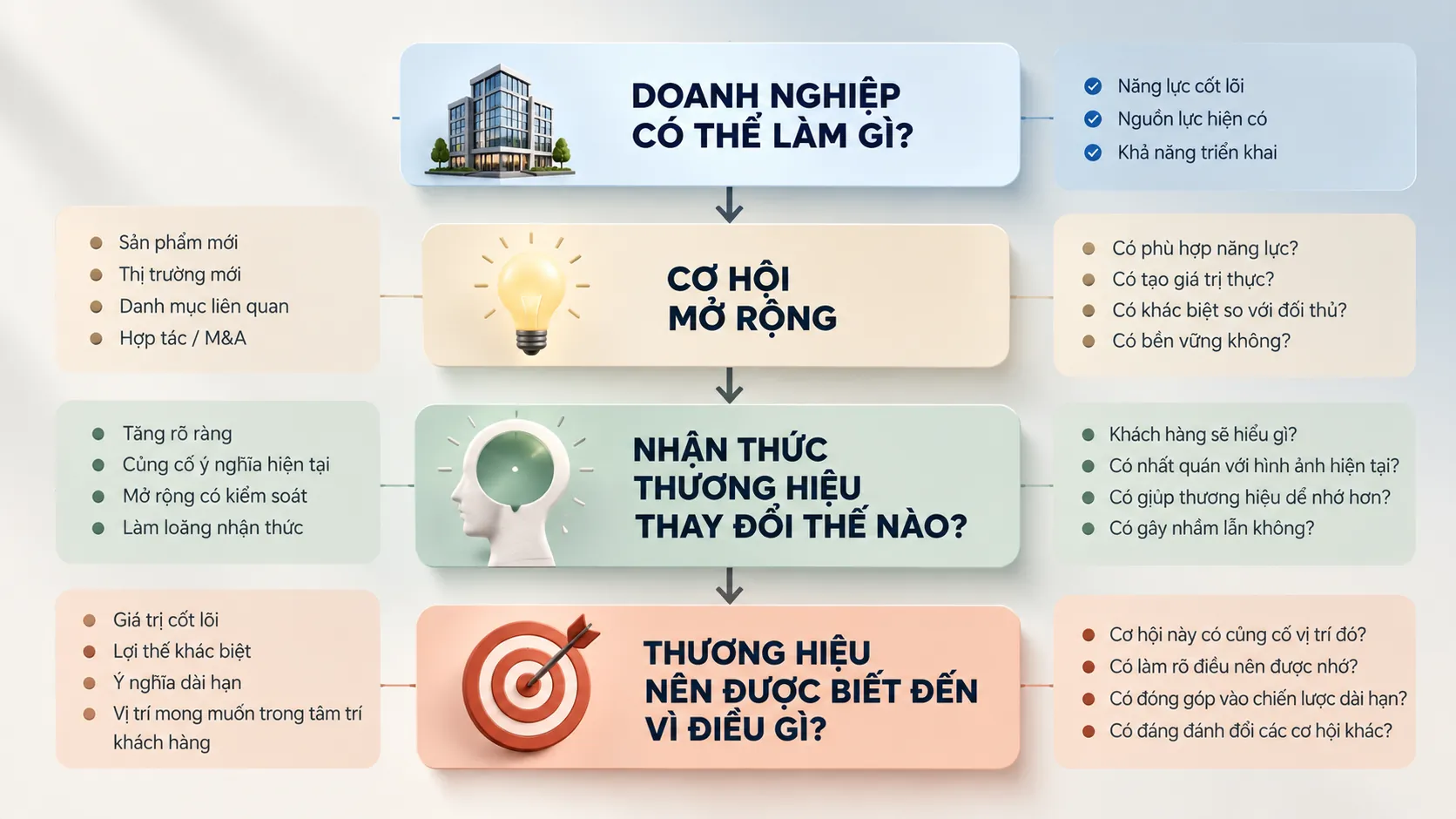
When a brand does not yet own a clear position, expansion usually makes the problem harder. The more products a business adds, the more messages there are; the more messages there are, the harder it is for customers to tell what is core.
Conversely, once a brand has a clear meaning, the business has a frame of reference for judging what should be brought in and what should stay out.
PRINCIPLE 02
Focus is a decision about perception before it is a decision about the range
A brand does not need to be remembered for everything the business can do. It needs to be remembered for one thing that is clear, relevant and consistent enough to create differentiation.
This also changes how we see the “specialist”. A brand is seen as specialized not necessarily because it says so, but because everything customers repeatedly see, experience and associate reinforces the same position.
Strategic advice from FreshBrand
Brand simplification should not be understood as an aesthetic choice or a limit on business ambition. It is a strategic decision about what the business wants to occupy in the market’s mind.
A business can still develop many products, enter new markets and build more capabilities. But before each step of expansion, two questions need to be kept apart: “What can we do?” and “What should our brand be known for?”
These two questions do not always have the same answer.
From FreshBrand’s perspective, the value of positioning does not lie in mechanically making a brand say less. It lies in helping a business know what to emphasize, what to keep in the background and what must not change the core meaning of the brand.
When quality is the foundation, positioning is the mechanism that makes that foundation meaningful in competition. And as markets offer ever more similar choices, being recognized for one clear thing can matter as much as how well the business actually performs.
FRESHBRAND
Is your brand currently remembered by customers for one clear thing, or for too many things at once?
FreshBrand approaches positioning through the relationship between business capability, customer perception and the competitive space the brand chooses to own.