
What a brand really is: a management view
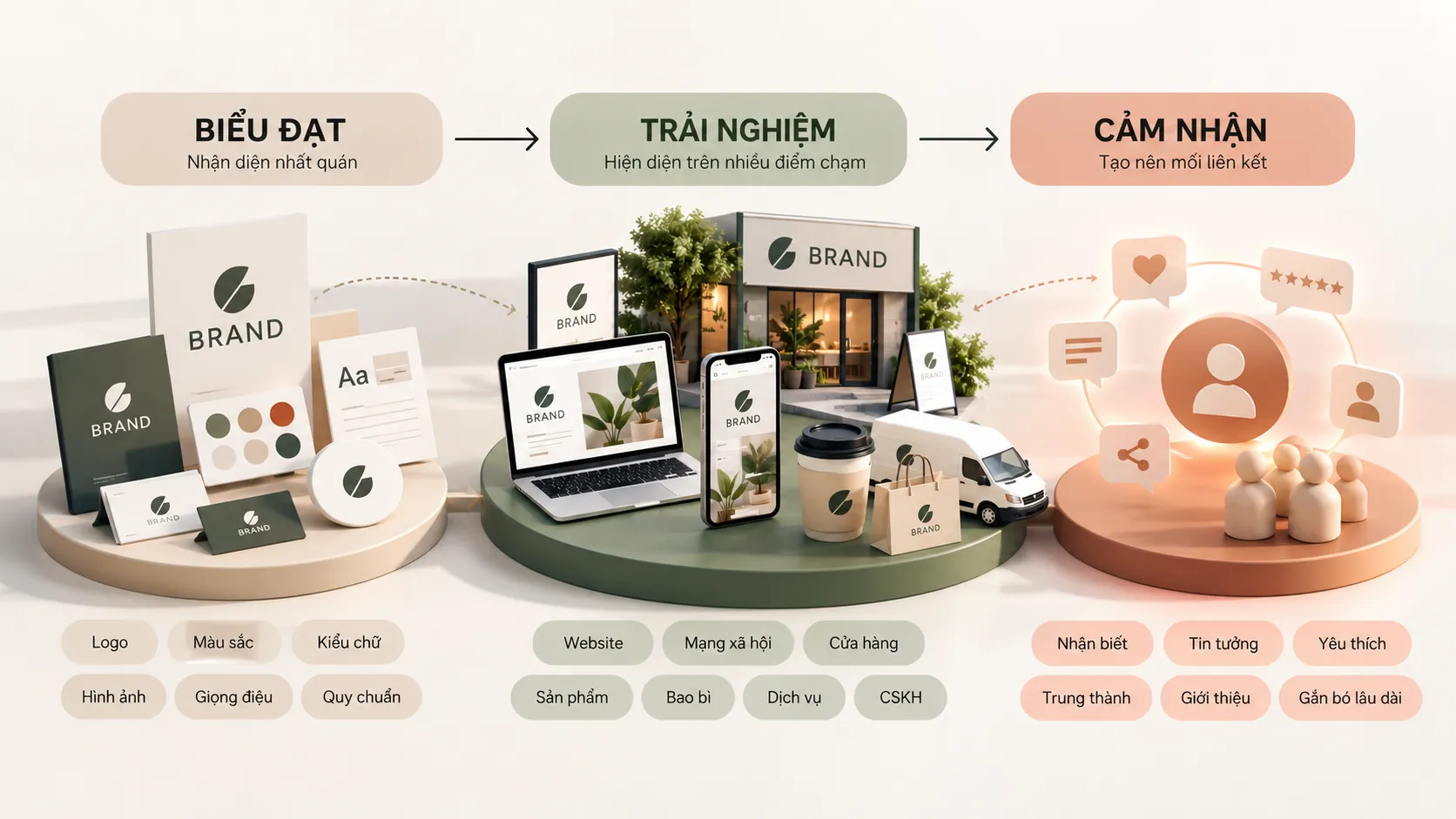
A brand is usually seen first through its name, logo, packaging or identity system. From a management view, though, that is only the part a business can design and control directly. What decides the value of a brand lies elsewhere: in how the organization operates, how the business keeps its promise, and how customers remember and interpret those experiences over time.
KEY TAKEAWAY
A brand is not something a business owns outright; it is the perception formed in the customer’s mind from the consistency of promise, expression and experience.
A brand is not the “shell” of a business
One of the most common ways to understand a brand is to equate it with the identity system: the name, logo, colors, packaging, communication imagery or brand guidelines.
This view is not wrong, but it is incomplete.
Tangible elements help a brand be recognized. They give customers signs for telling one business from another. But being recognized is not the same as being trusted, chosen or remembered.
A logo does not create credibility by itself. A beautiful identity does not create a good experience by itself. And a consistent communication campaign cannot sustain, for long, a promise that the business’s actual operations fail to meet.
So a more important question than “what does the brand look like?” is:
What does the business want to be known for, and is its whole system reinforcing that?
At the management level, a brand should be seen through two closely related layers of value: the system of expression and the perception in the customer’s mind.
The system of expression: when a brand becomes an operating system

The system of expression is the part of the brand a business can design and organize on its own initiative. It includes visual identity, language, communication, digital touchpoints, space, packaging, and even how employees interact with customers.
The key is the word “system.”
If each touchpoint is built as a separate task, customers meet several different versions of the same business. The website speaks one way, the packaging presents another, the store feels different again, and customer care uses an entirely different tone.
Conversely, when touchpoints are built on one shared frame of reference, the brand begins to be consistent.
Consistency here does not mean everything must look identical. A website, packaging, a store and a service have different functions. What needs to be unified is the principle customers recognize behind those different expressions.
PRINCIPLE 01
Consistency does not mean making everything identical
A good brand system does not force every touchpoint into the same form. It ensures that even as the form changes with context, customers still recognize the same brand essence.
This turns the brand from a set of design assets into a system that guides behavior and expression.
When identity becomes a management tool
From this view, brand guidelines are not just a document for designers. They can become a tool that helps the organization answer very practical questions: how the brand is expressed, what must stay consistent, what can stay flexible, and which principles should not be broken.
A clear set of standards reduces reliance on instinct during implementation. When a new employee joins, a new partner produces materials, or a new market needs the brand localized, the organization has a shared point of reference that cuts down on deviation.
Here an often-overlooked value of a brand appears: the capacity to organize.
Three management values of consistency
When the system of expression is built well, a brand can have effects that reach beyond communication.
- Proof of capability: A consistent system of expression shows how organized and professional a business is from the very first contacts, especially with partners who have little direct experience of it.
- Reducing deviation in implementation: Clear standards help departments and partners understand how the brand should be expressed, which limits each person interpreting it in their own way.
- Building internal commitment: When employees understand which values they represent, the brand can become a shared symbol within the organization rather than just an asset of the Marketing department.
But even a well-organized system of expression is not yet a complete brand.
Because a business can control what it says, but cannot fully control what customers feel.
Perception in the mind: where a brand actually exists
Products are made in a factory. But the meaning of a brand is formed in the customer’s mind.
After every contact, customers accumulate a large number of very different signals: product quality, how staff respond, how fast problems are solved, the look of the packaging, the website interface, the content, how convenient the process is, and the expectations set before the purchase.
Over time, those signals are combined into a fairly stable perception.
That is why the same brand can be seen in different shades by different customers. One person remembers convenience, another remembers reliability, and another ties the brand to one specific experience.
A business cannot dictate how customers should feel.
What a business can do is design and manage the conditions that underlie that perception.
FRAMEWORK
Three layers for looking at a brand
- Expression: What does the business say and show through its name, identity, packaging, content and touchpoints?
- Experience: What do customers actually meet when they buy, use, interact and need support?
- Perception: After those experiences, what do customers remember and trust about the brand?

These three layers do not exist independently. The wider the gap between them, the more inconsistent the brand becomes.
If a business says it values simplicity but its sign-up process is complicated, the problem is not the wording on the website. It is the gap between promise and experience.
If a business wants to be seen as trustworthy but handles complaints inconsistently, a communication campaign about “trust” will struggle to fix the root cause.
A brand is therefore not built by saying more. It is built by narrowing the gap between what the business commits to and what customers actually experience.
Touchpoints are where the brand promise is tested
One of the common mistakes in brand management is to judge the brand mainly by what customers see in communication.
But customers do not meet the brand only in advertising.
They meet the brand when searching for information. When reading a product page. When opening the packaging. When signing up for a service. When waiting for delivery. When they need to make a return. When they file a complaint. When they get an answer from a staff member. And finally, when they tell someone else about that experience.
Every touchpoint can either reinforce or weaken the perception already formed.

FIELD NOTE
In management practice, a brand can have a very clear identity while the experience falls short of it. The problem is then rarely that the design is “not good-looking enough”; it is the gap between the system of expression and the system of operation. The more touchpoints there are, the more visible this gap becomes if the business lacks a brand principle clear enough for every department to use.
This also explains why the brand should not be handed over entirely to Marketing.
Marketing can manage how the brand is communicated. But product, sales, customer care, technology, operations and HR all take part in creating the brand experience.
Apple and the lesson of a brand as an experience ecosystem
Apple is often cited as a highly consistent brand. What stands out is not only the symbol or identity system, but how brand elements appear throughout the environment in which users have their experience.
In Apple’s ecosystem, users meet the brand through products, software, stores, digital touchpoints and support services. Each touchpoint has its own function, yet together they form a fairly unified perception of the brand.
The point here is not that every business should copy how Apple builds its experience. The lesson is more general: brand value builds up across the whole experience, not from any single asset.
EXAMPLE
Picture a business with carefully developed packaging and a consistently designed website. Customers see a clear brand from the very first contact.
But when they need support, customers go through many unnecessary steps and get inconsistent answers. At that point, the real experience starts to send a different signal from the one the identity is conveying.
This hypothetical example shows an important point: a brand does not end where design ends. It continues to be made in activities that customers may never call “branding.”
The mistake of treating the brand as Marketing’s own asset
COMMON MISTAKE
“The brand is a job for Marketing and the design team.”
Why it is not enough
This view separates the brand from the activities that create the experience directly. Marketing can define and communicate the brand promise, but product, service, operations and people are where that promise is tested. If departments do not share and act on one common principle, the brand easily becomes a message aimed outward rather than a trait of the business itself.
The brand therefore starts with the leader’s thinking.
Not because the CEO needs to join every design detail, but because brand direction bears directly on what the business wants to be chosen for, what experience it wants to create, and how it is prepared to organize its resources to sustain that.
When leaders treat the brand as a business asset, decisions about product, service, people, communication and customer experience begin to be viewed within one frame of reference.
From “identity” to “position”: a shift in management thinking
If the brand is seen only as identity, the questions tend to revolve around these: is the logo distinctive enough, are the colors right, does the packaging stand out, is the communication imagery uniform.
These are necessary questions.
But at the strategic level, these are not the final questions.
A business needs to go further:
- What do customers remember first when they think of the brand?
- Which experiences are reinforcing that perception?
- Which touchpoints are creating a gap between promise and reality?
- Does everyone internally understand the same brand principle?
- Is the identity system helping the organization implement more consistently?
- Is what the business wants to be known for actually proven through experience?
CHECKLIST
Questions worth asking:
- Is the business’s brand defined by a system, or by a set of disconnected assets?
- Are the most important touchpoints expressing the same promise?
- Does what the business says about itself match what customers actually experience?
- Is the organization clear enough internally to turn brand principles into behavior and implementation?
- If the logo were removed from a touchpoint, could customers still recognize the brand’s essence through the experience?

How does brand value build up?
A brand is an intangible asset, but the process of creating it is anything but intangible.
It builds up from very specific decisions: the choice of positioning, how the identity is organized, how the packaging is designed, how a message is written, how the sign-up process is built, how staff answer customers, and how the business handles situations that are not in the script.
Each decision creates only a small signal.
But when those signals repeat consistently enough, customers begin to form an expectation. When experience reinforces the expectation, it gradually becomes trust. And when trust is stable enough, the brand can become a valuable asset for the business.
That is why a brand investment should not be judged only by the number of communication assets produced.
The more important question is: are those assets helping the business build a clearer and more consistent awareness in the customer’s mind?
LESS EFFECTIVE
- Seeing the brand mainly as a logo, colors and an identity set.
- Judging the brand by how consistent its communication materials are.
- Handing brand responsibility mainly to Marketing.
- Trying to control what customers should think about the business.
STRONGER
- See identity as part of a wider brand system.
- Assess consistency across all touchpoints.
- See the brand as a cross-functional responsibility that starts with management thinking.
- Focus on designing the conditions for customers to form a perception that fits the brand promise.
A strong brand is not the one that talks best
A brand can say very clearly who it is. But if the experience does not confirm it, the gap between the intended perception and the actual one keeps growing.
Conversely, when the promise, the system of expression and the experience are organized on the same principle, the brand does not need to keep explaining itself. Customers recognize it on their own through what they see, use and experience.
This is an important shift in brand thinking: from controlling the message to designing consistency.
A business cannot fully control the customer’s mind. But it can control the quality of the signals it creates, the consistency across touchpoints, and how honest the promise is to the experience.
When those elements are connected, the brand begins to extend beyond the scope of an identity set.
It becomes a system that helps the business be recognized, understood and remembered in a reasonably consistent way.
A brand is business infrastructure, not a recurring communication cost
Seeing the brand through a management lens also changes how a business views investment.
If a brand is seen only as a logo, packaging or communication campaign, its cost is easily judged as a Marketing expense to be optimized period by period.
But if a brand is seen as a system connecting positioning, identity, experience and perception, investing in the brand becomes part of building the business’s infrastructure.
A good system helps a business make more consistent decisions. A clear promise gives touchpoints the same direction. A sound set of standards reduces deviation in implementation. A fitting experience reinforces what communication has said.
None of these elements creates a brand on its own.
Value appears when they operate together on one logic.
WHAT WE LOOK FOR
From a brand strategy view, the first thing to look at is not how many identity assets the business lacks, but how clearly the assets it already has serve a defined position.
- Check the gap between what the brand wants to be known for and what customers actually meet at the touchpoints.
- Define the principles that must stay consistent instead of trying to make everything identical.
- See identity, experience and operations as linked parts of the same brand system.
When a brand becomes a perception that can be sustained
Finally, a brand does not live in a design file.
A design file can be archived. A logo can be registered. An identity set can be handed over. But the perception of a brand exists only when what the business creates is continually seen, experienced and remembered by customers.
Building a brand is therefore not an effort to make customers “think of us the way we want.” It is the process of building a frame of reference clear enough that different experiences lead customers to one consistent perception.
As what the business commits to and what customers experience move closer together, the brand begins to take on a life of its own in the market’s mind.
That is also when the brand moves beyond the role of identity.
It becomes an intangible asset that builds up over time, is reinforced by experience, and can help the business create long-term value.
FRESHBRAND
If your brand is still seen mainly through its logo, packaging or identity system, the next question is not necessarily “should we redesign?” The more important question is this: is the brand being managed as a system, or still as a collection of assets?
FreshBrand can work alongside your business to look again at its identity, its position, its system of expression and the touchpoints that shape how the brand is perceived. The first step is to measure the gap between what the business wants to be known for and what customers actually experience.