
Brand: when an intangible asset becomes a competitive advantage

A brand is usually seen through a logo, colors, a slogan or a complete identity kit. But those elements are only the visible part of a larger asset: how a business is recognized, remembered and chosen in the customer’s mind. That is why the brand question does not begin with “designing something nice.” It begins with which position the business wants to occupy, on the strength of which value, and through what kind of consistent system of expression.
KEY TAKEAWAY
A strong brand is not made by an attractive symbol, but by a clear position in the customer’s mind and a system consistent enough to turn that position into a long-term asset.
A brand begins with the business deciding what it is really competing on
One of the common mistakes in building a brand is starting too early with the question: “What should the logo look like?”
That is a question of expression, while the first problem lies in strategy.
Before choosing colors, typefaces or an image style, a business needs to understand what it wants to be remembered for. Without a clear enough answer, an identity system easily becomes a set of disconnected aesthetic choices: the logo may be handsome and the website polished, but they do not all lead to one unified perception.
In that sense, a brand is a system linking positioning, values, expression and experience. Every touchpoint either reinforces or weakens the perception the business wants to build.
Narrow the scope to create clarity

A strong brand does not have to speak to everyone.
The more a brand tries to suit too many audiences, the easier it is to slip into generic messaging. When a business says “high quality,” “professional service,” “innovation” or “customer-centric” without an interpretation of its own, those claims are hard to turn into a reason for customers to remember it.
Amazon is an example often cited for expanding from a relatively focused starting point: books. The value of the example is not that every business should start the way Amazon did, but a simpler principle: focus gives a brand the chance to form a clear association before it widens its scope.
PRINCIPLE 01
Difference does not begin with doing more than competitors
Difference has value when it helps customers understand more clearly why they should remember this business rather than another.
So the strategic question is not only “What are competitors doing?” but also “What do we want to be recognized for that other options have not clearly claimed?”
A mission must be clear enough to serve as a decision criterion
A mission statement has value only when it can influence specific decisions.
If a mission appears only on the website or in the company profile and does not help the business decide what to do, what not to do, whom to speak to and which experiences to prioritize, it is unlikely to become a real part of the brand system.
Nike is often cited for extending the idea of sport beyond the shoe. What stands out here is not a particular slogan, but how an idea that is broad enough and consistent can become the foundation for the way a brand communicates with consumers.
A clear mission does not have to be long or declarative. On the contrary, the easier it is to understand and the better it can guide decisions, the more useful it is for management.
FRAMEWORK
From industry to brand position
To avoid starting the brand conversation from the product, a business can answer three questions in turn:
- What does the business do? Identify the capabilities, products or services it offers.
- What value is the business creating? Clarify the real problem the business helps customers solve.
- What does the business want to be remembered for? Move from describing activities to a position that means something in the customer’s perception.
The third question is usually where the brand problem starts to look different.
Once the strategy is clear, a brand identity can become a system

A brand cannot be judged through a logo standing alone.
A logo is only one component of an identity system. Alongside it come color, typography, imagery, layout, language, rules for application and the way the brand appears at different touchpoints.
What matters is not how many design assets a business owns, but whether those assets together create one perception.
COMMON MISTAKE
“Having an identity kit means the brand is already consistent.”
Why it is not enough
An identity kit is only a foundation. Consistency is formed as the system is applied across the website, social media, packaging, sales materials, company profile, physical spaces and other points of contact.
If every touchpoint interprets the brand in its own way, customers have to “decode” the business again and again. Recognition and memory then struggle to build up into an asset that works as a system.
Consistency does not mean everything has to be identical
This is an important distinction.
A consistent brand system is not one that allows only a single layout, a single image or a single way of presenting things. Consistency lies in core identity principles that are maintained throughout, while the way they are applied can change with the context.
A website should prioritize usability. Packaging should prioritize recognition and product information. A company profile should support the process of evaluating the business. Social media should fit how people consume content.
So a good system must be both recognizable and workable in practice.
FIELD NOTE
In practice, the problem is usually not that a business lacks identity assets, but that each asset was created with a different logic. One party made the logo, another developed the website, another team is in charge of content, and sales materials are edited to suit short-term needs. Without a shared frame of reference, the brand gradually fragments even when each individual asset has been invested in.
A unique value is not found only in the product
If two businesses offer a similar product, customers need another reason to tell them apart.
That reason can come from the product, the service, the experience, the way the business operates or a commitment the brand can truly sustain.
TOMS was once known for a model that tied its business to a social commitment, “One-for-One.” The example shows that a brand can add a layer of meaning that reaches beyond the product itself.
However, a point of difference has value only if there is something to support it. A business cannot turn a slogan into a competitive advantage simply by declaring it.
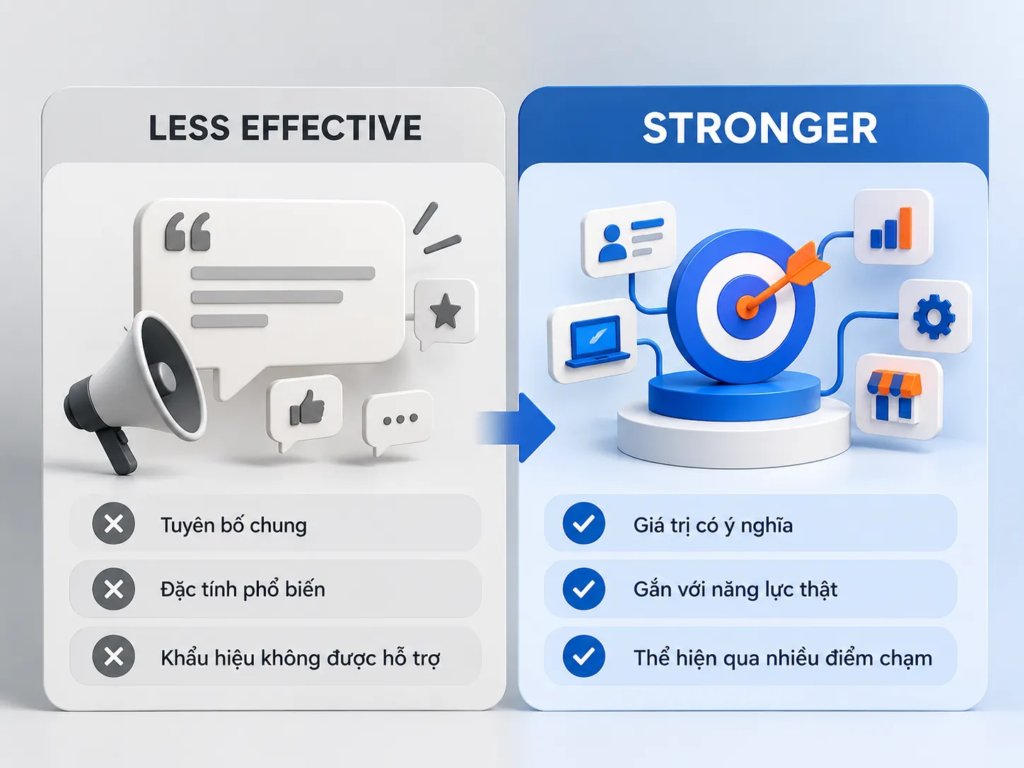
LESS EFFECTIVE
- Saying the brand is “different” without pointing to where the difference lies.
- Choosing a common attribute that most competitors could also claim.
- Turning a slogan into a promise that actual operations do not support.
STRONGER
- Identify a value that matters to a specific group of customers.
- Tie the difference to capabilities the business actually has.
- Turn difference into principles that can be recognized across many touchpoints.
Investing in the visual is investing in recognizability
The logo, colors, typefaces and other visual elements are usually the first things seen. But their role does not stop at aesthetics.
An effective visual system should help the brand be recognized, told apart and reproduced consistently in different contexts.
This matters especially when the brand appears at small scale, on digital screens, on packaging, in business documents or in an environment crowded with competitors.
That is why a good logo needs more than to look “good.” It needs to be recognizable, practical to apply and able to keep its own character when used at many sizes and on many materials.
This is also why FreshBrand approaches brand identity as a strategic asset rather than a decorative item. In FreshBrand’s V.E.R.A framework, four elements, Visual, Exclusive, Recognition and Authority, are set side by side to judge whether a visual asset is both distinctive and recognizable, and whether it strengthens the brand’s credibility.
A strong brand is not built only on what a business says about itself

A business can write that it is professional, reliable, innovative or customer-centric.
But customers do not just take in those claims. They form a perception from what they actually see and experience.
That is why a brand needs to be examined across every point of contact: how the business presents itself, how staff communicate, how products are packaged, how the website works and how the business responds when something goes wrong.
A brand sits between the business’s intent and the customer’s perception. The two can be alike, but they can also be very different.
Where does the brand gap lie?
Understanding competitors is part of building a brand, but the goal is not to copy what is already working in the market.
Competitive analysis has value when it helps a business see the patterns that keep repeating: what brands are saying, what language they use, which benefits they stress and which zone of perception they are competing in together.
From there, the business can look for a gap, the Brand Gap, where a meaningful value has not yet been expressed clearly enough.
WHAT WE LOOK FOR
In looking at a brand system, what matters is not only asking “Is this design attractive?” More practical questions are usually:
- Can customers recognize this brand even when the logo or brand name does not appear in full?
- Do the touchpoints convey the same personality and position?
- Does what the brand wants to be remembered for actually show up in the experience?
If these questions have no clear answers, adjusting a single logo or printed piece usually does not solve the root problem.
A brand story has value only when it clarifies the people behind the business
Customers do not care only about what a business sells. In many cases they also want to understand why the business exists and what drives its choices.
The founder’s story, the team’s path, how the business got through a problem or its commitment to the community can add depth to a brand.
But storytelling does not mean turning every brand into a touching tale.
A brand story has value when it helps explain a truth about the business: why it chose a particular direction, why its products are made that way, or why a certain value has been upheld over a long time.
EXAMPLE
Imagine two businesses that both say they “put the customer at the center.”
One business stops at the statement on its website. The other shows it in how it designs its service, how it provides information, how it handles feedback and how its team communicates.
Two businesses can use the same words and still give customers very different experiences.
This shows that a brand is not determined entirely by what the business says. A message carries weight only when it is backed by what the business actually does.
Building a brand is a process of accumulation, not a one-time launch
A brand’s identity can be changed in a day, but perception cannot be built in a day.
A new identity can create initial attention. A campaign can generate large reach. A story can draw a positive reaction. But brand value accumulates when those signals are repeated consistently enough and confirmed through experience.
So the important question is not only “What does the brand look like after the refresh?” but also “Does the new system help the business appear more consistently, be recognized more clearly and express the position it wants to occupy?”
CHECKLIST
Questions to ask:
- Can target customers describe the brand with a perception clear enough?
- Where is the business different in a way that matters to customers?
- Is that difference expressed consistently across touchpoints?
- Is the current identity system flexible enough to work in practice?
- Is what the brand wants to be remembered for reinforced by real experience?
From an identity to a competitive asset
A brand becomes an asset when it goes beyond a name or an identity kit.
That is when customers can recognize the business faster, understand it better and form associations stable enough to tell it apart from other options.
This process requires a business to see the brand as a system: strategy sets the direction, identity provides the means of expression, experience reinforces perception, and consistency lets those signals accumulate over time.
In other words, a brand is not a decoration laid on top of the business. It is the way the business is recognized, interpreted and remembered.
A strong brand is not the one that talks most about itself, but the one that leaves a perception clear enough to be remembered and told apart.
FRESHBRAND
Does your business currently own a brand system clear enough for customers to recognize and tell apart, or only a visual identity?
FreshBrand can start by looking again at the current system: the brand’s position, how it is expressed, and the gap between what the business wants to say and what customers actually notice. From there, the new identity question can be set properly in its strategic context instead of being handled as a standalone design problem.