The 8-week brand building roadmap: From strategy to an identity system that works in practice
A brand is not formed by working through a checklist of tasks one after another, such as naming, logo design and then an identity kit. What decides the quality of the result is how the decisions connect: which position the business wants to occupy, which identity needs to take shape, which criteria will be used to choose, and how that choice becomes a system that can operate consistently. A good brand-building roadmap therefore has to be firm enough to control risk, yet flexible enough for ideas to be developed and tested stage by stage.
KEY TAKEAWAY
An effective brand-building process is not shortened by skipping steps; it is optimized by putting the right decision at the right time.
Why brand building needs a roadmap rather than separate tasks
When starting a brand project, a business usually sees fairly concrete outputs: a name, a logo, colors, typefaces, packaging or a set of guidelines. But these assets are only the visible part of a larger system.
Behind a name is a question of positioning. Behind a logo is a question of identity. Behind color and typeface is a question of how the brand wants to be recognized. And behind the identity kit is an operating problem: how will the team use the system so the image does not distort over time?
If these questions are settled in random order, a decision at a later stage can force the business back to revise one made earlier. A name that seemed right, for example, can become hard to grow once it sits inside a broader positioning strategy. A beautiful design direction may stop working once it is tested on real touchpoints.
The 8-week roadmap should therefore not be read simply as “it takes 8 weeks to make a brand.” Its value lies in separating the layers of decisions, creating control points, and reducing the chance that a business has to rework the whole system because one early choice was not clear enough.
PRINCIPLE 01
Strategy must come before expression
Design can make a brand easier to recognize, but it cannot decide by itself what the brand should be recognized for. Before looking for a beautiful symbol, then, it is necessary to define the brand problem to be solved and the criteria for judging a solution to be right.
Stage 1: Initiation and strategic positioning (weeks 1–2)
The goal of the first stage is to set the frame of reference for the whole project. Rather than starting right away by producing many options, the team needs to understand where the business stands, where it wants to go and which limits must be respected.
Week 1: Setting the strategy and shaping the goals
A brand project should begin with a conversation with the people who hold decision-making authority and are responsible for the business’s direction.
This is not just a session to gather information. What matters more is clarifying what usually lives scattered in the minds of the leadership: which perception the business wants to change, which strengths to keep, what the brand should not be associated with, and which expectations exist but have never been put into concrete criteria.
From there, both sides can set an initial set of criteria, covering the “must-have” elements and those to exclude. For naming, for instance, the criteria might concern domain names, keyword direction, ease of pronunciation or groups of references to avoid.
FIELD NOTE
In practice, the “do not want” criteria are often as valuable as what the business wants. They narrow the creative space and spare the team from spending time on options that could never be accepted at the final step.
Week 2: Developing solutions and establishing the identity
Once the frame of reference is clearer, the next stage moves from defining the problem to developing solutions.
Rather than trying to defend a first idea, the strategy team widens the search space, researching and distilling many possibilities. For the naming problem in the process described, hundreds of potential solutions may be considered before being narrowed to about 8 to 12 notable candidates.
The point is not the number 8 to 12 but how the options are presented. A name should not appear as a list of unrelated words. It needs context, an explanation of proportion and applicability, and descriptive keyword lines so the business can begin to picture the identity that option could grow into.
FRAMEWORK
From scattered ideas to a frame of reference for choosing
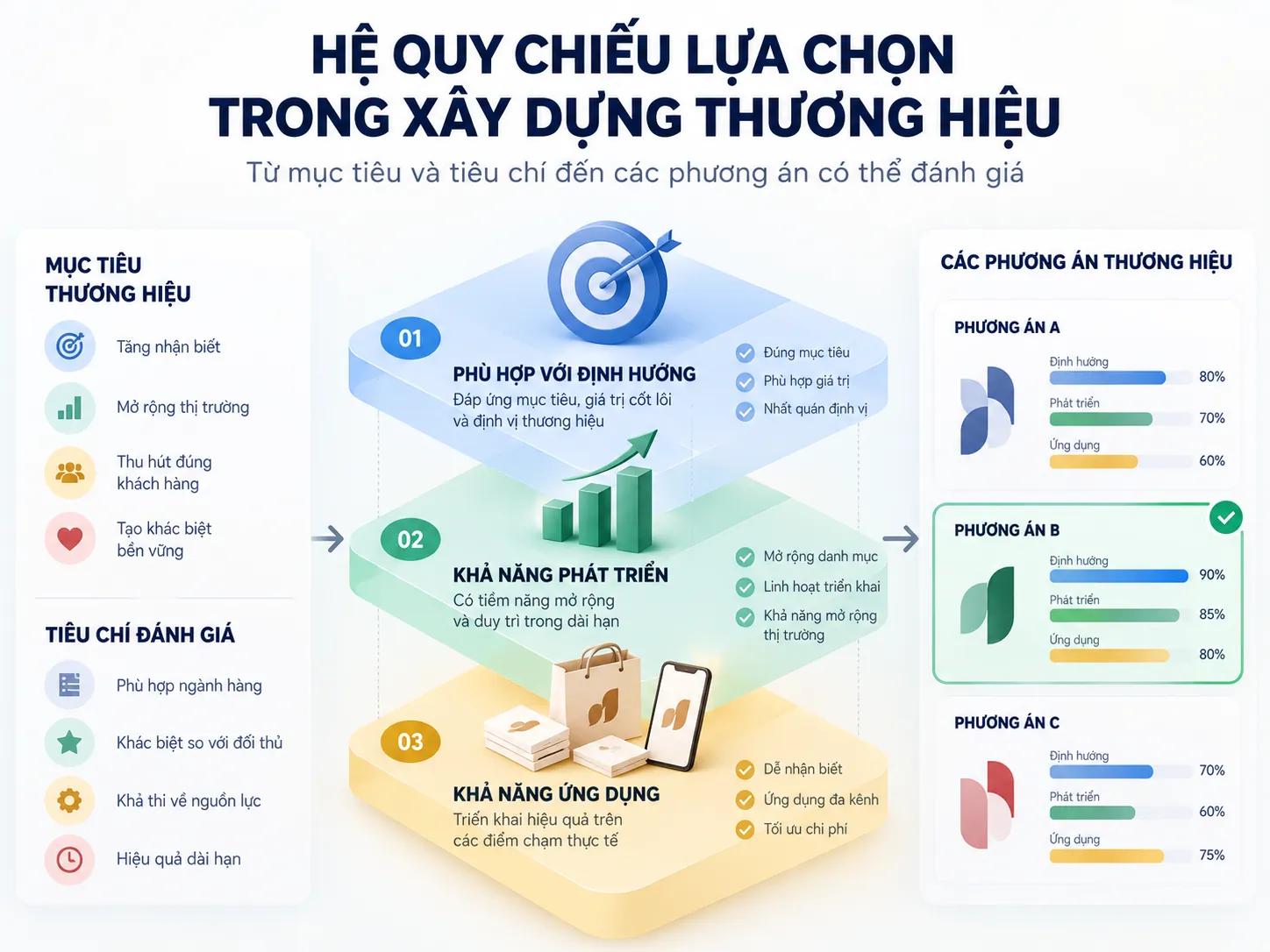
A brand option can be examined through three layers:
- Fit with direction: Does it reflect the goals and direction that were agreed?
- Potential to grow: Does it leave enough room to form an identity, rather than only meeting an immediate need?
- Applicability: When placed in real contexts, does it stay clear and recognizable?
These three layers move the discussion from “which option do I like” to “which option better meets the criteria we agreed on.”
Stage 2: Refinement and consensus (weeks 3–4)
If the first two weeks create a space of options, the next two have the job of narrowing that space on a sound basis.
This matters because feedback on a brand project easily turns into comments of personal taste. One person likes this color, another likes that one; one side finds the name modern, the other finds it hard to pronounce. Without shared criteria, each round of feedback can send the project in a different direction.
Week 3: Feedback and the first round of refinement
Partner feedback is treated as input for the next stage of development, rather than simply as a request to “fix the design.”
In the process described, in-depth survey tools are used to collect qualitative and quantitative feedback on names, keywords and colors. This feedback helps the team see what needs adjusting and keep refining the options that still have potential.
What matters is that feedback is placed in relation to the overall strategy. An option may stir positive feelings and still not fit the brand’s direction. Conversely, an option that draws less attention at first may have a better foundation for growing into a consistent identity system.
COMMON MISTAKE
“The option most people like is naturally the most suitable one.”
Why it is not enough
How much people like an option is a signal, but not the whole basis for a decision. A brand choice also has to be weighed on how well it reflects the message, its marketing foundation, ease of pronunciation, recognizability and fit with the direction set at the start.
Week 4: Settling the option and controlling risk
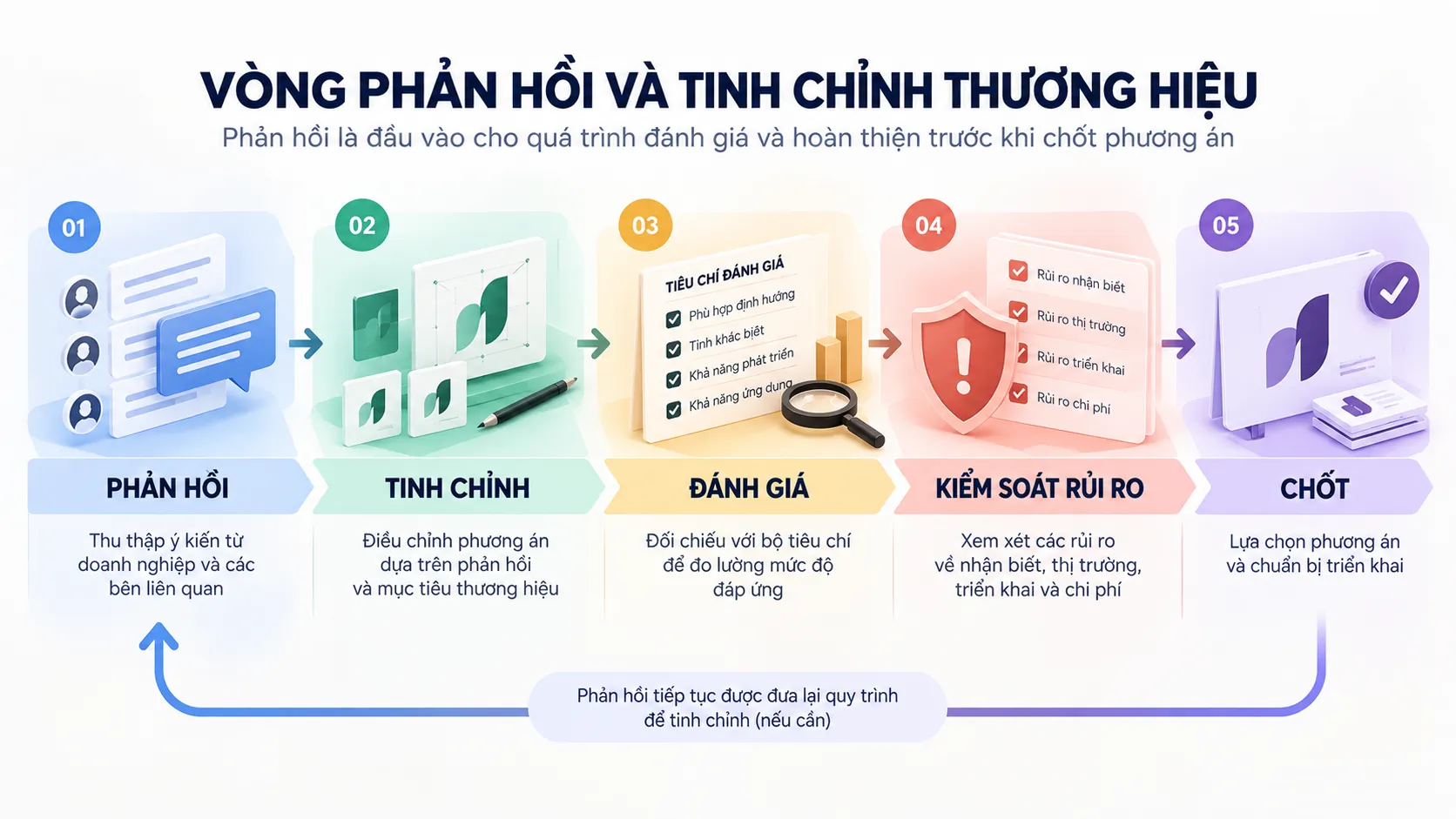
After the first round of refinement, the remaining options need to be evaluated against one consistent set of criteria before the business makes its final choice.
Some of the criteria used in the process include how well the option reflects the message, its marketing foundation, and how easy it is to pronounce and recognize.
For a name, the creative decision also needs a layer of risk control. Once the business settles on an option, FreshBrand carries out a preliminary check following the process described, including a search of domestic trademarks and the USPTO.gov database to help assess the likelihood of registering the intellectual property later.
The scope of this review should be understood correctly: it is a preliminary check within the process and does not replace legal advice or the formal process of registering intellectual property.
WHAT WE LOOK FOR
In a brand project, we do not look only at whether an option is “beautiful” or “impressive.” The more important questions are:
- Does the option come from the criteria that were agreed?
- Does it still make sense when placed across many different touchpoints?
- Were the important risks checked before the business invested more deeply?
Stage 3: Realizing the visual identity (weeks 5–7)
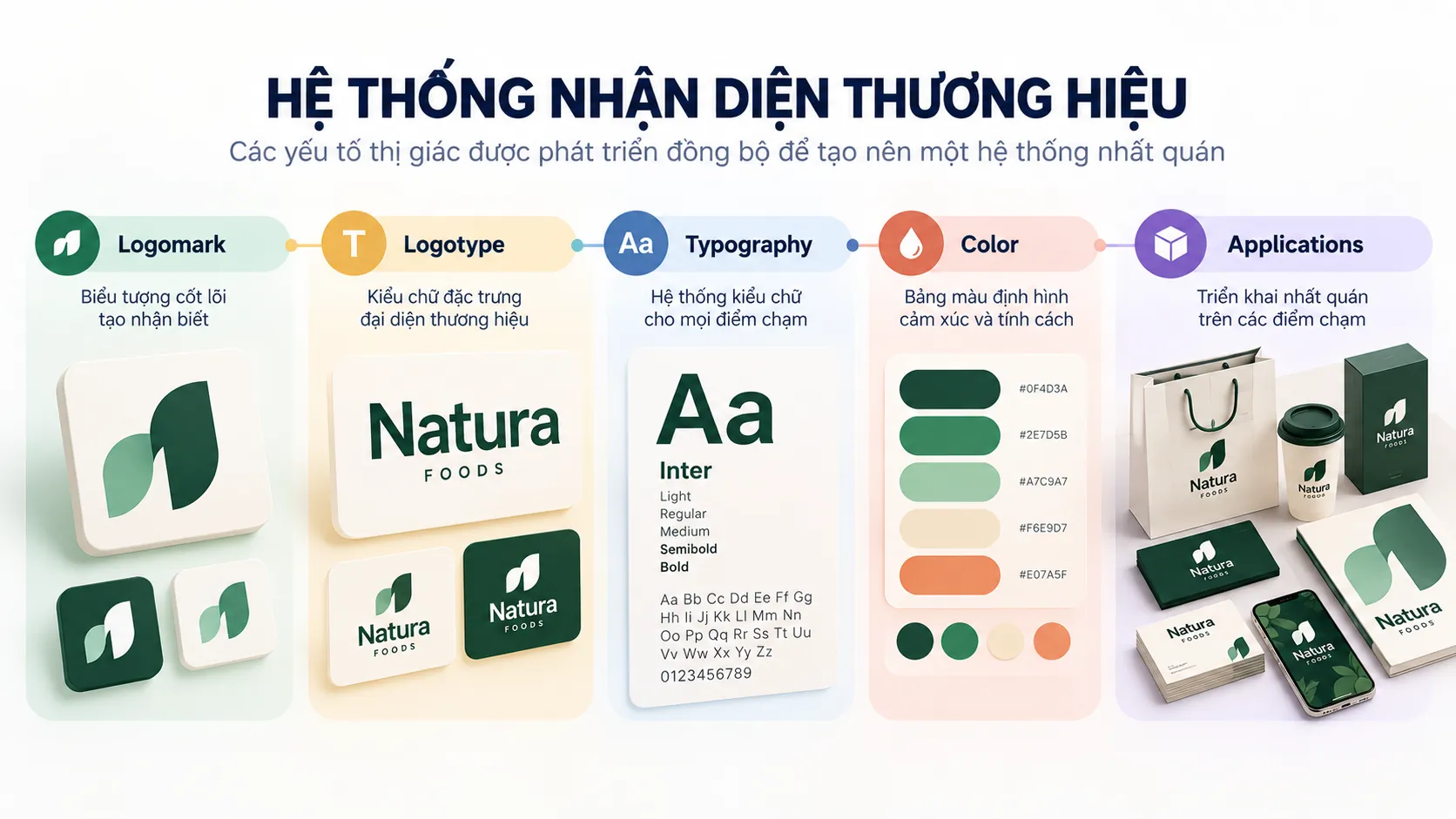
Once the direction and core options are set, the project moves to the visual layer.
This is when strategy is turned into an identity system: the logo, typefaces, colors and symbolic elements. But “design” here should not be understood as finding a beautiful image to represent the business. The aim is to build a system clear enough to create recognition and flexible enough to work in many contexts.
Week 5: Shaping the design style
The design team begins developing concepts based on the core values that have been defined.
Components such as the logomark, logotype, typography, colors and symbols are considered in relation to one another. A symbol does not exist apart from the typeface, and color should not be chosen apart from how the brand wants to be perceived.
Staying close to the principle of Functionalism at this stage stresses one important point: form must serve function. The logo has to be recognizable, the typeface has to support legibility, and the visual system has to work in practice instead of only suiting a good-looking presentation.
Week 6: Refining and developing the visual identity
Feedback after the first presentation round becomes the basis for further development.
The design team keeps refining the logomark, logotype and related elements to find a balance between strategic direction and the business’s requirements. The second presentation round is therefore not simply a “revised version” but the result of a process of selection, feedback and adjustment.
A good identity system rarely appears complete at the first presentation. Its quality is built by identifying the right problem in each round and knowing which elements to keep and which to change.
LESS EFFECTIVE
- Choosing a design mainly on a feeling at one moment in time.
- Judging the logo apart from the typeface, colors and application context.
- Treating every round of revisions as a complete change of idea.
STRONGER
- Evaluating the design against the established set of criteria.
- Treating identity as a system rather than a single symbol.
- Using feedback to develop options instead of constantly starting over.
Week 7: Standardization and final approval
This is the stage where small details begin to matter a great deal for the consistency of the system.
Color weight, spacing between characters, kerning, tracking, and the proportion and position of the symbol all need review. These adjustments may not be easy to see in an overview presentation, but they determine how stable the identity is once deployed across many platforms.
Once the final logo is approved, all assets are packaged in formats such as .ai, .eps, .pdf, .png and .jpg. The aim is not only to store files but to prepare for the brand’s real day-to-day use.
FIELD NOTE
An identity system is truly tested only when it leaves the presentation and starts to appear at different touchpoints. Standardizing files and specifications is therefore not an administrative chore at the end of the project; it is the bridge between design and operation.
Stage 4: Handover and support (week 8)
By the eighth week, the question is no longer “have we finished designing?” but “can the business operate this system consistently on its own?”
Week 8: Building the brand guidelines
The brand guidelines, or Brand Guideline, are the document that turns an identity system from a project asset into a tool for long-term use.
It defines how the identity components are used and gives the internal team a shared basis for deploying the brand image across platforms, from print to digital.
Handover should therefore not stop at delivering a folder of logos. The business needs to receive all the brand assets along with guidance clear enough for the team to know how to use the system, control it and protect its consistency in daily operation.
PROCESS
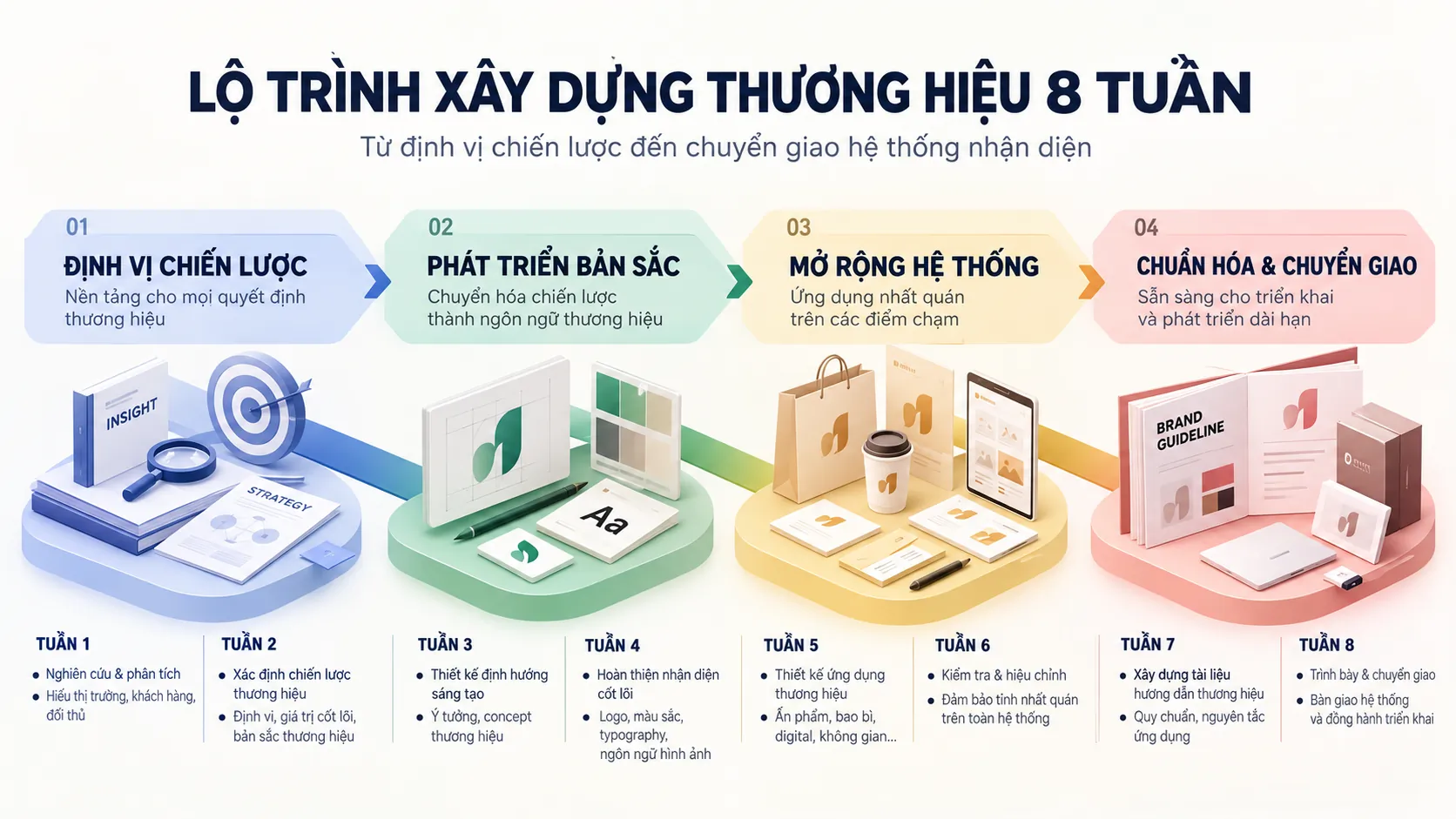
- Initiation: Clarify the goals, context, mandatory criteria and limits to avoid.
- Development: Research, widen the options and establish the choices with potential.
- Refinement: Gather feedback, evaluate against the criteria and narrow the options.
- Realization: Turn strategy into the logo, typography, colors and identity system.
- Standardization: Review the details, finalize the files and approve the final system.
- Handover: Build the Brand Guideline and give the business the ability to operate the identity.
Eight weeks is really a chain of linked decisions
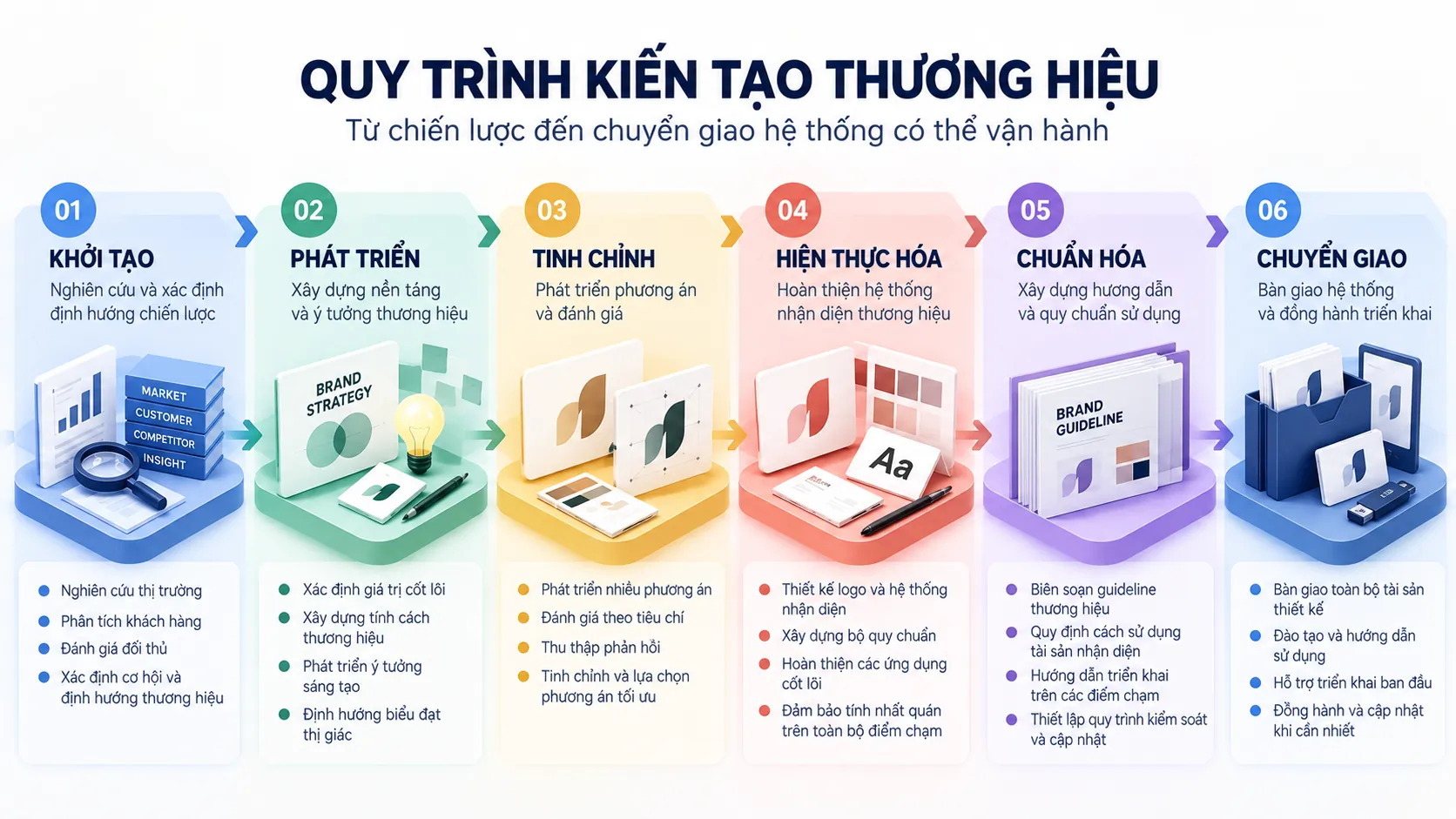
Looking at the whole process, the eight weeks are not eight independent blocks of time.
The decisions of week 1 set the criteria for week 2. The results of week 2 become the input for weeks 3 and 4. The option settled in week 4 becomes the foundation for design in weeks 5 to 7. And the system completed in week 7 becomes an asset to be standardized and handed over in week 8.
This creates an important logic: each brand task should not be judged as a standalone product.
A good name without clear direction can still lead to an inconsistent system. A carefully designed logo that does not rest on a clear identity can look good in one setting and be hard to extend. A complete identity kit without operating standards can quickly be distorted once many people use it.
CHECKLIST
Questions to ask:
- Were the brand selection criteria agreed before the options were developed?
- Is feedback being used to test the strategy, or only to adjust to personal taste?
- Are the name and identity evaluated in the context of real applications?
- Were the risks related to the name checked before investing more deeply?
- Does the final identity system have enough assets and standards for the internal team to operate it?
A good process does not remove creativity; it lets creativity go in the right direction
Creativity in brand building does not mean having a great many ideas. The value lies in turning those ideas into choices that fit a specific business problem, then developing them into a system that can be recognized, used and managed.
An 8-week roadmap therefore makes sense when each stage answers a different question: What problem does the business need to solve? What options exist? Which option fits? How does that option become an identity? And how does the business keep using it correctly after the project ends?
It is also how a branding process shifts from producing visual assets to building a system that can serve the business over the long term.
FRESHBRAND
If your business is facing a rename, a repositioning or a rebuild of its identity system, the first question is not necessarily “how should the logo be designed?” The more important question is: which decisions does the business need to make before design begins?
FreshBrand can work with the business to clarify that problem, build the set of criteria and connect strategic decisions with the development of the brand’s identity and visual system.